Table of Contents
Walk into a trendy health-conscious restaurant today, and you might spot a badge of honor on the menu: "No Seed Oils." It has become a cultural signifier of quality, driven by a pervasive narrative on social media that vegetable oils—specifically those high in linoleic acid like corn, soybean, and safflower oil—are the hidden drivers of chronic inflammation and heart disease. The argument suggests that our evolutionary biology is at odds with these "industrial" fats and that we should return to ancestral sources like tallow, lard, and butter.
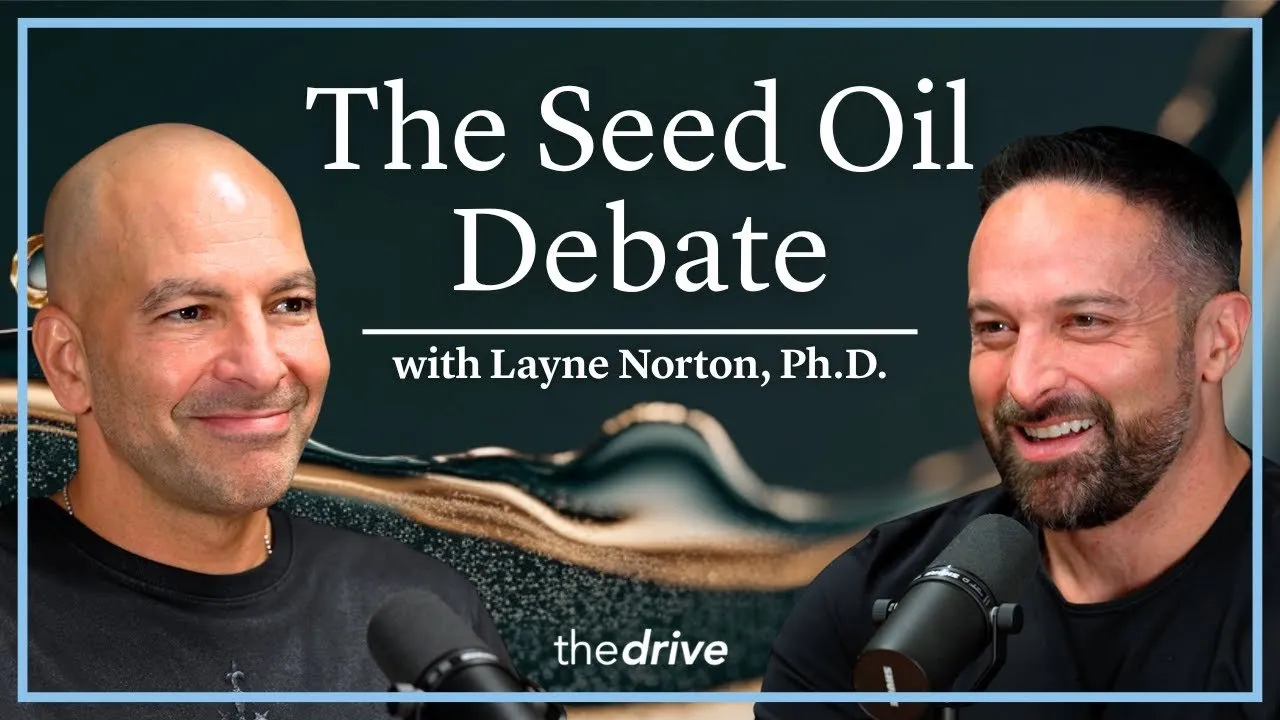
However, when you strip away the social media hot takes and look strictly at the hierarchy of nutritional evidence, the story changes. In a deep-dive discussion, Dr. Peter Attia and nutritional scientist Dr. Layne Norton deconstructed the anti-seed oil arguments. By examining historical randomized control trials (RCTs), genetic data, and biochemical mechanisms, they make a compelling case that seed oils are not uniquely harmful—and when used to replace saturated fats, they may actually be cardioprotective.
Key Takeaways
- Trans fats confounded early studies: Famous trials suggesting seed oils were harmful (like the Minnesota Coronary Experiment) used margarines loaded with toxic trans fats, which are chemically and metabolically distinct from unhydrogenated seed oils.
- Genetics favor lower LDL: Mendelian Randomization studies consistently show that lifelong lower LDL cholesterol—which polyunsaturated fats help achieve—results in significantly lower risks of cardiovascular disease.
- Oxidation context matters: While polyunsaturated fats are prone to oxidation, the majority of dangerous oxidation occurs inside the arterial wall, driven by the number of particles retained there. Saturated fats increase particle retention and aggregation more than seed oils.
- The "Industrial" fear is overblown: Concerns about hexane residues from processing are mathematically negligible. You would need to consume thousands of kilograms of oil to reach toxicity thresholds.
- Major in the major: Fixating on seed oils often distracts from far more impactful health levers, such as total energy balance, exercise, and fiber intake.
The Trans Fat Confounder in Historical Data
The cornerstone of the anti-seed oil argument often rests on older randomized control trials, specifically the Minnesota Coronary Experiment (MCE) and the Sydney Heart Study. These studies, conducted largely in the 1960s and 70s, appeared to show that substituting saturated animal fats with polyunsaturated vegetable fats lowered cholesterol but failed to improve—or even worsened—mortality rates.
However, looking at these studies through a modern lens reveals a critical flaw: the widespread use of trans fats.
The Structural Difference
In the mid-20th century, food scientists hydrogenated vegetable oils to make them solid at room temperature (margarine) to mimic butter. We now know that trans fats are uniquely atherogenic. In the MCE and Sydney studies, the intervention groups were consuming significant amounts of these trans fats—up to 40% of their fat intake in some cases.
The biochemistry explains why this matters. A natural unsaturated fat has a "cis" double bond, which puts a kink in the fatty acid chain. This kink creates space in the cellular membrane, increasing fluidity. A trans fat, however, straightens that chain out, making it behave structurally like a saturated fat but with a double bond that is still prone to oxidation. This creates a "worst of both worlds" scenario: rigid membranes and oxidative stress.
If we include all the human randomized control trials looking at substituting polyunsaturated fats for saturated fat, the overall effect is null... But if we take out the trans fats... there was a very clear benefit to substitution.
When you filter for studies that were not confounded by trans fats, such as the Finnish Mental Hospital Study, the data flips. In that study, replacing saturated fat with polyunsaturated fat (without trans fats) led to a significant reduction in cardiovascular events and mortality.
Mendelian Randomization and the Case for Lower LDL
While nutritional epidemiology relies on dietary recall (which is notoriously unreliable), Mendelian Randomization (MR) offers a "nature’s randomized control trial." MR looks at genetic variants randomly assigned at birth. Specifically, we can look at people born with genes that result in naturally lower LDL cholesterol throughout their lifetime.
The logic follows a clear syllogism:
- High saturated fat intake raises LDL cholesterol.
- High polyunsaturated fat (seed oil) intake lowers LDL cholesterol.
- Genetic data confirms that lifelong lower LDL is causally linked to lower heart disease risk.
The MR data is staggering in its consistency. Regardless of the specific gene variant—whether it affects cholesterol absorption, production, or clearance—if it lowers LDL, it lowers heart disease risk. For every 1 mmol (approx. 39 mg/dL) reduction in LDL, there is roughly a 50–55% risk reduction in cardiovascular disease over a lifetime.
This "time exposure" element is crucial. Starting a statin at age 50 is like slamming the brakes on a truck that is already rolling downhill. Having genetically low LDL (or keeping it low via diet from a young age) prevents the truck from ever gathering speed.
The Mechanics of Oxidation: The Bonfire Analogy
A sophisticated argument against seed oils involves oxidation. Polyunsaturated fats have multiple double bonds, making them chemically more reactive and prone to oxidation than saturated fats. Critics argue that eating seed oils loads your LDL particles with linoleic acid, making them highly oxidizable and therefore more dangerous.
While it is true that oxidized LDL is atherogenic, the location of that oxidation matters. Very little oxidation happens in the bloodstream (plasma) because the body protects these particles with antioxidants like Vitamin E. The dangerous oxidation largely occurs after an LDL particle has penetrated the arterial wall (the intima) and become retained.
Aggregation vs. Oxidation
Layne Norton proposes that we must look at the total number of particles causing damage, not just how flammable the particles are.
Think of ApoB-containing particles (like LDL) as sparks flying from a bonfire, and your arteries as a forest.
- Saturated Fat Diet: Creates a massive bonfire. It throws off a huge number of sparks (high LDL particle count). Furthermore, saturated fat makes the particles rigid, causing them to "clump" (aggregate) more easily once they hit the forest floor. This clumping is a primary driver of atherosclerosis.
- Seed Oil Diet: The individual sparks might be slightly more "flammable" (prone to oxidation) due to the linoleic acid. However, the bonfire is significantly smaller (lower LDL particle count), meaning far fewer sparks hit the forest. Additionally, the fluid membrane of these particles prevents them from clumping together.
The net result is that the "smaller fire" of a diet higher in polyunsaturated fats results in less total damage to the arterial wall.
Industrial Processing and the "Natural" Fallacy
Beyond biochemistry, there is an emotional argument: Seed oils are "industrial sludge" processed with chemicals like hexane, whereas butter is "natural."
It is true that hexane is used to extract oils from seeds, and trace amounts can remain. However, the dose makes the poison. The residual hexane in vegetable oil is measured in parts per million. To reach even a mild toxicity threshold found in rodent studies, a human would effectively need to consume over 11,000 kilograms of oil. The body handles these trace amounts effortlessly.
Furthermore, the appeal to nature—that we should eat what our ancestors ate—is a logical fallacy. Evolution selects for reproduction, not longevity. Just because an ancestor ate high amounts of saturated fat (if they could get it) and survived to reproduce does not mean that diet is optimal for preventing heart disease at age 70.
There’s a reason naturalism has its own fallacy associated with it because you can find a lot of things in nature that are horrific toxins. You can find a lot of synthetic things that are quite good for you.
Practical Advice: Majoring in the Minor
If you prefer the taste of olive oil (a monounsaturated fat) or butter, that is a personal culinary choice. But removing seed oils from your diet in the hopes of radically transforming your health is likely a misallocation of effort.
The "benefits" people feel when cutting seed oils often come from the substitution effect. When you eliminate seed oils, you are usually eliminating ultra-processed foods: Doritos, fast food fries, and commercial baked goods. You are cutting calories, refined carbs, and salt. Is it the lack of soybean oil making you feel better, or the fact that you stopped eating junk food?
A Note on Deep Frying
There is one context where seed oils are indisputably negative: commercial deep frying. When any oil is heated repeatedly for days in a restaurant fryer, it produces polar compounds and oxidative byproducts that are harmful. However, this is an argument against eating deep-fried fast food, not an argument against using a splash of safflower oil to sauté vegetables at home.
Conclusion
The seed oil debate is a classic example of "majoring in the minor." While mechanisms exist that theoretically show downsides to linoleic acid, the converging lines of evidence—from human outcome data to genetics—suggest that replacing saturated fats with unsaturated fats reduces heart disease risk.
If you are exercising, maintaining a healthy body weight, eating sufficient fiber, and managing your ApoB/LDL levels, the type of oil in your salad dressing is statistically insignificant. Rather than fearing a specific molecule, focus on the larger picture of energy balance and metabolic health.