Table of Contents
Technologies that once felt like distant science fiction are rapidly integrating into the fabric of daily life. In the Bay Area and beyond, autonomous drone delivery is transitioning from experimental pilots to robust infrastructure, while generative AI is evolving from creating static videos to simulating entire physical worlds. These advancements are not merely incremental improvements; they represent a fundamental shift in how physical goods move through our cities and how digital intelligence understands reality.
Recent discussions with Keller Clifton of Zipline and Anastasis Germanidis of Runway reveal a shared trajectory: both companies are moving past the "proof of concept" phase into massive scale and deep utility. Whether it is a droid descending on a tether to deliver dinner or an AI model simulating a car crash to train an autonomous vehicle, the convergence of hardware and software is redefining the limits of logistics and simulation.
Key Takeaways
- Zipline’s "Teleportation" Network: Zipline has moved beyond medical drops in Africa to a high-frequency consumer delivery network (Platform 2) that aims to serve 99.9% of homes with "magical" precision.
- Vertical Integration is Mandatory: Hardware companies succeed by owning the entire stack—from the aircraft to the customer app—rather than selling drones as standalone products.
- World Models vs. Video Models: Runway is pioneering "World Models" that don't just generate pixels but simulate physics and environmental interactions, serving as a brain for future robotics.
- Synthetic Data for Autonomy: The immediate killer app for World Models is generating rare, dangerous "edge cases" (like accidents) to train autonomous systems safely.
- The Founder’s Code: Successful deep-tech startups often rely on founders who write the initial code and build the prototypes themselves to avoid the "can't ship" trap.
Automating the Sky: Zipline’s Mass Scale Logistics
While much of the tech world remains fixated on digital AI, Zipline has quietly built the largest commercial autonomous system on Earth. Operating out of a newly expanded factory in South San Francisco capable of producing 20,000 aircraft annually, the company is effectively industrializing instant logistics.
The company’s growth curve has gone vertical. Zipline is currently conducting more flights daily than United Airlines and is on track to surpass the daily flight volume of all U.S. airlines combined by the end of the year. This volume is driven by their transition from "Platform 1" (long-range, fixed-wing drones used primarily for medical supplies in Rwanda and Ghana) to "Platform 2" (P2), a system designed specifically for dense suburban delivery.
Literally the way we describe this to our customers is we are showing up and we're installing a magical portal in the wall of your building. Like it's like Rick and Morty or Stargate... pass it through the magical portal, and it's teleported directly to the home that it needs to go to in a way that is ultra fast, great for the environment, and amazing customer experience.
The Engineering Behind Platform 2
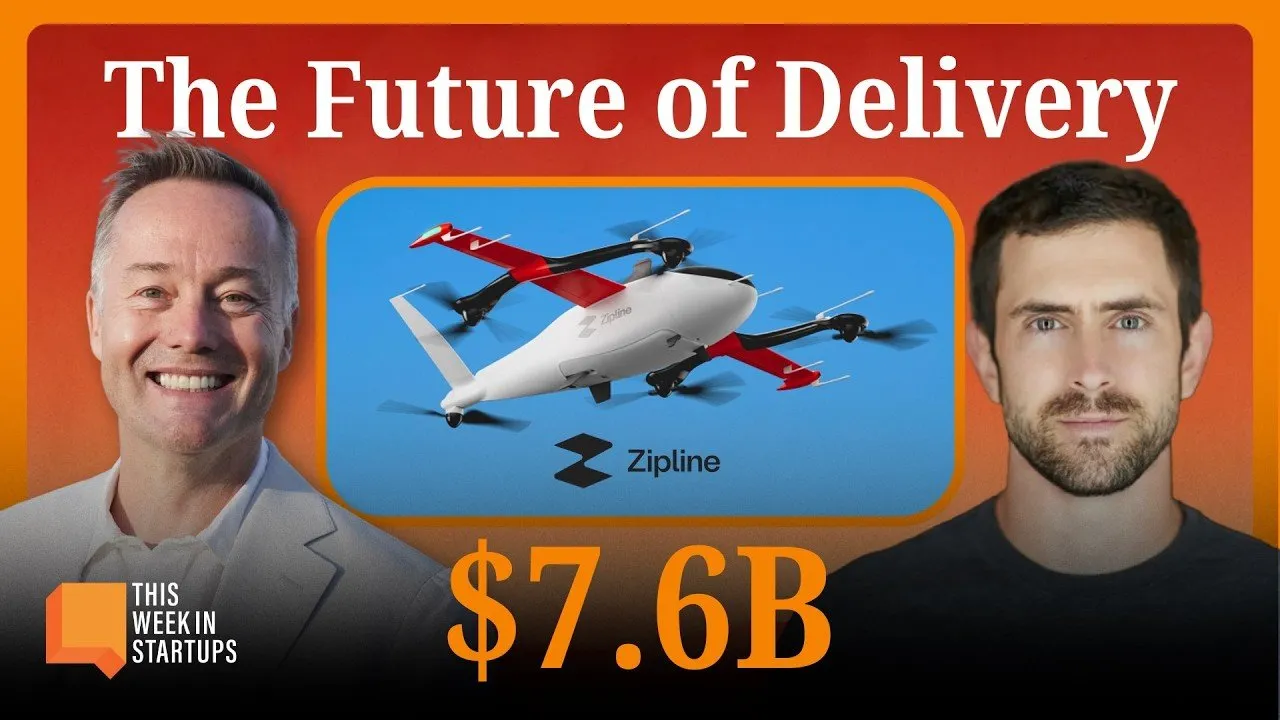
The P2 system solves the "last 50 feet" problem of delivery through a unique two-part mechanism. The main aircraft cruises at 300 feet—keeping noise away from the ground—while a smaller "droid" descends on a tether to deliver the package to a precise GPS coordinate. This allows for deliveries to backyards, patio tables, or even public parks without the drone ever landing.
This architecture addresses the primary friction points of drone delivery: noise and safety. By keeping the propulsion systems high in the air, Zipline’s aircraft are significantly quieter than competitors. The system has logged over 135 million commercial autonomous miles with zero safety incidents, a statistic that stands in stark contrast to the accident rates associated with traditional car-based delivery.
The Economics of "Private Taxis for Burritos"
Current delivery infrastructure relies on 4,000-pound gas-combustion vehicles to transport 5-pound payloads. Zipline views this as a physics problem with an obvious solution: matching the vehicle weight to the payload weight. An electric, autonomous aircraft weighing roughly 50 pounds is inherently more efficient than a car.
Critically, Zipline refuses to sell its hardware. They operate as a service because the aircraft represents only about 15% of the complexity. The remaining 85% involves regulatory approval, unmanned traffic management, maintenance, and app integration. By vertically integrating, they offer retailers like Walmart and Chipotle a "magical portal" experience rather than a piece of hardware they have to manage themselves.
From Video Generation to World Simulation
While Zipline conquers physical space, Runway is attempting to map the physics of reality into digital models. Known for their generative video tools, Runway is pivoting toward "General World Models" (GWM). The distinction is subtle but profound: a video model generates a clip based on a prompt, whereas a world model builds an internal representation of an environment and simulates continuous actions within it.
This shift represents a move from creative tools to functional intelligence. A world model understands object permanence, gravity, and cause-and-effect relationships. It is not just predicting the next pixel; it is predicting the next physical state of the world.
The "Bitter Lesson" of Compute
Building these models requires immense computational resources. Runway’s Gen 4.5 video model serves as the foundation, providing the necessary understanding of physics. To turn this into a world model, the system must be trained autoregressively, looking back at previous states to project future ones consistent with physical laws.
Runway CTO Anastasis Germanidis acknowledges the "bitter lesson" of AI: simply adding more compute and data reliably improves performance. To simulate reality accurately, the models must be fed massive amounts of video data, allowing them to learn physics implicitly rather than being programmed with explicit rules.
The Killer App: Training Robots in the Matrix
The immediate commercial utility for world models lies in robotics and autonomy. Training physical robots in the real world is slow, expensive, and dangerous. You cannot easily collect data on car crashes or robotic failures because causing them in reality is prohibitive.
World models offer a solution: simulation. A robust world model can generate thousands of variations of a specific scenario—such as a child running into the street or a robot dropping a plate—allowing autonomous systems to learn from synthetic experiences.
It's very difficult to collect data of accidents, right? You don't so most of the data you might collect is actually things that are very easy to simulate... Getting the data for the right edge cases is very very critical and that's something that you know if you're able to generate that data you're able to make those models much more robust.
This capability allows companies to create "digital twins" of their robots, running them through millions of simulated hours in a single day. Eventually, the video model itself may become the "policy" that controls the robot, translating visual input directly into physical action.
The Founder Mindset: Shipping vs. Stalling
The progress seen in companies like Zipline and Runway often traces back to the composition of the founding team. A recurring theme in successful deep-tech startups is the presence of founders who write code and build the product themselves.
Outsourcing core technology in the early stages is a significant risk factor. If a team has spent significant capital without shipping a Minimum Viable Product (MVP), it often indicates a lack of internal technical capability. The "Paul Graham rule"—ensuring the founding team includes the people actually writing the code—remains the gold standard for velocity.
Runway exemplifies a variation of this builder culture. Founded by art school students from NYU rather than traditional computer science PhDs, the company emphasizes a culture of prototyping and "showing" rather than academic theory. This approach allows them to move faster than research labs that may be bogged down by credentials and theoretical constraints.
Conclusion
We are entering an era of abundance in both the physical and digital realms. Zipline is proving that physical goods can be moved instantly and cheaply through autonomous networks, bypassing the congestion of traditional infrastructure. Simultaneously, Runway is demonstrating that the physical world can be simulated with high fidelity, unlocking new speeds of learning for AI and robotics.
As these technologies mature, the line between the simulation and the street will blur. Robots will learn in generated worlds and operate in the real one, while drone networks will make physical delivery feel as instant as sending an email. For builders and investors, the message is clear: the future belongs to those who can bridge the gap between complex hardware and intelligent software.