Table of Contents
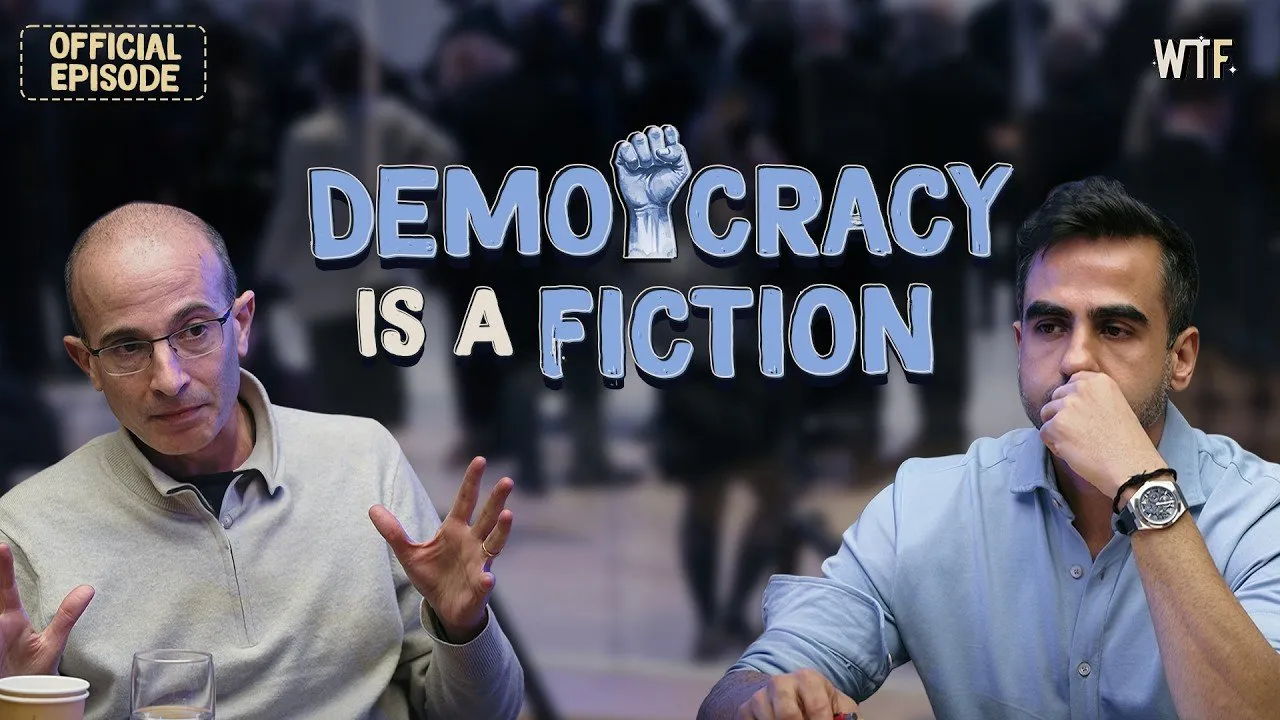
In a world increasingly defined by polarization, technological disruption, and geopolitical instability, few thinkers offer as much clarity as historian and philosopher Yuval Noah Harari. Known for his global bestsellers like Sapiens, Harari recently sat down with Nikhil Kamath to dissect the narratives that currently rule our world. The conversation ranged from the abstract power of storytelling to the tangible dangers of artificial intelligence, offering a sobering look at why the erosion of truth is the defining crisis of our time.
Harari argues that humanity is regressing to a "kindergarten" level of geopolitics, where raw power supersedes cooperation and trust. Whether discussing the mechanics of religion, the pitfalls of modern democracy, or the future of intimacy with AI, Harari challenges us to look beyond the fiction we create and confront the singular, often uncomfortable, reality that exists beneath it.
Key Takeaways
- Fiction drives history: Human cooperation relies on shared stories—from money and corporations to religion—rather than objective biological reality.
- The "power" trap: A worldview that reduces all human interactions to power struggles inevitably leads to misery and societal collapse.
- AI's shift to intimacy: Algorithms are moving beyond competing for human attention to competing for intimacy, with profound implications for social structures.
- Trust is an asset: In both banking and geopolitics, trust takes years to build but can be destroyed in a day; isolationism weakens nations rather than strengthening them.
- The nature of truth: While opinions vary, reality is singular. Understanding the truth of suffering is more vital than participating in the "drama" of the universe.
The Role of Fiction in Shaping History
Harari’s central thesis, popularized in Sapiens, remains vital today: history is shaped more by human imagination than by biological facts. Humans control the planet not because we are the strongest or smartest individuals, but because we are the only species capable of cooperating in large numbers based on fiction. Institutions like corporations, currencies, and nations do not exist in the physical world; they exist because we collectively agree on their story.
This dynamic is most visible in religion. Harari suggests that the success of specific religions, such as Christianity, often comes down to a combination of historical luck and compelling storytelling. The most successful stories address deep human needs.
"Christianity has a very compelling story... that you are loved by the God that created, that controlled the universe... This is such an attractive idea. The irony, to some extent, is that the more attractive an idea is, the bigger the chance that it's not true."
Harari warns that the comfort provided by a story often correlates with its lack of evidence. The desire to believe in an afterlife or a benevolent cosmic plan is universal, yet the evidence is "meager." This friction between attractive fictions and complex realities defines much of human conflict.
The Crisis of Trust in Geopolitics
Moving to the current state of the world, Harari describes the geopolitical landscape as "terrible," noting a regression to a nihilistic worldview where power is the only currency. He criticizes the re-emergence of the idea that relationships between nations—and people—are purely transactional power struggles.
The Return to Medieval Politics
Modern politics was built on the concept that relationships exist between states, not individuals. A treaty signed by one president remains binding for the next. However, Harari observes a shift back to "medieval" dynamics, where foreign relations are increasingly conducted between dynasties and families rather than institutions. When trust erodes, the cost of security skyrockets.
"Carpenters build tables... Bankers build trust. This is what they do throughout their life... Politics, like banking, is most—if you finally managed to build a trustworthy relationship in politics, this is your biggest asset."
Harari highlights that isolationism and the betrayal of allies (such as the diplomatic friction between the US and Europe) ultimately weaken powerful nations. True power, he argues, is having friends who come to your aid when you are in crisis, not merely coercing others when you are strong.
The AI Revolution: From Attention to Intimacy
Perhaps the most urgent warning Harari issues concerns Artificial Intelligence. While the last decade of technology focused on algorithms competing for human attention (often by triggering anger and greed), the next phase is a competition for intimacy. AI agents are no longer just content curators; they are becoming friends, partners, and advisors.
AI and the Future of Religion
Harari posits that for the first time in history, we may see religions written by non-human intelligence. Religions of the book, like Judaism and Christianity, rely on text. AI, having the capacity to "read" and remember every theological text ever written, could become the ultimate arbiter of religious interpretation, or even the author of new sacred texts.
The Bureaucracy of Algorithms
Discussing the potential for efficiency in government (referencing the "DOGE" concept of efficient bureaucracy), Harari notes a double-edged sword. While cutting human bloat is efficient, replacing human bureaucrats with AI bureaucrats creates a system that is opaque and unaccountable. A human can be questioned; a "black box" algorithm cannot.
"You don't really get rid of bureaucracies... It's getting rid of human bureaucrats and replacing them with AI bureaucrats, which are far more opaque, far more secretive."
Defining Truth, Reality, and Suffering
In a world of "alternative facts," Harari offers a grounding definition of truth: the connection to reality. While perspectives differ, reality itself is one. He uses the Israeli-Palestinian conflict as an example where multiple perspectives exist, but the underlying reality—that both sides have committed atrocities and both sides deserve security—remains the singular truth.
When asked about the purpose of life, Harari rejects the idea of a grand cosmic drama. Instead, he aligns with a view closer to secular Buddhism: the purpose of life is to understand reality to liberate oneself from suffering.
Ignorance, not desire, is the root of suffering. Harari argues that even the most powerful people are slaves to their own minds if they cannot observe their thoughts without attachment.
"I can order a nuclear strike on another country... [but] I cannot order my thought to stop. I can't even control that. And if you cannot control that, are you really in control of anything?"
The Future of Work and Democracy
For young people navigating this volatile era, Harari advises against narrow specialization. With AI poised to overtake technical skills like coding, the most resilient assets will be emotional intelligence, mental stability, and the ability to adapt. He emphasizes "spiritual skills"—not in a religious sense, but as the rigorous investigation of one's own mind.
The Self-Correcting Mechanism
Despite the gloom, Harari remains a proponent of democracy. Its primary advantage over dictatorship is not efficiency, but the ability to self-correct. Dictatorships may get things right ten times in a row, but they lack a mechanism to fix a fatal error. Democracy allows for the peaceful transfer of power and the correction of mistakes—provided the mechanisms of elections and information have not been captured by algorithms optimized for hate.
Conclusion
The conversation concludes with a plea against cynicism. The belief that "everything is power" is a mental trap that leads to personal misery and global anarchy. If leaders and individuals succumb to the view that truth doesn't matter, we risk dismantling the cooperative networks that have allowed humanity to survive and thrive.
Harari’s final advice is a call for mental discipline: observe the cynical thoughts that arise, but do not identify with them. In an age of artificial intelligence and synthetic narratives, the most radical act may simply be retaining the human capacity for truth and genuine connection.