Table of Contents
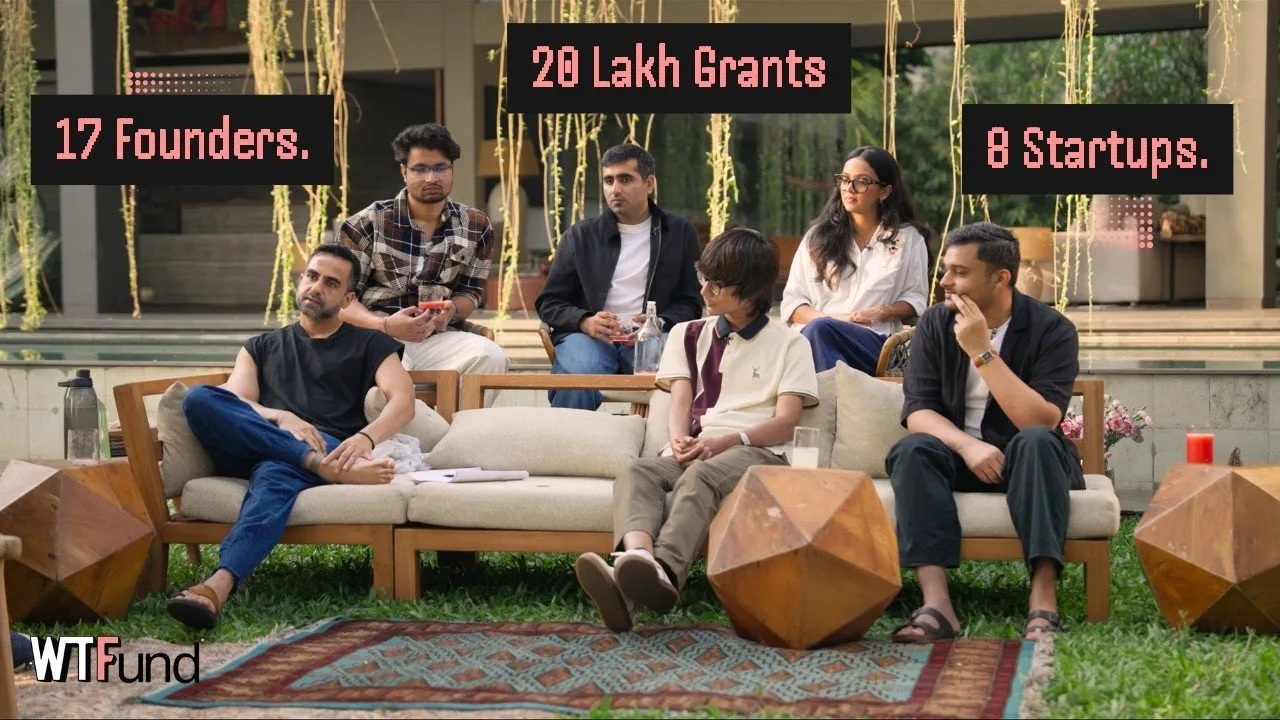
The entrepreneurial landscape in India is shifting rapidly, moving away from generic consumer apps toward deep-tech solutions, hardware innovation, and AI infrastructure. In the third cohort of the WTFund Bootcamp, held against the scenic backdrop of Goa, the stakes were high. Out of 3,000 applicants, only eight startups made the final cut, each receiving a ₹20 Lakh grant and mentorship from industry heavyweights like Nikhil Kamath.
This cohort represents a microcosm of the future of Indian tech. The focus has pivoted from "content strategy" to tangible problem-solving—whether that is democratizing manufacturing, revolutionizing cancer detection, or building the financial rails for artificial intelligence. The conversations during this bootcamp went beyond pitch decks; they explored the philosophy of founders, the mechanics of storytelling, and the inevitable intersection of life and legacy.
Key Takeaways
- AI is Moving from Information to Action: The next wave of AI isn't just about chatbots; it is about "agentic" workflows that can execute financial transactions and manage logistics without human intervention.
- Healthcare Requires India-Specific Innovation: From electricity-free oral cancer screening to AI-driven pathology operating systems, founders are building scalable health solutions tailored for the Indian demographic.
- The Hardware Renaissance: Young founders are challenging the software-only status quo by building rehabilitation robots, smart security systems, and desktop manufacturing units.
- Soft Skills Determine Hard Success: Technical brilliance is the baseline, but mastering storytelling and negotiation is what separates a good founder from a great one.
The Evolution of AI: Infrastructure and Interfaces
One of the most prominent themes of the cohort was the transition of Artificial Intelligence from a tool for information retrieval to a tool for execution. While Large Language Models (LLMs) like ChatGPT have mastered content generation, they often hit a wall when it comes to performing real-world actions, particularly payments.
Prava Payments: The Financial Layer for AI
Founders Sushant and Shubham identified a critical gap in the AI ecosystem: the lack of a financial infrastructure. Currently, if a user asks an AI agent to buy a product, the process fragments into multiple steps, usually redirecting the user to a third-party website to finalize the purchase. Prava Payments aims to streamline this by allowing AI agents to execute payments securely on behalf of the user.
"We realized that there is a financial infrastructure missing when it comes to AI making payments... We are becoming PSP-agnostic. So Perplexity has to just integrate with us, and any merchant in the world, be it Stripe or Adyen, we are able to process payment."
This "action-first" approach is vital for the future of autonomous agents, moving the industry from simple discovery to complete transaction fulfillment.
Antimattr: The OS for Wearables
On the interface side, Sridipto and Sirsho are building antimattr, described as an "AI layer for wearables." Their thesis is that voice will supersede screens as the primary interface for technology. Starting with earbuds, they are creating an operating system that allows users to interact with services—like booking a cab or ordering food—solely through voice commands, without unlocking their phones. By turning passive listening devices into active assistants, they aim to reduce screen time and increase productivity.
Deep-Tech and Healthcare: Solving for Billions
The health-tech startups in this cohort are characterized by a move toward precision medicine and accessibility. The founders are not merely digitizing records; they are fundamentally changing how diseases are diagnosed and treated.
OncoALERT: Democratizing Cancer Screening
Dr. Jayanti, founder of Astraeus Innovus, presented OncoALERT, a nanotech-based biosensing platform for oral cancer detection. The current standard for oral cancer screening in rural India involves visual inspection, which is subjective and prone to error. OncoALERT offers a painless, needleless, and electricity-independent solution designed to work in the remotest villages.
This low-cost diagnostic tool addresses a massive public health crisis—oral cancer caused by tobacco usage—by making early detection scalable and affordable for the 70-80 crore people at risk.
Precision Pathology and BloomRehab
Complementing the screening side is a team of engineers and doctors building an AI-based operating system for diagnostic labs. Their solution digitizes glass slides and uses AI to identify biomarkers in cancer tissues, enabling personalized treatment plans even in Tier-2 and Tier-3 cities. This reduces the dependency on ultra-specialized pathologists who are often concentrated in major metros.
On the recovery front, BloomRehab is tackling the post-stroke recovery gap. Standard rehabilitation is expensive and logistically difficult, often limiting patients to 45 minutes of therapy. BloomRehab’s robotic arm allows patients to perform rehabilitation exercises at home, increasing therapy time to the gold standard of three hours a day without the logistical nightmare of clinic visits.
Hardware, Manufacturing, and Security
Contrary to the trend of low-overhead software startups, several founders in this cohort are embracing the complexities of hardware and physical security.
Placestation: The Factory on a Desk
Perhaps one of the most ambitious projects is Placestation, founded by a solo entrepreneur who taught himself electronics and robotics. The startup aims to reduce the iteration time for hardware prototypes from months to days. Placestation builds desktop-sized "pick and place" machines that allow engineers to manufacture small batches of printed circuit boards (PCBs) in-house. This innovation essentially puts a factory on a desk, lowering the barrier to entry for hardware innovation in India.
O3 Security and Aeyi
In the digital realm, Rohit from O3 Security is moving beyond standard cybersecurity compliance. His company offers a contextual security solution that integrates across a company's entire stack to reduce false positives and secure the software supply chain. Meanwhile, Aeyi is transforming physical security by converting passive CCTV setups into smart, active alarm systems that can detect emergencies, such as falls, and alert caregivers instantly.
The Founder Mindset: Philosophy and Soft Skills
Beyond the pitch decks, the interaction between Nikhil Kamath and the founders revealed the psychological and philosophical underpinnings required to build a company. The discussion touched on the importance of "nature vs. nurture," the isolation of the solo founder, and the necessity of mastering soft skills.
The Art of Storytelling
A recurring advice for technical founders was the critical need for storytelling. A great product often fails without a compelling narrative to sell it to investors, employees, and customers.
"The one thing you all should totally spend time on is to become better storytellers... A story needs to have a beginning, a middle, a twist, a call to action... If you can't appeal to me in that one line, tomorrow, when you sell it, that's the same line you're gonna use."
Founders were encouraged to study the structures of narrative to better communicate their vision. Whether pitching a cancer screening device or a cybersecurity platform, the ability to frame the problem and solution emotionally is as vital as the code behind it.
Negotiation and Empathy
Kamath highlighted that negotiation is rarely about facts and figures; it is about reading people. Understanding who in the room wants to agree with you and who is predisposed to disagree is a superpower. This requires a level of empathy and curiosity—traits that are also indicators of a healthy founder mindset versus a narcissistic one.
Conclusion: The Future of the Ecosystem
The third WTFund cohort illustrates a maturing Indian startup ecosystem. These founders are not replicating Western models for the sake of it; they are identifying fundamental gaps in infrastructure, healthcare, and manufacturing, and building bespoke solutions.
From the "Zero Envy" philosophical debates to the nitty-gritty of PCB manufacturing, the bootcamp showcased that the next generation of Indian unicorns will likely emerge from deep-tech and hardware sectors. As these young founders move from prototypes to production, their success will depend not just on their technical acumen, but on their ability to tell their stories and navigate the complex human elements of business.