Table of Contents
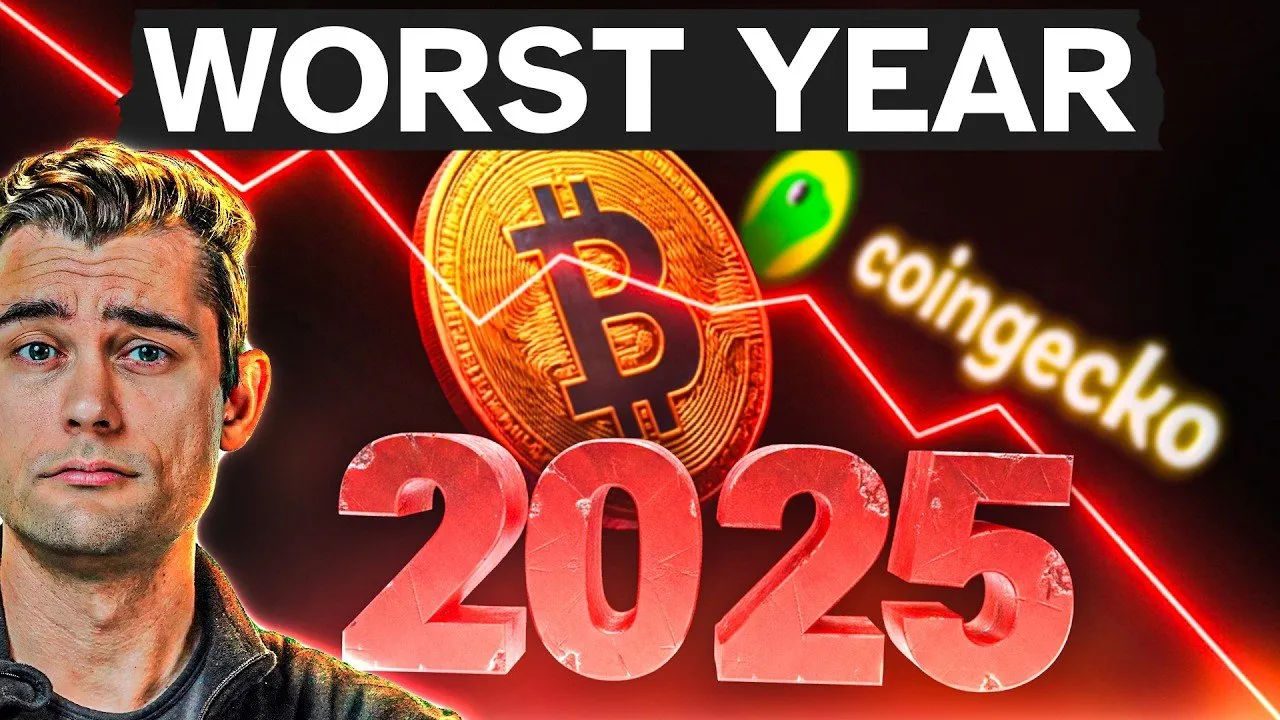
The cryptocurrency market concluded 2025 with a 10% decline in total market capitalization, ending the year at $3 trillion and marking the industry's first annual contraction since 2022. According to the 2025 Annual Crypto Industry Report by CoinGecko, a catastrophic liquidation event in October—triggered by aggressive U.S. trade tariffs—erased early-year gains, causing digital assets to significantly underperform against gold and traditional equities.
Key Points
- Market Contraction: The total crypto market cap fell to $3 trillion, driven by a massive $20 billion single-day liquidation event in October following the announcement of 100% U.S. tariffs on China.
- Asset Decoupling: Gold emerged as the year’s top asset with a record-breaking 62% gain, while Bitcoin closed the year down 6%, effectively decoupling from its role as a "digital gold" safe haven.
- Institutional Activity: Despite price drops, Digital Asset Treasuries (DATs) accumulated nearly $50 billion in crypto, and U.S. spot Bitcoin ETFs ended the year with $120 billion in assets under management.
- Sector Shifts: While meme coins and AI tokens led user attention, liquidity shifted toward Real World Assets (RWAs) and prediction markets, with Kalshi overtaking Polymarket in market share.
- Security Breaches: The industry suffered $2.38 billion in thefts, dominated by a record-breaking $1.5 billion hack of the Bybit exchange attributed to the Lazarus Group.
The "October Shock" and Market Contraction
While 2025 began with bullish momentum, seeing the total market cap hit an all-time high of $4.4 trillion early in the year, the fourth quarter fundamentally altered the landscape. The report identifies a pivotal moment in October when the announcement of 100% tariffs on Chinese goods by the Trump administration triggered a "risk-off" sentiment across global markets.
This geopolitical shock resulted in nearly $20 billion in liquidations within 24 hours. The crash effectively canceled out the gains from the previous two quarters. Bitcoin dominance closed the year at 57.4%, as investors fled altcoins for the relative safety of Bitcoin and stablecoins.
The fourth quarter was particularly devastating for the broader altcoin market. Ethereum dropped 28%, XRP fell 35%, and Solana declined by 40%. High-risk sectors suffered even steeper losses, with leading meme coins like Pepe and Dogecoin tanking by over 50%.
Asset Class Divergence: Gold Shines, Crypto Fades
One of the most defining trends of 2025 was the divergence between traditional safe-haven assets and cryptocurrency. While Bitcoin struggled to maintain value, ending the year as the third-worst performer among major assets, gold enjoyed a historic rally.
"Gold's record year was driven by a historic perfect storm of central bank accumulation, geopolitical risk, and uncertainty around tariffs. This put major doubts on Bitcoin as a safe haven asset."
While the S&P 500 and NASDAQ posted healthy gains of 17% and 21% respectively, Bitcoin’s 6% loss signaled a decoupling from the technology stocks it has historically tracked. This separation suggests that institutional investors sought alpha in traditional tech sectors rather than the crypto markets during the late-year economic uncertainty.
Emerging Narratives and Institutional Flows
Despite the bearish price action, underlying industry data reveals significant shifts in adoption and infrastructure.
The Rise of RWAs and Prediction Markets
With gold performing exceptionally well, Real World Assets (RWAs) became a defensive stronghold within the crypto ecosystem. Tokenized precious metals captured the gains of the underlying commodities, driving the RWA sector to grow nearly 7% to $17 billion by year-end.
Simultaneously, prediction markets saw explosive growth, with notional volume jumping over 300% to $63.5 billion. The sector witnessed a changing of the guard in Q4, with regulated platform Kalshi capturing 39% market share, surpassing early leader Polymarket. The composition of these markets also shifted, with sports-related trades accounting for 90% of Kalshi’s volume.
Institutional Accumulation and ETFs
Corporate treasuries remained aggressive buyers throughout the volatility. Digital Asset Treasury companies spent nearly $50 billion acquiring crypto in 2025. By year-end, these entities held over 1 million BTC and 6 million ETH, representing more than 5% of the total supply for both assets.
The ETF landscape showed mixed signals. While Bitcoin ETFs experienced their first-ever quarter of net outflows in Q4, they maintained a robust $120 billion in assets under management (AUM). BlackRock’s IBIT ETF continued to dominate with a 57% market share. Furthermore, Solana spot ETFs, approved in mid-October, managed to attract nearly $950 million in AUM despite launching during a severe market downturn.
Infrastructure and Revenue Dynamics
The report highlights the staggering dominance of stablecoins in generating protocol revenue. Tether alone generated over $5 billion, accounting for nearly 42% of all protocol revenue industry-wide.
On the Solana blockchain, a unique trend emerged regarding liquidity. Proprietary Automated Market Makers (Prop AMMs)—which utilize professional market maker capital rather than crowdsourced liquidity—accounted for 44% of on-chain volume. This structural difference sets Solana apart from Ethereum, where traditional DEXs like Uniswap remain the standard.
Looking Ahead to 2026
As the industry moves into 2026, market sentiment appears to be stabilizing. The "fear and greed" index has shifted away from extreme fear, and Bitcoin dominance is showing early signs of slipping, which typically precedes increased interest in altcoins.
The CoinGecko report suggests that privacy-focused solutions may be a key sector to watch. In Q4 2025, privacy coins like Zcash surged over 800% as governments ramped up KYC and transaction surveillance. Additionally, the resilience of tokenized collectibles and the continued expansion of prediction markets suggest these narratives may drive the next cycle of innovation.
While the immediate outlook remains cautious due to macroeconomic conditions, the continued infrastructure development during this "bear market" phase—including Ethereum's scaling upgrades and the maturation of AI agents on-chain—points to a focus on long-term technological utility over short-term speculation.

![URGENT: This Next Market Rotation Will Go Parabolic! [& It’ll Be Quick]](/content/images/size/w1304/format/webp/2026/03/market-rotation-parabolic-shift-forecast.jpg)