
Table of Contents
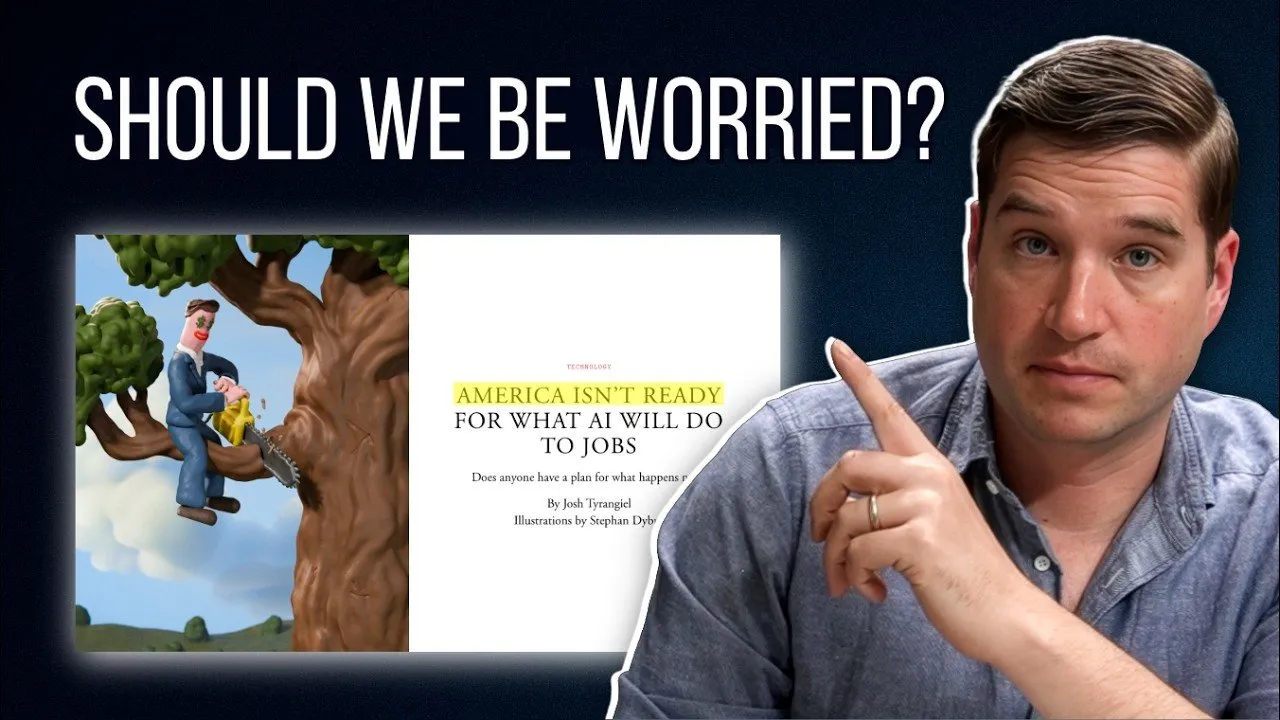
Recent media coverage of artificial intelligence has taken a decidedly dark turn. From viral Substack dispatches warning of a 2028 economic collapse to mainstream articles suggesting white-collar workers should start training for careers as pet masseuses, the narrative of impending doom is everywhere. While these stories are undeniably effective at grabbing attention, they often rely on speculative "vibe reporting" rather than hard economic data.
Key Takeaways
- Distinguishing hype from reality: Much of the current "AI doom" reporting relies on anecdotes and speculative fiction rather than verifiable economic trends.
- The role of corporate narratives: AI CEOs often benefit from painting their technology as world-altering, as it helps justify massive capital investments and high company valuations.
- Economic reality check: Professional economists generally view technological disruption through an S-curve lens, suggesting that change occurs gradually rather than through instant, catastrophic displacement.
- The danger of doomsday reporting: Focusing on apocalyptic scenarios distracts the public from holding companies accountable for mismanagement, poor hiring practices, and impulsive strategic decisions.
The Anatomy of Economic "Vibe Reporting"
Modern coverage of AI often follows a predictable, recurring pattern. First, a scary scenario is proposed, such as a total collapse of white-collar employment. To ground this fantasy in reality, journalists pair it with tangible events—like recent corporate layoffs—even when those layoffs are clearly linked to pandemic-era overhiring or specific, failed vanity projects like the metaverse.
This technique creates a sense of false inevitability. By framing the recent cooling of the job market as the "beginning of the end" rather than a standard macroeconomic correction, these reports manipulate reader anxiety. As Cal Newport notes, this effectively turns journalism into a form of "vibe reporting," where directionally aligned but unrelated facts are woven together to build a narrative that ignores the mundane, messy reality of market cycles.
The argument leans heavily on narrative and emotion rather than hard evidence. That doesn't mean it will ultimately be wrong, but the vibes to substance ratio is undeniably high. — Jim Reed, Deutsche Bank
The Strategic Incentive for Apocalyptic Claims
One of the most curious aspects of this discourse is the reliance on the very people profiting from AI development to forecast its dangers. When CEOs like Sam Altman or Dario Amodei warn that their own technology might wipe out half of all entry-level jobs, the media often treats these warnings as objective truth. However, there is a clear strategic incentive behind this rhetoric.
The Wizard of Oz Effect
Major AI firms are currently under immense pressure to justify staggering research costs and debt. They need to demonstrate that their tools will generate hundreds of billions of dollars in revenue in the coming years. By positioning their technology as the most powerful, industry-obliterating invention of the last two centuries, they distract investors and the public from the difficult questions regarding current profitability and real-world utility.
What Economists Actually See
While mainstream op-eds are busy writing fanfiction about 2028, professional economists are looking at the data—and they aren't reaching the same conclusions. Institutional analysts, who are incentivized by accuracy rather than engagement, point out that historical technological diffusion follows an S-curve. Adoption starts slow, accelerates as infrastructure builds, and eventually hits a plateau.
Why Mass Displacement Is Unlikely
- Compute Constraints: Replacing massive swaths of white-collar labor would require levels of compute capacity that simply do not exist today.
- Economic Boundaries: As demand for compute scales, costs naturally rise. Once the marginal cost of AI exceeds the cost of human labor, substitution naturally tapers off.
- Historical Context: Successive technological waves have historically offset stagnant growth rather than rendering labor obsolete.
Displacing white collar work would require orders of magnitude more compute intensity than the current level utilization. If automation expands rapidly, demand for compute definitionally rises, pushing up its marginal cost.
The Cost of Ignoring Reality
Perhaps the greatest danger of "AI doomsday" discourse is that it provides cover for corporate malfeasance. When a company experiences a major layoff due to impulsive leadership or poor fiscal management, the media is increasingly likely to blame it on "the AI revolution." This lets executives off the hook, allowing them to hide behind a futuristic excuse rather than facing scrutiny for their actual business decisions.
If we continue to treat AI as an unstoppable force of nature, we lose the ability to effectively regulate it. By treating AI as a normal technology—something to be deployed, monitored, and checked when it fails—we gain the power to actually shape its trajectory. We must demand evidence-based reporting that holds leaders accountable for their actions, rather than giving them a free pass under the guise of an inevitable, sci-fi future.
Conclusion
The fear-based narratives surrounding AI are proving to be remarkably persistent, yet they lack the grounding of solid economic theory. While the transition toward an AI-integrated economy will certainly be disruptive, it is unlikely to resemble the apocalyptic scenes described in viral blog posts. By ignoring the hype and focusing on how we use existing tools to address real-world labor challenges, we can foster a more productive conversation. Ultimately, the best way to prepare for the future is to stop reading ghost stories and start looking at the data.
![Bitcoin Is on Sale [How to Buy It in 2026]](/content/images/size/w1304/format/webp/2026/03/how-to-buy-bitcoin-2026.jpg)



%20%7C%20AI%20Reality%20Check%20%7C%20Cal%20Newport)