
Table of Contents
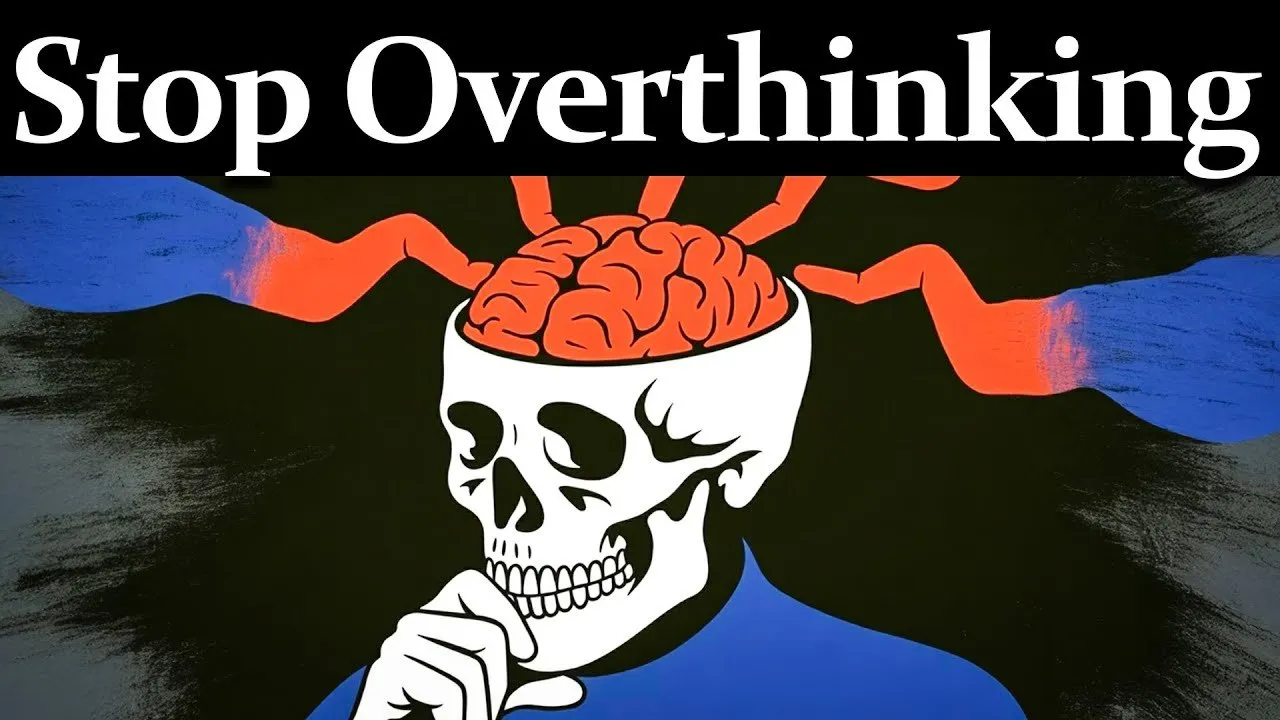
Have you ever felt mentally exhausted before you’ve even made a decision? You might spend hours, days, or even weeks analyzing every possibility, revisiting old conversations, and planning the minute details of a project you ultimately never launch. If this resonates, understand that while you are not alone, this state is not a benign quirk of personality. It is a symptom of a sophisticated cognitive trap that masquerades as intelligence.
We often believe that excessive analysis is a sign of wisdom or maturity. We tell ourselves that weighing every variable protects us from error. However, this habit is frequently a defense mechanism—an elegant excuse designed by your mind to avoid the risks associated with living. Daniel Kahneman, the Nobel Prize-winning psychologist and author of Thinking, Fast and Slow, demonstrated that the problem isn't that overthinkers think too much; it's that they are thinking the wrong way. By applying the wrong cognitive systems to simple problems, you drain your energy budget and trap yourself in a cycle of stagnation.
Key Takeaways
- Misapplied Cognitive Systems: Overthinking occurs when you force your brain’s slow, analytical system (System 2) to handle tasks better suited for your fast, intuitive system (System 1).
- The Energy Cost: Deep analysis consumes a finite "attention budget," leading to cognitive fatigue and decision paralysis known as ego depletion.
- The Illusion of Control: Excessive rumination is often a fear response disguised as planning, designed to eliminate uncertainty that cannot be eliminated.
- Action Over Analysis: Confidence is a byproduct of action, not a prerequisite. Strategies like the 10-10-10 rule can help break the cycle of hesitation.
The Two Systems: Understanding Your Mental Battlefield
To understand why we get stuck, we must look at how the human mind processes information. Kahneman revolutionized our understanding of behavior by proposing that we operate using two distinct systems. Your mind is not a linear processor; it is a battlefield where these two systems wage a silent war.
System 1: The Intuitive Pilot
System 1 is fast, automatic, and emotional. It operates on instinct and pattern recognition. This is the part of your brain that makes you slam on the brakes before you consciously realize a car has stopped in front of you, or allows you to detect a lie in a conversation without knowing exactly why. It is efficient, low-energy, and surprisingly accurate in familiar situations.
System 2: The Analytical Engineer
System 2 is slow, logical, and deliberate. You activate this system when you solve a complex math problem, fill out a tax form, or learn a new skill. It allows for planning and rationality, but it comes with a significant drawback: it is biologically expensive. System 2 is lazy by design and consumes a massive amount of glucose and mental energy.
The core problem of the overthinker is an addiction to using System 2 for System 1 problems. Instead of trusting the intuition built by experience, the overthinker forces their brain into high-consumption mode for trivial decisions. They treat choosing a route to work with the same gravity as a career change. This doesn't lead to better results; it leads to a distorted reality where irrelevant details are overvalued and the brain becomes gridlocked by manufactured variables.
The Hidden Cost of Cognitive Exhaustion
There is a biological price for living in your head. If you have ever woken up tired despite a full night's sleep, or felt that simple tasks like replying to an email feel like lifting heavy weights, you may be experiencing "ego depletion." Because System 2 operates on a limited energy budget, constant overthinking drains your self-regulation resources.
"The more time you spend analyzing a decision that could be made simply and intuitively, the greater the chance that you will end up getting lost in irrelevant details."
When you keep your mind revved up in a state of constant simulation, you burn through your fuel without moving forward. This creates a dangerous paradox: the more exhausted you become from overthinking, the less capable you are of making good decisions. A fatigued brain eventually defaults to the path of least resistance, leading to procrastination or impulsive, reactive behavior.
Ultimately, you lose the benefits of both systems. You are too tired to use the logic of System 2 effectively, but you are too anxious to trust the flow of System 1. The result is a loop of anxiety and inaction, where you wait for a feeling of "readiness" that never arrives because you have exhausted your capacity to act.
The Illusion of Control and Confirmation Bias
Why do we persist in this behavior if it is so draining? We do it because overthinking provides a seductive illusion of control. We tell ourselves that if we analyze the data just a little longer, we can predict the outcome and avoid pain. We believe that deep thinking brings us closer to the truth, but often, it only brings us closer to our fears.
When you are immersed in overthinking, you stop dealing with what is and start reacting to what could be. You enter a state of hyper-rationalization where you are not seeking clarity, but guarantees. Since life rarely offers guarantees, the mind begins to manufacture reasons not to act. This is where confirmation bias takes hold.
Rather than objectively analyzing facts, an anxious mind seeks evidence to support its hesitation. If you are afraid of failure, your analysis will inevitably find "logical" reasons why a project is doomed. If you fear judgment, your mind will construct a compelling case for why silence is safer than speech. You aren't preparing; you are using false logic to build a prison of safety. The cost of this safety is high: you drift away from reality, human connection, and the concrete experiences that actually shape wisdom.
Strategic Frameworks to Break the Loop
Escaping the trap of overthinking does not require you to think less; it requires you to think better. It involves preserving your mental energy for high-stakes decisions and employing tactical frameworks to bypass the urge to ruminate.
1. The 10-10-10 Rule
When you feel paralysis setting in, ask yourself: How will I feel about this decision in 10 minutes? In 10 months? In 10 years? This technique forces you to step out of immediate emotional volatility and view the choice through a temporal lens. Most decisions that feel monumental in the moment lose their weight when viewed from a distance, allowing you to downgrade the threat level and decide quickly.
2. The Information Cutoff Point
Overthinkers often fall into the trap of "just one more piece of data." To combat this, set strict constraints before you begin analyzing. Decide that you will research for exactly one hour, consult only three sources, or consider two distinct scenarios. Once those conditions are met, you must decide. Accepting that you will never have 100% of the information is a crucial step toward mental autonomy.
3. The Pre-Mortem
Instead of vaguely fearing failure, look it in the eye. Assume the decision has already been made and it failed. Now, ask why. This exercise utilizes System 2 correctly—not to worry, but to identify specific, preventable risks. If you cannot identify a catastrophic, irreversible outcome, your fear is likely unfounded, and you should proceed.
4. Reclaiming Intuition
If you are in a familiar environment or dealing with a situation you have navigated before, trust your System 1. Kahneman acknowledges that intuition is not magic; it is simply recognition. It is wisdom condensed by practice. If your gut tells you something is right or wrong, it is processing data faster than your conscious mind can explain. Learn to listen to it.
Conclusion: The Power of Imperfect Action
You have likely spent years believing that confidence must precede action—that you must feel ready before you move. The reality is the inverse. Confidence is the byproduct of action. It is what happens after you decide, execute, and realize you can handle the outcome, whatever it may be.
Those who live waiting for certainty eventually die waiting. The world does not reward those who know everything; it rewards those who act on what is sufficient. True strength is not found in the elimination of uncertainty, but in the courage to walk alongside it. You do not need to trust your mind less, but you must learn to govern it. Stop waiting for permission or a guarantee that will never come. Make the decision, however small, and reclaim your power from the illusion of control.

)