Table of Contents
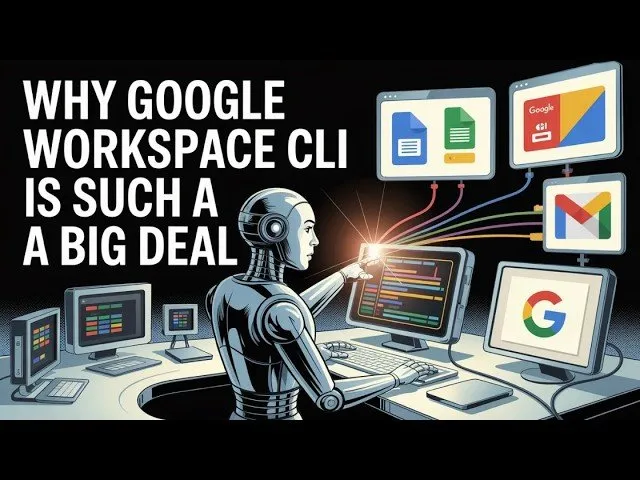
Google has officially launched the Google Workspace CLI (command-line interface), marking a significant strategic pivot in how developers and AI agents interact with the company’s suite of productivity tools. While the tech industry remains focused on the high-profile rivalry between Anthropic and OpenAI, Google is quietly building the infrastructure necessary to make its vast ecosystem of data—Gmail, Docs, Drive, and Sheets—the primary operating environment for the next generation of autonomous AI agents.
Key Points
- Agent-First Design: The Google Workspace CLI was built specifically for AI agents, prioritizing machine-readable output and deterministic results over human-centric navigation.
- Context Efficiency: By operating via terminal commands, the CLI avoids the "context window tax" associated with other protocols like MCP (Model Context Protocol), which can consume thousands of tokens by pre-loading tools.
- Competitive Moat: Google is leveraging its massive, proprietary data stores—which neither OpenAI nor Anthropic can access—to solidify its position in the productivity software wars.
- Multimodal Integration: Alongside the CLI, Google released Embedding 2, a natively multimodal system capable of retrieving information from images, slides, and charts without the need for text conversion.
The Rise of the Command Line in the AI Era
The developer community has increasingly moved toward agentic coding, where AI agents execute tasks directly within a terminal environment. Historically, developers relied on third-party solutions to interact with Google Workspace. The release of an official CLI changes this dynamic, transforming the tool into an API layer designed specifically for agentic workflows.
Justin Pon, the engineer behind the project, emphasized the design philosophy in a recent blog post:
I built a CLI for Google Workspace agents first, not build a CLI, then noticed agents were using it. From day one, the design assumptions were shaped by the fact that AI agents would be the primary consumers of every command, every flag, and every bite of output.
This design choice addresses a growing friction in the developer ecosystem: the "abstraction tax." While other protocols like MCP attempt to simplify tool usage for humans, they often introduce overhead that hinders AI performance. By keeping the CLI lightweight and deterministic, Google is allowing agents to fetch data—such as listing Drive files or creating a spreadsheet—with minimal latency and zero unnecessary context bloat.
Strategic Deepening: Context as a Moat
Google’s recent product updates reveal a strategy focused on "context-aware" intelligence. By integrating Gemini directly into Docs, Sheets, and Slides, Google is making it easier for users—and by extension, their agents—to pull data from emails and historical files. This creates a functional advantage that standalone LLMs cannot replicate, as Google maintains the user's entire history within its ecosystem.
This initiative coincides with the release of Embedding 2, which allows for native multimodal search. Previously, searching through a company's internal documents required text-based metadata or captions. Embedding 2 removes this requirement, enabling systems to retrieve information across disparate file types—such as screenshots, diagrams, and video—based on semantic meaning rather than keywords.
What Lies Ahead
The office productivity wars have effectively evolved into "agent wars," where the victor will be determined by which platform provides the most seamless integration for automated workflows. As Microsoft continues to iterate on Copilot for M365, Google’s aggressive expansion of its developer-facing tools signals a move to capture the agent builder demographic.
For developers and enterprise users, the next phase will involve moving beyond simple chat-based AI interactions toward complex, multi-step agent workflows. As the transition from GUI-based interaction to terminal-based automation continues, expect Google to expand its command-line capabilities to cover more of its service architecture, further entrenching the Google Workspace as the default backend for business-focused AI agents.
![Bitcoin Is on Sale [How to Buy It in 2026]](/content/images/size/w1304/format/webp/2026/03/how-to-buy-bitcoin-2026.jpg)