Table of Contents
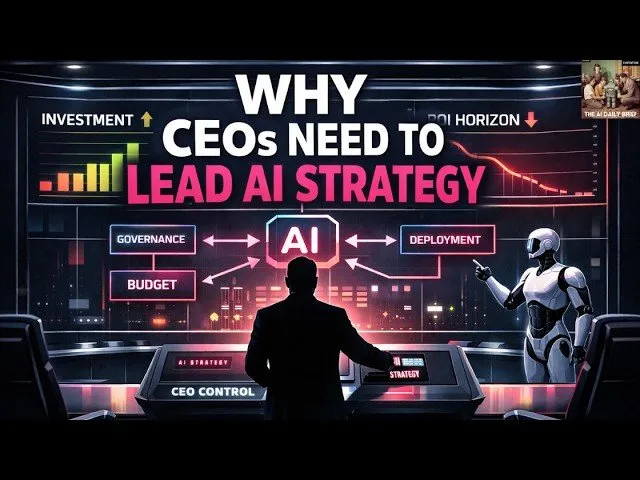
Major enterprises are undergoing a fundamental shift in artificial intelligence strategy, moving from experimental, IT-led initiatives to core business mandates directly overseen by Chief Executive Officers. According to new data from KPMG and Boston Consulting Group (BCG), CEOs are increasingly taking ownership of AI decision-making as investments remain robust despite economic volatility, with leaders now viewing AI adoption as existential to their tenure and company survival.
Key Points
- CEO-Led Strategy: 72% of CEOs now identify as the primary decision-makers for AI strategy, marking a pivot away from delegating these responsibilities to CIOs.
- Recession-Proof Investment: 67% of leaders plan to maintain AI funding even in a recession, with average planned spending rising to $124 million over the next 12 months.
- Accelerated ROI: Expectations for returns have tightened, with two-thirds of CEOs now anticipating measurable value within 1 to 3 years, a significant pull-forward from previous 3-to-5-year timelines.
- Agentic AI Maturation: While reported deployment rates have adjusted downward due to stricter definitions, organizations are aggressively hiring for AI-specific roles and paying premiums for necessary skills.
The Shift to Executive Ownership
Recent surveys indicate that the era of treating generative AI as a departmental experiment is ending. Data from KPMG’s latest quarterly Pulse Survey reveals that AI is becoming the "backbone of enterprise strategy." This transition is characterized by a widening gap between early adopters who are scaling operations and those who have stalled after initial pilots.
Steve Chase, KPMG’s global head of AI and digital innovation, emphasized the structural nature of this change:
"AI isn't just an investment. It's becoming the backbone of enterprise strategy. What the numbers don't show is the growing divide. While some organizations stall after early deployments, the leaders are scaling fast and pulling ahead. For those treating AI as a true disruptor, this isn't about catching the next wave. It's about agents fundamentally changing how value is created and sustained across the enterprise."
This sentiment is echoed in BCG’s findings, where 72% of CEOs stated they are now the main decision-makers regarding AI. This involvement is driven by high stakes; half of the CEOs surveyed believe their job stability depends on successfully implementing AI strategies. Consequently, 94% of CEOs indicated they would continue to invest in AI capabilities in 2026 even without immediate payoffs, highlighting a commitment to long-term structural transformation over short-term gains.
Investment Trends and ROI Expectations
Despite economic uncertainties, capital allocation toward AI remains aggressive. Organizations reporting more than $1 billion in revenue plan to spend an average of $124 million on AI in the coming year, an increase from $114 million in Q1. This spending is increasingly viewed as "recession-proof," with 59% of leaders committed to investment regardless of immediate tangible ROI metrics.
However, optimism regarding the speed of returns is increasing. In late 2023, nearly two-thirds of CEOs expected ROI to take 3 to 5 years. In the latest 2025 outlook, that timeline has collapsed:
- 66% expect ROI within 1 to 3 years.
- 20% anticipate returns in just 6 months to a year.
- Only 2% believe it will take longer than 5 years.
The definition of ROI is also expanding beyond simple productivity or revenue. Metrics now frequently include strategic improvements, such as enhanced decision-making at the C-suite level, which has jumped nearly 20 percentage points as a key performance indicator.
The Reality Check on AI Agents
As organizations move from simple automation to "agentic" AI—systems capable of autonomous reasoning and task execution—data suggests the market is maturing. KPMG reported a drop in AI agent deployment from 42% in Q3 to 26% in the current quarter. Analysts attribute this decline not to a reduction in activity, but to a better understanding of what constitutes a true AI agent versus a standard automation script.
Comparison data suggests that true agentic deployments comprise roughly 14% of use cases, while assisted and automated tasks make up the majority. As enterprises grapple with this complexity, they face significant hurdles:
- 41% cite a lack of organizational infrastructure, a figure that has tripled in two quarters.
- 45% report inconsistent use of agents across the organization.
- 32% point to unclear enterprise strategies.
Workforce and Security Implications
The rise of agentic AI is reshaping human capital strategies. Companies are actively creating new roles, with 71% of respondents hiring AI prompt engineers and 59% recruiting AI performance analysts. Demand for these skills is driving wage inflation, with 76% of employers willing to pay a premium of up to 10% for candidates demonstrating strong AI literacy, critical thinking, and adaptability.
Simultaneously, the integration of autonomous agents has elevated cybersecurity to a critical priority. Half of the surveyed leaders plan to allocate between $10 million and $50 million specifically to harden model governance and secure agentic architectures. Cyber risk is now a primary factor for re-evaluating strategy for 71% of executives.
Looking Ahead
The data points toward 2026 as a pivotal year where AI transformation moves from isolated deployments to orchestrated ecosystems. With 90% of CEOs believing that AI will significantly transform success metrics by 2028, the focus is shifting toward governance, security, and workforce adaptation. As technical barriers regarding infrastructure and data lineage become more apparent, direct CEO engagement will likely remain necessary to navigate the organizational restructuring required to accommodate fully agentic workflows.