Table of Contents
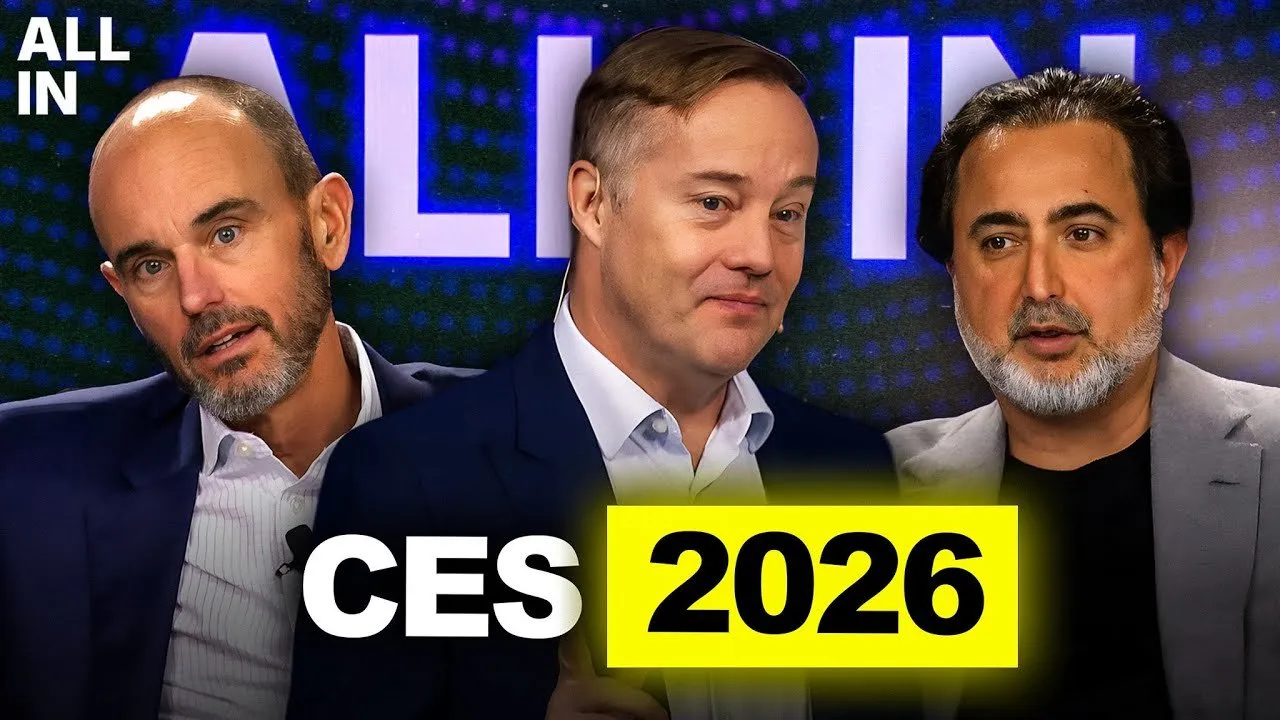
The pace of technological change has shifted from a linear progression to an exponential explosion. At CES 2026, the conversation moved beyond the novelty of gadgets to a fundamental restructuring of the global economy. In a spirited debate featuring Jason Calacanis, McKinsey Global Managing Partner Bob Sternfels, and General Catalyst CEO Hemant Taneja, the consensus was clear: the AI revolution will dwarf every technological shift that preceded it, including the PC, the internet, and mobile computing.
This discussion offered a rare glimpse into how the world’s most influential consulting firm and a top-tier venture capital fund are navigating "peak ambiguity." From the re-engineering of the workforce to the geopolitical race for manufacturing dominance, the implications of AI are no longer theoretical—they are financial, structural, and immediate.
Key Takeaways
- The "Transform or Die" Era: Incumbent enterprises are no longer just competing with startups; they are racing against obsolescence. The choice is binary: adopt AI to radically increase speed and efficiency, or face displacement.
- A New Venture Capital Playbook: VC firms are moving beyond seed funding for software startups. Strategies now involve acquiring declining assets—like hospitals and call centers—and revitalizing them through aggressive AI integration.
- Workforce Bifurcation: Companies are simultaneously hiring aggressive growth roles while shrinking administrative headcounts. McKinsey’s own internal restructuring reveals a future where growth is decoupled from total headcount.
- The Rise of Physical AI: While 2026 is defined by self-driving technology, 2027 is predicted to be the year of humanoid robotics, with huge implications for global manufacturing and labor shortages.
- Resilience Over Rote Learning: The educational system is failing to prepare students for an AI world. The most valuable skills are now resilience, "radical collaboration," and the ability to ask the right questions rather than solve solved problems.
The Velocity of Value Creation
The speed at which companies can now scale revenue is unprecedented. In previous decades, reaching $100 million or $1 billion in revenue was a journey measured in years or decades. Today, AI-native companies are compressing these timelines significantly.
Hemant Taneja highlighted the trajectory of companies like Anthropic and OpenAI. When General Catalyst invested in Anthropic, the company was generating substantial revenue, which then grew 10x year-over-year. This compression of value creation is driven by code that effectively writes itself and distribution channels that are instantaneous.
Peak Ambiguity and the CFO vs. CIO Conflict
We are currently operating in a period of "peak ambiguity," characterized by massive geopolitical shifts and rapidly evolving toolsets. This creates a paralyzing dynamic within large enterprises. CEOs are currently torn between two voices in the boardroom:
- The CFO: Focused on ROI and cost containment, asking why heavy investment is necessary before seeing immediate returns.
- The CIO: Arguing that failing to invest now guarantees disruption and obsolescence.
The winning organizations are those that align these two perspectives, moving out of "pilot purgatory" to deploy AI not just for incremental efficiency, but for total organizational speed.
Venture Capital: Buying the Castle to Lower the Drawbridge
One of the most striking revelations from the discussion was the shift in venture capital strategy. Historically, VCs backed founders to act as "barbarians at the gate," disrupting legacy industries from the outside. Today, firms like General Catalyst are taking a more direct approach: acquiring the incumbents themselves.
Taneja described a strategy of "radical collaboration" and transformation. By acquiring entities like a nonprofit health system in Ohio, the firm can directly implement AI to create abundance and resilience. This is not traditional Private Equity, which typically optimizes an asset for a flip. This is a new asset class focused on transforming declining businesses—such as call centers or legacy healthcare providers—into AI-first enterprises.
"This is not private equity. This is about how do you transform incumbent entities into something different. Private equity typically optimizes an existing asset class at a certain scale. This is about transformation."
This approach allows tech innovators to bypass the slow sales cycles of selling software to reluctant giants. Instead, they own the customer base and can deploy innovation at will, effectively upending the ecosystem from the inside out.
The Bifurcation of the Workforce
The impact of AI on employment is often discussed in binaries—jobs lost versus jobs created. However, the reality within elite firms suggests a more complex "bifurcation." Bob Sternfels shared internal data from McKinsey that serves as a microcosm for the broader professional services industry.
The McKinsey Case Study
McKinsey is executing two opposing headcount strategies simultaneously:
- Expansion: Growing the client-facing consulting body by 25% to tackle more complex, creative problems.
- Contraction: Shrinking non-client-facing support roles by 25%, while achieving a 10% increase in output through automation.
This destroys the decades-old mental model that business growth requires linear headcount growth. Companies can now grow revenue and output while shrinking their administrative footprint. For the workforce, this means the "safe" middle-management and administrative paths are evaporating.
The Agentic Teammate
The future organizational chart includes AI agents as recognized teammates. McKinsey is approaching a 1:1 ratio of humans to personalized AI agents. These are not simple chatbots; they are functional entities capable of search, synthesis, and execution.
The critical skill for the next generation of workers is learning to be a "conductor" of these agents. The barrier to entry for leadership is shifting from managing people to managing an orchestra of digital intelligences.
Physical AI: The Next Frontier
While Large Language Models (LLMs) dominate current headlines, the integration of AI into the physical world—"Physical AI"—represents the next massive wave of capital deployment.
From Self-Driving to Humanoids
The panel dubbed CES 2026 as the year of "Self-Driving," with autonomous vehicles finally reaching maturity across global markets. However, the forecast for 2027 turns toward humanoid robotics. With labor shortages plaguing manufacturing sectors in the US, Germany, and Korea, robotics is no longer a luxury but a demographic necessity.
The prediction is bold: a future with a one-to-one ratio of humans to humanoid robots. This technology will allow LLMs to "understand the world" and execute physical tasks, fundamentally altering the economics of labor and production.
"I can tell you now, nobody will remember that Tesla ever made a car. They will only remember the Optimus and that he is going to make a billion of those."
The Manufacturing Geopolitics
There is a global race occurring between the "Western stack" of innovation and Chinese manufacturing dominance. While the US leads in AI software and self-driving technology, it lacks the manufacturing infrastructure to produce hardware at competitive costs. The challenge for Western economies is to leverage AI to rebuild manufacturing resilience, reducing reliance on fragile global supply chains.
Redefining Education and Resilience
If the workforce is splitting and technology is evolving weekly, the current education model—designed 700 years ago—is obsolete. The panel argued that the "four-year degree followed by 40 years of work" model is broken.
The Death of the Resume
For young people entering this volatile market, the advice is stark: there is no training program coming to save you. Corporate onboarding is being replaced by AI agents that are easier to configure than humans are to train. To break in, candidates must demonstrate "chutzpah" and resilience.
Actionable advice for new graduates:
- Stop sending resumes: They are filtered by agents.
- Do the work first: Audit a company, redesign their product, or solve a specific problem, and send the solution directly to leadership.
- Focus on human-centric skills: Since AI can solve problems, the human value add is in aspirational leadership (setting the goal) and judgment (determining the parameters).
Conclusion
As we look back at the "ghosts of gadgets past"—from the pager to Google Glass—we see a history of tools that were eventually absorbed or rendered obsolete by better iterations. The AI revolution is different because it is not just a new tool; it is a new intelligence. It is compressing the time between idea and execution, and between expense and value.
The consensus from CES 2026 is that we are in a moment of "transform or die." Whether for a nation trying to secure its supply chain, a CEO trying to balance their budget, or a student trying to enter the workforce, the strategy is the same: embrace the ambiguity, leverage the tools to move faster, and build the resilience to adapt when the landscape shifts again tomorrow.