Table of Contents
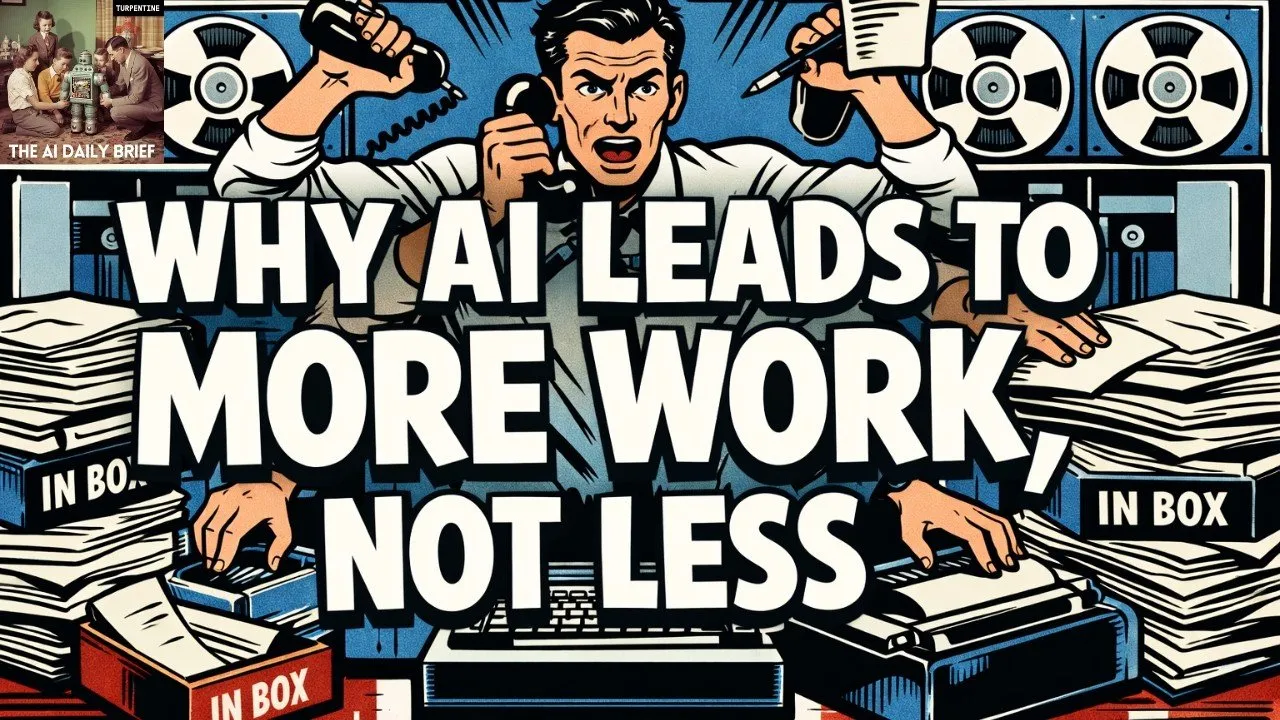
Contrary to the utopian narrative that artificial intelligence would usher in an era of shorter workweeks and increased leisure, new research suggests the technology is having the opposite effect on power users. A recent study published in the Harvard Business Review reveals that rather than reducing workload, the adoption of generative AI is driving "work intensification," characterized by expanded job scopes, multitasking, and the erosion of boundaries between professional and personal time.
Key Points
- Work Intensification: Research indicates AI adoption is leading to task expansion and multitasking rather than reduced hours, as workers seek to maximize the technology's potential.
- Three Core Drivers: The study identified three mechanisms increasing workload: task expansion into new domains, blurred boundaries between work and breaks, and simultaneous multitasking.
- Psychological Shift: The anxiety surrounding AI has shifted from fear of job displacement ("Am I valuable?") to performance pressure ("Am I doing enough?").
- Agentic Future: A separate report from Anthropic predicts a democratized future where "agentic coding" expands across non-technical roles, further increasing the volume of work capable of being processed.
The Paradox of Productivity
Researchers from the University of California, Berkeley, and Harvard Business School conducted an in-depth study embedded within a 200-employee technology company from April to December of last year. Unlike broad market surveys, this research tracked the lived experience of employees who were positively inclined toward AI adoption, though not mandated to use it.
The study challenges the prevailing assumption that AI is strictly an efficiency tool designed to reduce labor hours. Instead, the findings suggest a paradox: while AI reduces the time required for individual tasks, it dramatically increases the aggregate volume of work by making previously inaccessible tasks viable. The researchers concluded that in a lived context, AI is not reducing work but intensifying it.
Mechanisms of Intensification
The study identified three specific behaviors that contribute to this phenomenon, fundamentally altering how employees structure their days.
1. Task Expansion
Workers are increasingly stepping into responsibilities that previously belonged to other departments or were outsourced. Because generative AI provides an "empowering cognitive boost," employees feel capable of executing tasks outside their core competency. Product managers began writing code, and researchers took on engineering tasks. While this leads to a sense of mastery, it results in a meaningful widening of job scope.
2. Blurred Boundaries
The friction of starting a new task has been reduced so significantly that workers are slipping work into moments that were previously reserved for recovery. Employees reported prompting AI during lunch, in meetings, or while waiting for files to load. The study describes this as work becoming "ambient"—something that can always be advanced a little further, regardless of the time of day.
3. Multitasking and Parallel Agents
The most distinct change is the rise of parallel workflows. Employees reported manually writing code while an AI generated an alternative version in the background, or running multiple AI agents simultaneously. This shift has transformed individual contributors into managers of digital teams, increasing the cognitive load required to monitor and integrate these various outputs.
The Hidden Costs of Efficiency
While the expansion of capabilities offers intrinsic rewards, such as feelings of mastery and increased organizational velocity, it brings new management challenges. The researchers noted a "frog in boiling water" effect, where employees did not realize how significantly their downtime had eroded until they were already exhausted.
Furthermore, the democratization of technical tasks has created spillover effects for specialists. Engineers, for instance, reported spending increased time reviewing, correcting, and guiding AI-generated work produced by non-technical colleagues—a phenomenon sometimes referred to as "vibe coding."
Simon Willison, a prominent software architect, commented on the exhaustion associated with this productivity boost:
"The productivity boost these things can provide is exhausting. I'm frequently finding myself with work on two or three projects running parallel. I can get so much done, but after just an hour or two, my mental energy for the day feels almost entirely depleted."
This sentiment is echoed by industry leaders, including OpenAI President Greg Brockman, who recently noted the feeling of missed opportunity whenever AI agents are not actively running. This psychological shift—from fear of obsolescence to the pressure of maximizing utilization—is creating a culture where employees feel they are leaving value on the table if they are not constantly prompting.
Market Implications and the Agentic Shift
These findings align with a new "Agentic Coding Trends" report released by Anthropic. The report highlights that coding capabilities are democratizing beyond engineering departments, predicting that domain experts across organizations will soon implement technical solutions directly.
The shift from "assisted AI" (using a chatbot for help) to "agentic AI" (deploying autonomous agents to complete workflows) is expected to exacerbate work intensification. As single-agent workflows evolve into multi-agent systems, the role of the knowledge worker is pivoting toward orchestration. This suggests that the aggregate amount of work is not a fixed state but is elastic, expanding to accommodate increased capacity.
Future Outlook
The data suggests that the winning organizations in the AI era will not be those that use the technology strictly for cost-cutting or headcount reduction. Instead, success will likely favor companies that treat AI as an expansionary technology—using the same headcount to enter new markets, develop new product lines, and increase velocity.
However, this expansion comes with a mandate for new management strategies. Organizations may need to implement "intentional pauses," better sequencing of work, and "human grounding" protocols to prevent burnout. As the barrier to creating work lowers, the challenge for leadership will shift from managing scarcity to managing an overwhelming abundance of output.