Table of Contents
If you only glanced at the S&P 500 headlines last week, you might assume nothing happened. The index was effectively flat, moving less than a percentage point. Yet, beneath that placid surface, the market experienced one of the most violent rotations in recent memory. While the headline indices yawned, the average stock surged, and former market darlings in the software sector faced an existential reckoning. We are witnessing a decoupling where the "market" is finally becoming a market of stocks again, rather than a monolith driven by a handful of tech giants. From the resurgence of value investing to the massive capital expenditure bets by hyperscalers, the financial landscape is shifting rapidly.
Key Takeaways
- The Great Rotation is Real: While the S&P 500 remained flat, the average stock rose nearly 2%, with massive outperformance in materials, industrials, and consumer staples.
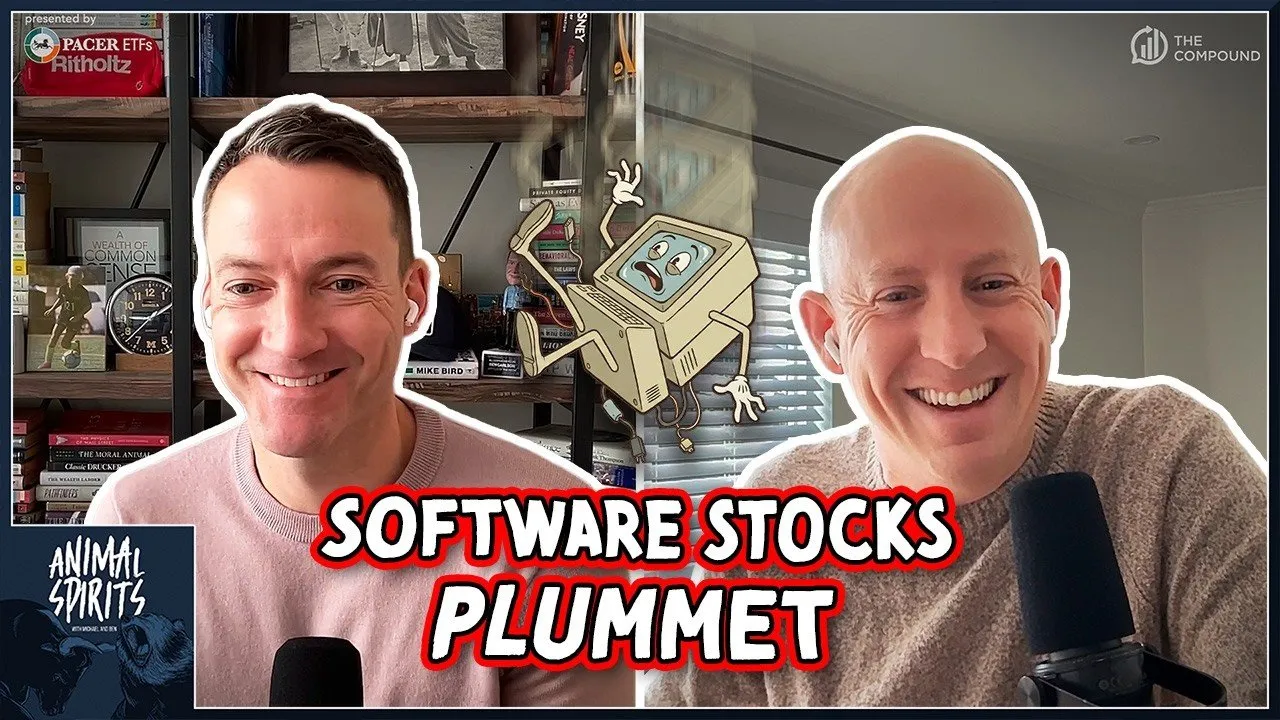
- SaaS Under Siege: Fears that AI will commoditize coding and software architecture have triggered a massive sell-off in enterprise software stocks, damaging their perceived "moats."
- Private Credit Contagion Risks: A significant percentage of private credit loans back software companies; as software valuations rerate, this creates potential vulnerability in the private lending space.
- Unprecedented Capex Spending: Hyperscalers like Amazon and Microsoft are projecting astronomical capital expenditures—potentially reaching 90% of operating cash flow by 2026—to build out AI infrastructure.
- Crypto Correlates with Tech: Bitcoin is currently trading in lockstep with software stocks, acting more like a levered tech play than a non-correlated asset or inflation hedge.
The Market Under the Surface: Breadth and Rotation
For years, investors have waited for a "stock picker's market," and 2025 appears to be delivering it. The divergence between the capitalization-weighted indices and the average stock has reached historic extremes. Last week, while the S&P 500 was effectively unchanged, 337 individual stocks within the index outperformed the benchmark.
This is a total sea change from the environment of the last few years, where the "Magnificent Seven" sucked all the oxygen out of the room. We are seeing a massive bid for "real economy" companies. Duality Research data indicates that nearly every materials stock outperformed the S&P 500 last week. The numbers are equally staggering elsewhere:
- 96% of Energy stocks outperformed.
- 92% of Consumer Staples outperformed.
- 86% of Industrials outperformed.
Perhaps the most shocking statistic is the valuation flip. We have reached a point where the forward P/E ratios of defensive consumer staples are trading at parity with technology stocks. Walmart is trading at 46 times earnings; Costco is at 54 times. Investors are fleeing expensive momentum names and paying a premium for tangible assets, pricing power, and physical operations.
The "Falling Knife" Phenomenon
Despite the broader rally, specific sectors are experiencing panic selling. We observed a statistical anomaly last week where over 100 stocks fell 4% in a single session. Historically, when this level of selling pressure occurs, the index is usually in a deep bear market (down ~28%). Today, this carnage is happening while the index is within striking distance of all-time highs.
This creates a dangerous environment for bargain hunters. While it is tempting to buy stocks down 40% to 70%—names like Estée Lauder, Nike, or various software entities—catching a falling knife during a fundamental sector rerating is perilous. The market is efficient, and often, a stock down 50% is "cheap" for a reason.
The Software Reckoning: Is AI Eating SaaS?
The most significant narrative shift in the market centers on the future of software as a service (SaaS). The release of advanced AI coding agents, such as Anthropic’s Claude, has terrified investors. The prevailing fear is that if AI can write code, debug applications, and build bespoke internal tools, the moat of traditional enterprise software companies evaporates.
This fear triggered a historic sell-off. Microsoft wiped out $357 billion in value in a single session—the second-largest market cap loss in history. The assumption is that AI is deflationary for software pricing power. If a company can "vibe code" its own CRM or ERP solution using AI agents, why pay Salesforce or Workday a premium subscription fee that increases annually?
"Replacing a core SAS platform effectively is open heart surgery for an enterprise entailing immense operational friction. It's far easier to add an AI co-pilot to existing operations than to fully migrate to an AI startup."
The Counter-Argument for Software
While the market is pricing in the death of the SaaS margin, this reaction may be overblown in the short term. Ben Thompson of Stratechery argues that while code generation will become commoditized, the value of enterprise software isn't just the code—it's the maintenance, security compliance, integration, and support.
However, the growth story is undeniably damaged. Companies are looking to cut software spend to reallocate budgets toward their own AI compute and token costs. This justifies a rerating of valuations, even if the business models aren't going to zero. We are likely seeing a transition where software companies become more efficient by using AI to write their own code, but they lose the leverage to aggressively hike prices on customers.
The Private Credit Connection
The crash in public software stocks has revealed a potential fault line in private markets. Private equity and private credit have heavily concentrated their portfolios in software businesses over the last decade. The logic was sound at the time: software offers high margins, recurring revenue, and low capital intensity—perfect for servicing debt.
Estimates suggest that within certain private credit universes, up to 70% of borrowers are software companies. If the public market is violently rerating software valuations down by 30-50%, the collateral backing these private loans is deteriorating in value. This explains the recent carnage in Business Development Companies (BDCs) and alternative asset managers like Blue Owl and Blackstone.
However, nuance is required. "Vertical" SaaS (software specific to one industry, like parking garages or construction) may be more vulnerable to bespoke AI replacement than "Horizontal" SaaS (platforms used by everyone, like Microsoft Office). A parking garage company might hire a programmer to build a bespoke AI tool to replace a vendor, but they aren't going to build their own Excel.
Hyperscalers and the Capex Wall
Despite investor anxiety, the biggest technology companies are doubling down on infrastructure spending. The capital expenditure (Capex) guidance from the "Hyperscalers" (Amazon, Google, Microsoft, Meta) is nothing short of astronomical.
Amazon alone has guided for up to $200 billion in Capex. To put that in perspective, the combined Capex spending of the top five tech firms is projected to exceed $300 billion in incremental spend by 2026. Some projections suggest these companies will spend 90% of their operating cash flow on Capex in 2026, up from a historical average of 40%.
This spending is fueling the broader economy—contributing significantly to GDP growth—but it raises a critical question: Where is the ROI?
Data from Kai Wu at Sparkline Capital suggests the ROI is beginning to appear. Companies that mention "AI-driven ROI" in their earnings calls are statistically outperforming the market by approximately 5% annually. This indicates that while the infrastructure build-out is expensive, the companies effectively deploying these tools are seeing tangible economic gains.
Bitcoin, Sentiment, and Volatility
Crypto markets have not been spared from the volatility. Bitcoin has recently traded in tight correlation with the software sector (specifically the IGV ETF). When software crashes, crypto crashes. This undermines the narrative of Bitcoin as an uncorrelated asset or a hedge against traditional market turmoil.
Sentiment in the crypto space has turned deeply negative, described by some as "the worst sentiment ever seen," despite Bitcoin trading at relatively high levels historically. This disconnect highlights the psychological aspect of markets: price drives narrative. When prices stall or drop, investors quickly pivot from euphoria to despair.
For traders, this volatility creates opportunities. When an asset class liquidates on high volume due to panic rather than fundamentals, it often presents a buying opportunity for those with a strong stomach. However, the current price action suggests that for now, crypto is behaving like a high-beta technology stock.
Conclusion
We are in the midst of a significant regime change. The "easy" trade of blindly buying big tech is over, replaced by a more complex environment where valuations, tangible assets, and sector rotation matter. The market is broadening out, which is historically a healthy signal, even if it comes at the expense of the previous cycle's winners. Whether this is a short-term correction or a long-term restructuring of the economy around AI remains the defining question for the next decade.