Table of Contents
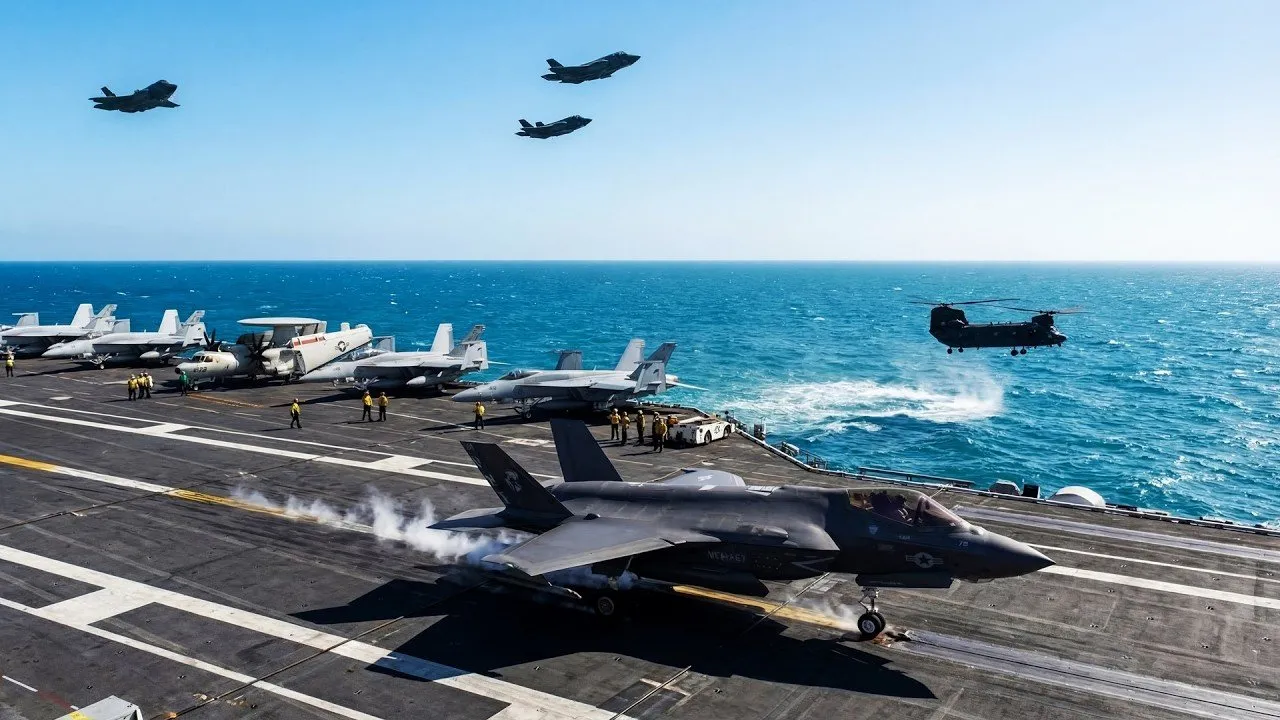
On January 3rd, 2026, a hypothetical operation occurring 200 miles off the coast of Venezuela demonstrated a paradigm shift in modern naval warfare. The USS Gerald R. Ford carrier strike group executed a strategy that defied traditional concepts of stealth. Rather than disappearing from enemy sensors, the strike group flooded the battlespace with signal. By utilizing a "Sonic Shield"—a ceaseless roar of jet engines generated by an industrial-pace launch cycle—the Navy created a blanket of acoustic dominance. This operation wasn't just a show of force; it was the weaponization of tempo, geometry, and human perception. To understand how the US Navy can capture a target without initially firing a shot, one must understand the complex mathematics and engineering that turn a $13 billion ship into an acoustic prison.
Key Takeaways
- The Sonic Shield Paradox: True stealth in modern warfare sometimes requires flooding enemy sensors with "normal" activity to mask high-value insertions.
- Electromagnetic Launch Systems (EMALS): The USS Ford replaces steam with electricity, allowing for a 45-second recharge cycle and creating a seamless "conveyor belt" of air power.
- Pit Stop Logistics: Redesigned deck geometry and magnetic elevators reduce aircraft turnaround time from 40 minutes to 22 minutes.
- Atmospheric Dominance: Dual-band radar systems are required to pierce the unique "evaporation ducts" of the Caribbean that blind traditional sensors.
- The F-35B Engineering Marvel: The STOVL variant utilizes a clutch system capable of transferring 29,000 horsepower instantly to achieve vertical flight.
The Paradox of Acoustic Camouflage
For decades, the doctrine of special operations insertion relied on silence. The goal was to slide beneath the radar and move quieter than the ambient environment. However, operation "Tooti 26" illustrated a counter-intuitive evolution in psychological warfare: the saturation of enemy sensors.
When inserting a Delta Force team into a hostile capital, silence is fragile. A single anomaly breaks the illusion. The alternative is to engineer a state of reality where the "anomaly" becomes the baseline. By pushing the carrier’s systems to surge tempo, the USS Ford generated a constant, deafening roar of jet engines over the Caribbean.
The Delta Force team isn't sneaking in through the window. They are walking through the front door while the doorman is covering his ears.
To the enemy intelligence officers and radar operators, this massive surge of data looked like standard dominance maneuvers. Their sensors were overloaded not by jamming, but by excess legitimate information. Beneath this "perfect cover of familiarity," the rotor noise of four Chinook helicopters skimming the water was swallowed whole. The enemy heard everything, which ensured they distinguished nothing.
Engineering Tempo: The EMALS Revolution
Sustaining a "Sonic Shield" requires keeping over 100 aircraft airborne constantly. This creates a logistical bottleneck that older Nimitz-class carriers cannot overcome due to the limitations of steam physics. On a traditional carrier, launching too many jets too quickly depletes steam pressure, forcing a pause while the system recharges. These gaps in formation would break the acoustic shield.
The USS Gerald R. Ford solves this through the Electromagnetic Aircraft Launch System (EMALS). Acting essentially as a rail gun for aircraft, EMALS uses electricity flowing through coils in the flight deck to generate magnetic fields that push the launch shuttle.
The Mathematics of Sortie Generation
The operational difference comes down to recharge rates. A steam system requires roughly four minutes to recover between launches. EMALS recharges in just 45 seconds. This allows the Ford to hit a maximum surge rate of 270 sorties per day. The result is a seamless conveyor belt of air power: launching a wave, recovering the previous wave, and relaunching without the decibel levels ever dropping, effectively out-cycling the enemy’s ability to track individual threats.
NASCAR on the High Seas: The Logistics of Speed
Launch capability is only half of the equation; the other half is the speed of rearming and refueling. The designers of the USS Ford radically altered the geometry of the flight deck to implement what is known as "Pit Stop Theory." By moving the command island further back, they created massive open spaces modeled after auto-racing pit crews.
The critical innovation here is the Advanced Weapons Elevator system. On older ships, moving ordnance from deep magazines to the deck involved wire ropes, manual transfers, and a slow navigation through parked aircraft. The Ford uses electromagnetic rails to move bombs directly from the magazine to the flight deck at 150 feet per minute.
The impact on the mission timeline is drastic:
- Nimitz Class Turnaround: 40 minutes from landing to relaunch.
- Ford Class Turnaround: 22 minutes from landing to relaunch.
When multiplied across an air wing of 100 aircraft, that 18-minute saving per plane generates a cumulative advantage of 1,800 minutes of operational time per cycle. This efficiency is what makes the continuous acoustic cover mathematically possible.
Tactical Geometry and Atmospheric Physics
The positioning of the fleet during the operation was dictated by a precise blend of aircraft range and fuel economy. The USS Ford positioned itself exactly 380 nautical miles northeast of Caracas. This specific distance allows the F-35C Lightning II, with a combat radius of roughly 770 miles, to reach the target, orbit for 90 minutes, and return with safety reserves intact.
The Clockwise Fuel Hack
The strike group adopted a clockwise rotation pattern, with the carrier at the center and Arley Burke-class destroyers orbiting at the 12, 3, 6, and 9 o'clock positions. While this provided overlapping radar coverage, it also served a logistical function. Flying in a circular pattern with prevailing winds reduces fuel consumption by approximately 11% compared to straight-line flight.
Over a six-hour operation involving the entire air wing, that 11% efficiency saves roughly 290,000 pounds of jet fuel—enough to extend the operation by an additional 90 minutes.
Defeating the Caribbean Evaporation Duct
The Caribbean presents a unique challenge known as "evaporation ducting." In hot, humid environments, rapid evaporation creates a dense layer of moist air right above the ocean surface. Standard radar waves hit this layer, bend downward, and refract, creating ghost images or hiding low-flying objects entirely.
To counter this, the USS Ford utilizes a dual-band radar system combining SPY-3 (X-band) and SPY-4 (S-band) frequencies:
- S-Band (Volume Search): Scans the upper atmosphere, ignoring surface clutter.
- X-Band (Horizon Search): Uses a narrow, high-frequency beam to cut through humidity like a laser through fog.
While the enemy attempts to hide behind the atmospheric distortion of the archipelago, the Ford’s dual-frequency system filters out the geography, rendering the evaporation duct transparent.
The Engineering Miracle of the F-35B
While the USS Ford provided the shield, the rapid reaction force came from the USS Bataan, an amphibious assault ship positioned 80 miles closer to the coast. This ship carries the F-35B, a Short Take-off and Vertical Landing (STOVL) variant that represents one of the most complex mechanical engineering feats in aviation history.
Unlike the catapult-launched F-35C, the Bataan’s F-35Bs create their own lift via a massive fan located behind the cockpit. This fan is powered by the main jet engine via a carbon fiber drive shaft. When a pilot engages hover mode, a clutch activates that must transfer an immense amount of energy instantly.
This clutch has to transfer 29,000 horsepower from the jet turbine to the lift fan in a split second. That is equivalent to the power of 40 Formula 1 cars being transferred through a single shaft instantly.
This capability allows the F-35B to launch from a standstill without turning into the wind, drastically cutting reaction time. While the Ford’s fighters bought distance, the Bataan’s fighters bought time, reaching the extraction point in 11 minutes compared to the 28 minutes required for the Ford’s aircraft. This layered response ensures that by the time an extraction becomes contested, air superiority is already established.
Conclusion
The capture of a high-value target without leveling a city is not a triumph of brute force, but of applied physics. The "Sonic Shield" works because engineers stopped asking how to destroy and started asking how to dominate perception. From the 13,800-volt output of the A1B nuclear reactors to the precise geometry of fleet positioning, every element is a variable in a calculated equation.
Modern military dominance is increasingly defined by the ability to execute these physics problems under pressure. It relies on 19-year-old sailors managing electromagnetic catapults and logistics crews shaving minutes off refueling times. The result is a form of warfare where the math is done, the watch is set, and the victory is secured before the enemy even realizes the operation has begun.