Table of Contents
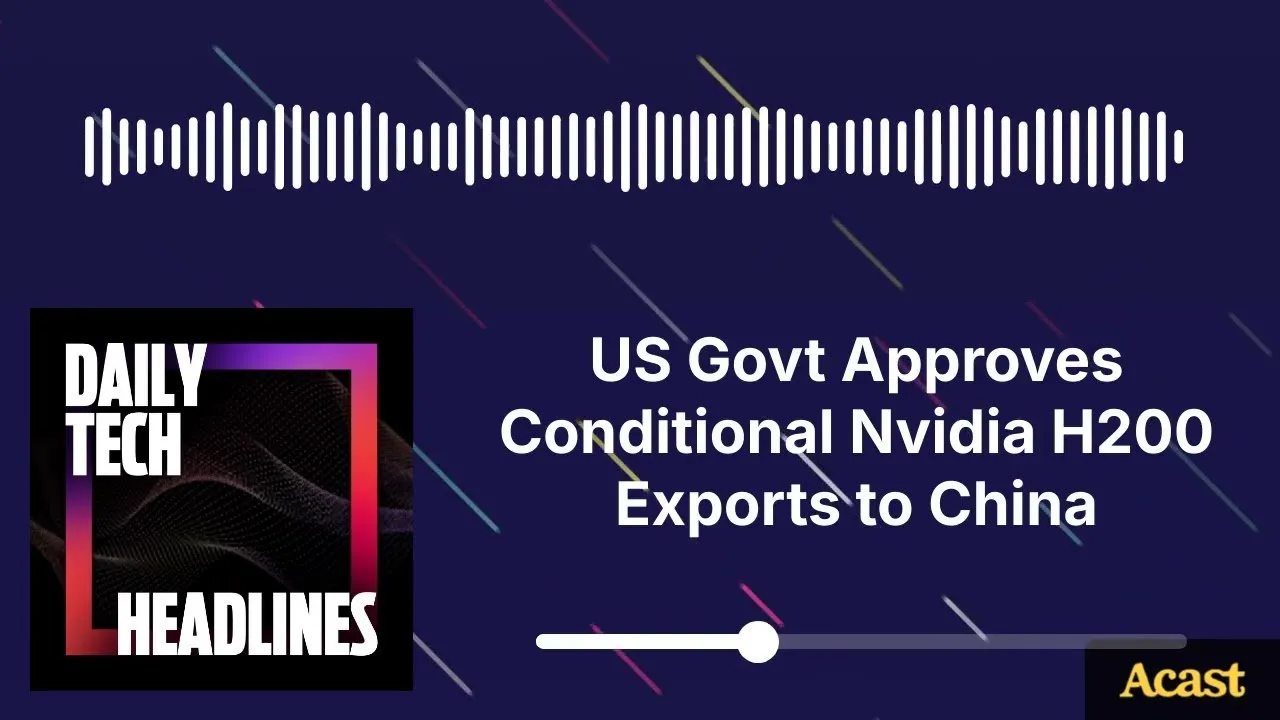
The United States government has formally authorized Nvidia to export H200 chips to China under strict regulatory conditions, creating an immediate geopolitical standoff as reports emerge that Beijing has instructed customs officials to block the hardware. This conflict highlights the escalating tension over semiconductor trade and artificial intelligence infrastructure, coinciding with significant policy shifts from major tech players like Tesla and Google.
Key Points
- Export Conflict: The US approved conditional Nvidia H200 exports, but Chinese authorities have reportedly banned the chips from entering the country.
- Tesla Strategy Shift: Tesla will remove the $8,000 one-time purchase option for Full Self-Driving (FSD), moving exclusively to a subscription model.
- AI Governance Failure: A UK police force admitted that a Microsoft Copilot hallucination regarding a non-existent football match influenced an intelligence report.
- Security Investment: Anthropic announced a $1.5 million investment in the Python Software Foundation to secure the software supply chain.
Nvidia H200: A Regulatory Tug-of-War
On Tuesday, the American government issued a "green light" for Nvidia to resume exports of its high-performance H200 chips to China, subject to rigorous oversight. To comply with US regulations, the chips must undergo third-party reviews to assess their AI capabilities prior to shipment. Furthermore, Chinese customers are required to attest to sufficient security protocols and verify that the hardware will not be utilized for military purposes.
The US Department of Commerce has also imposed volume restrictions, stating that shipments to China are limited regarding their proportion to American sales. Specifically, export volumes are capped at no more than 50% of the volume sold to American customers, a move likely designed to prioritize domestic supply chain stability.
Beijing’s Response
Despite the US authorization, the chips face significant hurdles upon arrival. According to sources cited by Reuters on Wednesday, Chinese authorities have instructed customs agents that Nvidia’s H200 chips are not permitted to enter the country. Furthermore, domestic technology companies in China reportedly met with government officials and were directed to avoid purchasing these foreign chips unless strictly necessary.
Discussions are reportedly underway within the Chinese government regarding potential exemptions for universities and Research and Development (R&D) purposes, suggesting a targeted approach to restricting dependence on American silicon while maintaining academic access.
AI Risks and Corporate Responsibility
As governments wrestle with hardware regulation, the operational risks of AI software have surfaced in law enforcement. In a letter to the UK Home Affairs Committee, West Midlands Police Chief Constable Craig Guildford admitted that generative AI contributed to a significant intelligence failure.
"I became aware that the erroneous result concerning the West Ham versus Makabe Tel Aviv match arose as a result of a use of Microsoft Copilot."
The AI tool hallucinated a football match that never took place. This erroneous data served as the basis for an intelligence report that led to banning Israeli football fans from a game in 2025. The West Midlands Police clarified that "AI tools are not approved for use" in their computer systems, highlighting the dangers of "shadow IT" usage in sensitive sectors.
In a proactive move to mitigate software risks, Anthropic announced a $1.5 million investment over two years in the Python Software Foundation. This funding is specifically aimed at strengthening the Python security ecosystem to protect users against supply chain attacks, acknowledging Python's critical role in AI development.
Market Shifts: Tesla and Consumer Tech
Tesla is fundamentally altering its monetization strategy for autonomous driving. Beginning February 14, the automaker will remove the option to purchase Full Self-Driving (FSD) for a one-time fee of $8,000. The service will transition to a subscription-only model, currently priced at $99 per month. Tesla has not announced any changes to the monthly fee structure, but this move suggests a shift toward recurring revenue streams over upfront hardware/software bundling.
In consumer AI updates, Google released an update to its video generator, VO3.1, dubbed "Ingredients to Video." This feature allows users to provide three images alongside a prompt to generate more consistent video outputs. The update allows for vertical format exports and is currently live in the Gemini and YouTube Create apps.
Meanwhile, Meta has rolled out algorithm personalization features for English-speaking Instagram users globally. The update utilizes Meta’s AI to suggest topics based on past data, allowing users to actively remove categories or request to see less of specific content types.
Future Outlook
The contradictory directives from Washington and Beijing regarding Nvidia suggest a deepening fragmentation of the global semiconductor market. Industry observers will be watching closely to see if China’s domestic chip directives soften for the commercial sector or if strict import bans will force a faster decoupling of the US-China tech supply chain.