Table of Contents
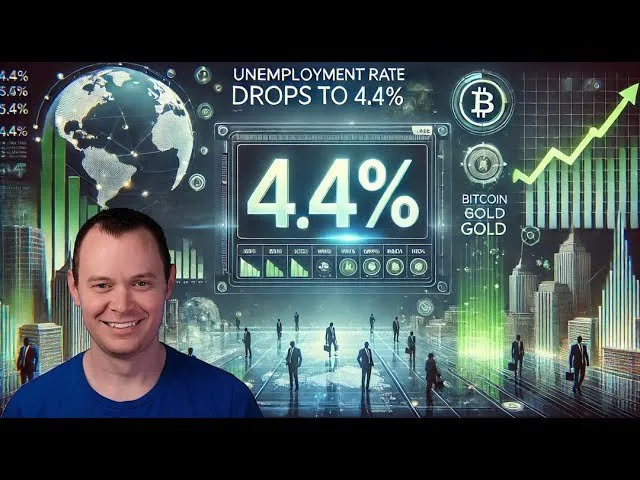
The latest labor market report has delivered a mix of data that challenges the prevailing narrative of an imminent economic downturn. With the unemployment rate dropping to 4.4%, the immediate fear of a spiraling, non-linear deterioration in the labor market has somewhat subsided. However, beneath the headline numbers lies a complex dynamic: hiring is slowing significantly, yet layoffs remain historically low. This divergence creates a unique environment where financial markets continue to climb the "wall of worry" while cryptocurrency assets struggle to find momentum in a restrictive monetary environment.
Key Takeaways
- Unemployment is stabilizing: The rate dropped to 4.4%, suggesting the labor market is not yet entering the rapid, non-linear phase of deterioration typically seen before a recession.
- Hiring vs. Firing disconnect: While job openings have dropped and hiring has slowed, initial jobless claims remain low, indicating that companies are not actively laying off workers despite a hiring freeze.
- Stock market resilience: Equities continue to grind higher, seemingly pricing in a soft landing, while recession risk models currently show low probabilities of an immediate contraction.
- Crypto remains constrained: Unlike stocks or precious metals, Bitcoin and the broader crypto market are struggling, mimicking price action from 2019 due to ongoing restrictive monetary policy.
The Labor Market: Cooling but Not Crashing
The most recent data print shows the unemployment rate retreating to 4.4%. Previously, there was concern that the metric was beginning to move in a "non-linear" fashion—essentially shooting straight up, which is a classic hallmark of a recession's onset. The revision of the prior month’s data down to 4.5% combined with this new drop paints a picture of a labor market that is cooling, but perhaps more controlled than it appeared just a month ago.
While the three-month moving average is still trending in a concerning direction, the immediate threat seems managed. This is largely because the rise in unemployment isn't being driven by a surge in firing.
"I have said frequently for probably the last 3 to 4 years that there is no recession until initial claims are printing above 300,000. So until that happens, it's just something that people can worry about."
Initial jobless claims remain the critical metric to watch. Currently, they are printing at relatively low levels. Until we see a sustained spike in these claims, the argument for a materialized recession remains weak. The risk metrics regarding employment, national income, and production have remained below the danger threshold (0.35 on the risk scale) since 2020.
The JOLTS Perspective: Harder to Get Hired, Hard to Get Fired
There is a distinct bifurcation in the labor market. Job openings (JOLTS) have dropped to 7.15 million, and the ratio of job openings to unemployed workers has slipped below 1.0, sitting at approximately 0.918. This is a metric frequently cited by Federal Reserve Chair Jerome Powell.
This data suggests we are in a unique cycle:
1. Hiring is down: If you do not have a job, it is increasingly difficult to find one.
2. Layoffs are flat: If you already have a job, your security is relatively high.
This dynamic prevents the unemployment rate from screaming higher. We have not yet seen the major surge in layoffs that turns a slowdown into a crisis. The steady hum of layoffs remains comparable to pre-pandemic levels.
Financial Markets: Climbing the Wall of Worry
One of the most perplexing aspects of the current cycle for bears is the continued resilience of the stock market. Despite cooling labor data and high interest rates, the S&P 500 continues to find new highs. Historically, the stock market acts as a leading indicator—it does not lag the economy. It is difficult to argue that a severe recession is imminent when equities are aggressively pushing upward.
Typically, job openings and the stock market track one another. When openings drop, stocks usually fall. Currently, we are witnessing a historical anomaly where job openings are plummeting while stocks are rising. Eventually, these two metrics will likely converge. Either liquidity returns and hiring picks up, or the liquidity dries up, causing stocks to correct. However, for the time being, the market is betting on the former.
The Role of AI and Structural Changes
There is a structural narrative to consider regarding hiring. If the Federal Reserve lowers rates, the assumption is that hiring will immediately bounce back. However, the integration of Artificial Intelligence may be permanently altering this dynamic. Companies may be opting to leverage AI rather than hiring fresh graduates, meaning a rate cut might not stimulate the labor market as effectively as it has in previous cycles.
This mirrors the Dot-com era: while technology destroyed some distinct job categories, it eventually created new industries. We may be in a painful transition phase where the "old" jobs are vanishing before the "new" jobs fully materialize.
Monetary Policy and Interest Rates
Because the unemployment rate came in lower than expected, the urgency for the Federal Reserve to aggressively cut rates has diminished. Market expectations for a rate cut have dropped, with higher odds now priced in for the Fed to hold rates steady at upcoming meetings.
From a technical standpoint, monetary policy remains restrictive. If we view the 2-year Treasury yield (approx. 3.5%) as a proxy for the neutral rate, the current Fed Funds rate (3.75%) is still sitting above it. This means the Fed is still applying brakes to the economy.
This delay in easing is a double-edged sword. It confirms the economy is resilient enough to handle higher rates, but it also prolongs the pressure on borrowers and liquidity-dependent assets.
Asset Allocation: Stocks, Metals, and Crypto
Understanding the macroeconomic cycle is vital for asset allocation. Different asset classes perform well in different economic phases, and currently, there is a clear divergence in performance.
Equities and Metals
Low-expense ratio index funds continue to be a reliable vehicle for wealth preservation and growth. Despite the "recession anxiety" pervasive in financial media, staying invested has been the correct play. Similarly, precious metals are currently in a bull market. Gold, silver, and even platinum group metals are performing exceptionally well, acting as a hedge against currency debasement and geopolitical uncertainty.
The Struggle for Crypto
Cryptocurrency, specifically Bitcoin, is currently "stuck in traffic." Bitcoin is seemingly repeating its 2019 market structure. During that cycle, Bitcoin stalled out against the S&P 500 and dropped exactly when Quantitative Tightening (QT) ended and the market transitioned toward easing.
Bitcoin behaves as a "risk-on" asset that sits further out on the risk curve than equities. It generally requires loose monetary policy and ample liquidity to sustain a parabolic run. With the Fed delaying cuts and the economy not yet demanding emergency liquidity, crypto lacks the macro tailwind it needs.
"Remember, there is always a bull market somewhere... Don't marry an altcoin. Don't marry an asset class. If there's a bull market somewhere, don't ignore it because you have some type of bias against that asset class."
Conclusion
The latest data suggests a "soft landing" narrative is still viable, though risks remain. The labor market is bending but not breaking, and the consumer—and by extension the stock market—remains resilient. However, the path forward is likely to be a slow grind rather than an immediate pivot to explosive growth or a sudden crash.
For investors, the current environment underscores the importance of diversification. While crypto waits for a liquidity injection, equities and metals are offering robust returns. By monitoring initial claims and staying agnostic toward asset classes, investors can navigate this transitional economic phase effectively.
![Bitcoin Is on Sale [How to Buy It in 2026]](/content/images/size/w1304/format/webp/2026/03/how-to-buy-bitcoin-2026.jpg)