
Table of Contents
One of the most persistent lies in product development is the field of dreams fallacy: "Build it, and they will come." Founders and product managers often obsess over technology, features, and roadmaps, believing that a superior product automatically generates demand. However, history—and the graveyard of failed startups—tells a different story. Supply does not create demand. A struggling moment creates demand.
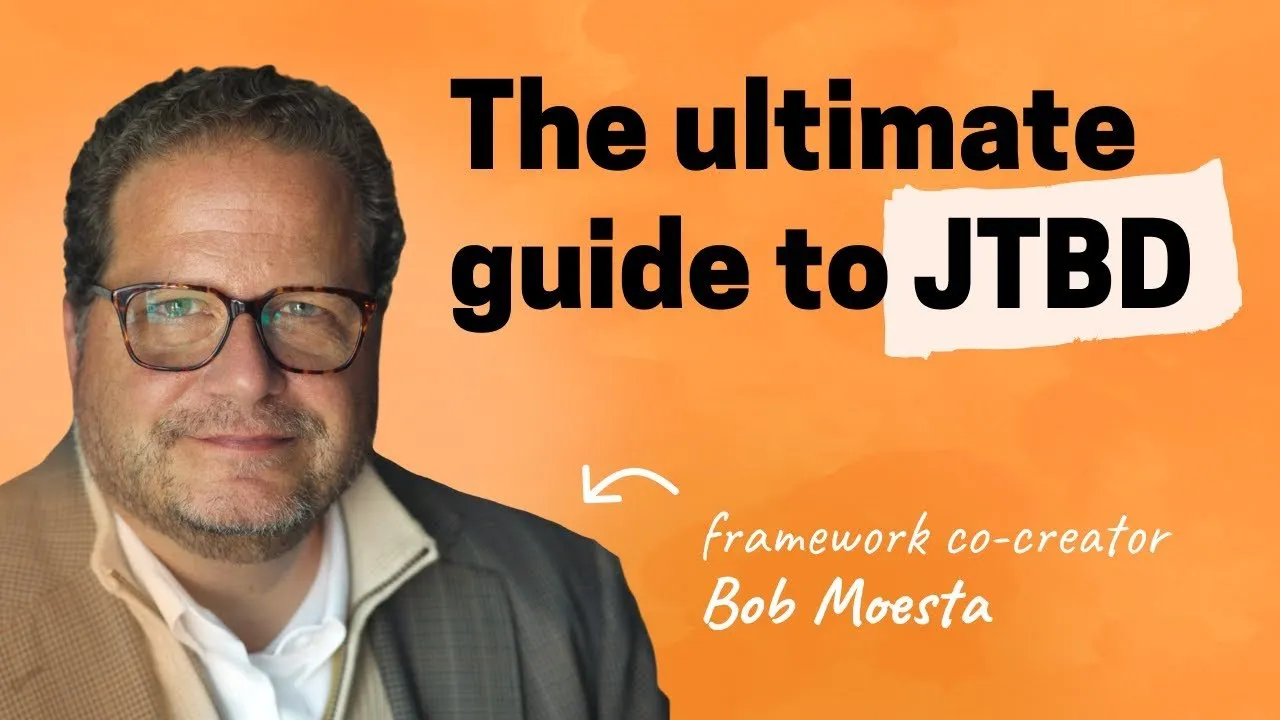
Bob Moesta, the co-creator of the Jobs to be Done (JTBD) framework alongside Clayton Christensen, argues that people don't buy products; they "hire" them to make progress in their lives. Understanding the causality behind why a customer switches from one solution to another requires shifting your perspective from the supply side (what you build) to the demand side (what the customer struggles with). This shift changes everything from your competitive analysis to your sales process.
Key Takeaways
- Context is greater than characteristics: A product’s features matter less than the specific context in which a user struggles. The same person may hire a Snickers bar for energy but a Milky Way for emotional comfort.
- The Four Forces of Progress: Moving a customer requires more than just a great new solution (Pull). You must also understand their current struggle (Push) and overcome their Anxiety about the new and their Habit of the old.
- Innovation starts with the "Struggling Moment": You cannot create demand; you can only channel it. Demand is generated when a consumer experiences friction or a struggle in their current reality.
- Sales is about helping people buy: Traditional sales funnels often fail because they focus on the seller's timeline. Effective sales processes align with the buyer's journey, helping them navigate trade-offs and decisions.
- Interrogate, don't interview: Standard customer interviews often yield surface-level data. To get to the real "job," you need to investigate the causal mechanisms behind a purchase like a detective.
Moving Beyond "Pain and Gain" to Context and Outcome
A common misconception about Jobs to be Done is that it is simply a framework for identifying customer "pains and gains." While useful, this view is incomplete. The framework is fundamentally about context and outcome.
When you strip away the context, consumer behavior often looks irrational. Why would someone pay more for a condo with a dining room they will never use? Why would a hungry person choose a protein shake one day and a candy bar the next? The context makes the irrational rational.
The Snickers vs. Milky Way Paradox
To understand how context defines the competitive set, look at the candy aisle. On the surface, a Snickers and a Milky Way are nearly identical commodities: chocolate, nougat, caramel. From a supply-side perspective, they compete against each other. From a demand-side perspective, however, they are hired for completely different jobs.
The Job of a Snickers:
- Context: You missed lunch, you have a deadline, and your stomach is growling.
- The Outcome: You need to keep working and stop the hunger pangs quickly.
- The Competition: It doesn't compete with other candy; it competes with a sandwich, a slice of pizza, or a protein bar.
The Job of a Milky Way:
- Context: You just finished a stressful meeting or an emotional event. You are likely alone.
- The Outcome: You need a moment of comfort and emotional reset.
- The Competition: It competes with a glass of wine, a brownie, or going for a run.
"Jobs helps you see the true competitive set from the demand side of the world as opposed to the competitive set from the supply side... it allows you to see what customers really want."
The Forces of Progress: Why People Switch
Customers don't switch products randomly. There is a complex system of forces at play that determines whether a user will move from their current solution (status quo) to a new solution (your product). Moesta illustrates this with four distinct forces:
- The Push (Force 1): The struggle in the current situation. If the user is perfectly happy with their current solution, no amount of marketing will move them. There must be a reason to leave.
- The Pull (Force 2): The attraction of the new solution. This is what most companies focus on—features, benefits, and the promise of a better life.
- Anxiety (Force 3): The fear of the new. "Will this work? Is it worth the money? What if I look stupid?" Anxiety acts as a brake on the purchase.
- Habit (Force 4): The inertia of the present. "I’m used to doing it this way. It’s not great, but I know how it works."
For a switch to occur, the sum of the Push and Pull must be greater than the sum of the Anxiety and Habit. If you only focus on adding features (increasing Pull) without addressing the Anxiety or reducing the friction of Habit, you will fail to convert the customer.
Reducing Friction Instead of Adding Features
Sometimes, innovation isn't about the product at all; it's about the onboarding. Moesta shared an example from his time building homes. He noticed that potential buyers of downsizing condos were cancelling contracts because they were overwhelmed by the logistics of moving from a large house to a smaller one.
Instead of adding granite countertops or lowering the price, he raised the price and included moving services and two years of storage. By removing the friction (Habit/Anxiety forces), sales increased by 30%. They didn't need a better house; they needed help with the transition.
Demand-Side Sales: Helping Customers Buy
Most sales processes are designed around how the company wants to sell: generate a lead, do a demo, close the deal. However, this often clashes with how people actually buy. Buyers go through specific cognitive phases:
- First Thought: Creating space in the brain for a new possibility.
- Passive Looking: Becoming problem-aware but not yet solution-aware.
- Active Looking: Framing the solution and narrowing down options.
- Deciding: Making trade-offs.
If a customer is in the "Passive Looking" phase, trying to "close" them is counterproductive. They aren't ready to decide; they are trying to understand the problem. Moesta worked with Autobooks to restructure their demos based on where the customer was in this timeline. By tailoring the conversation—one demo for storytelling/education, another for comparing alternatives, and a final one for decision-making—they significantly increased conversion rates while shortening the overall cycle.
"Instead of trying to base the sales process on how we want to sell, we need to design the sales process on how they want to buy."
The Art of the JTBD Interview
You cannot uncover these insights through surveys or focus groups. You must talk to people who have recently switched or made a purchase. However, simply asking "Why?" often leads to rationalized, logical answers that hide the emotional truth. To get to the real "job," you must interrogate the story.
Techniques for Uncovering the Struggle
Moesta recommends treating the interview like a documentary film or a criminal investigation. You are trying to reconstruct the timeline of events that led to the purchase.
- Focus on the "When," not the "Why": Ask "When was the first time you thought about buying this?" or "What happened that day?"
- Look for the Causality: People rarely buy because of a "deal." They buy because their old car had 200,000 miles, needed new brakes, and they had a long road trip coming up. The deal was just the catalyst.
- Beware of "Bitching": Users will often complain about a product but never leave. Moesta coins the phrase "Bitching ain't switching." If there is no behavioral change, the struggle isn't great enough to overcome the inertia of habit.
- The Dining Room Table Epiphany: In one famous case, Moesta found that families weren't buying new condos because they didn't know what to do with their old dining room tables. The table represented family history and emotion. The solution wasn't a bigger kitchen; it was creating a space—even a small one—where the table could fit, resolving the emotional anxiety.
Misconceptions and Applications
As the Jobs to be Done framework has gained popularity, misconceptions have proliferated. The most dangerous is the idea that you can brainstorm jobs in a conference room. You can't. You must extract them from the stories of real buyers.
0-to-1 vs. Established Products
Critics often argue that JTBD doesn't work for 0-to-1 products that don't exist yet. Moesta disagrees. Even for new innovations, the "job" already exists; users are just solving it poorly with a cobbling together of other solutions.
For example, before Uber, the job of "getting from point A to point B reliably without driving" was solved by taxis, calling a friend, or walking. By studying the struggles with existing solutions (taxis are unreliable, friends are inconvenient), you can identify the opening for a new product. There are very few truly "new" jobs, only new technologies to solve ancient human struggles.
When Not to Use JTBD
The framework has limits. It is less effective in environments where the user has no real choice, such as employer-provided health insurance. It also struggles with low-involvement, habitual purchases like chewing gum, where the decision-making process is so subconscious that users cannot recall the "struggling moment."
Conclusion
Ultimately, the Jobs to be Done framework is a tool for empathy. It forces product builders to stop looking at their creation and start looking at the person trying to use it. The struggling moment is the seed of all innovation.
Whether you are a founder, a product manager, or a marketer, your goal is not to convince people to want your product. Your goal is to find the people who are already struggling, understand the progress they are trying to make, and help them overcome the friction standing in their way.
"Struggling moments are the key... they are everywhere. And there's only certain context when all of a sudden we realize we have to do something about it... study struggling moments because at some point that's where we need the innovation the most."

)