Table of Contents
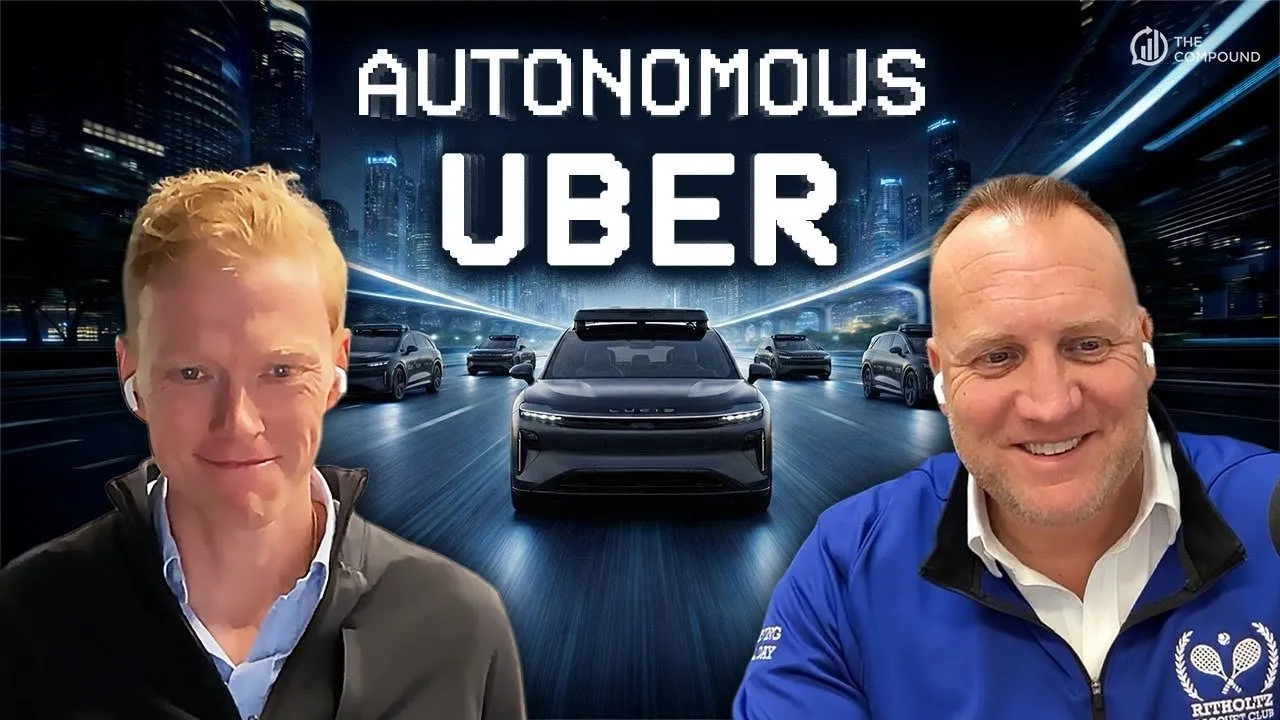
Uber currently stands at a fascinating intersection of record-breaking financial performance and existential technological change. While the company recently reported one of the best quarters in its history—surpassing 200 million monthly active users—investors remain fixated on a singular question: How will the autonomous driving revolution reshape the ride-hailing landscape? In a recent discussion with Josh Brown, Uber President and COO Andrew Macdonald (Mac) laid out a comprehensive strategy that challenges the prevailing bear narratives. Far from being disrupted by autonomous vehicles (AVs), Uber is positioning itself to be the critical infrastructure that allows the AV industry to scale.
Key Takeaways
- The "Aggregator" Strategy: Uber is betting that AV technology will be solved by multiple players, not a monopoly. By partnering with many OEMs (Original Equipment Manufacturers), Uber aims to be the neutral marketplace that aggregates demand for all of them.
- Utilization is King: The economic viability of expensive autonomous fleets relies on high utilization rates. Uber argues its massive network can generate 30% more efficiency for fleet owners than a standalone proprietary app.
- Operational Moat: Beyond software, AVs require physical depots, cleaning, charging, and customer support. Uber is building the physical and operational layer to manage these fleets, creating a barrier to entry for pure software companies.
- Asset-Light with Strategic Exceptions: While Uber remains committed to an asset-light model long-term, it is temporarily using its balance sheet to jumpstart the ecosystem, including putting branded Uber AVs (like Lucids) on the road.
- Global Growth: Contrary to saturation concerns, Uber views major markets like Japan, Germany, and Spain as early-stage opportunities, with AV partnerships already active in the Middle East and Asia.
The Financial Foundation: Growth at Scale
Before dissecting the future of autonomy, it is vital to understand the sheer scale of Uber's current leverage. The company has moved well past its era of "growth at all costs" to a period of disciplined profitability. Recent disclosures reveal a company hitting a $15 billion annual run rate in trips and seeing free cash flow rise significantly. Notably, the Uber One membership program has grown 55% year-over-year, creating a sticky ecosystem where members account for half of all gross bookings.
Macdonald pushes back strongly against the idea that Uber has saturated its market. While the brand is ubiquitous in top U.S. cities, the global picture tells a different story.
"In large markets where Uber is actually sort of a startup still... think about places like Germany, Spain, and Japan on the mobility side, Argentina... these are huge economies where Uber is just getting going."
This continued growth in the core human-driven business provides the cash flow and data necessary to fund the transition to autonomy without rushing it. Uber creates a massive demand funnel that new AV technologies will need to tap into to survive.
The Partnership Model: Why Uber Wins in an Open Market
The central debate in the autonomous vehicle space is whether the future will be vertical (e.g., Tesla or Waymo owning the car, the software, and the app) or horizontal. Uber is banking on the latter. Their thesis is that autonomous driving technology is rapidly becoming a commodity solved by many global players, including Waymo, Pony.ai, WeRide, and others.
The Economics of Utilization
The "bear case" for Uber suggests that once a company like Tesla or Waymo solves full self-driving, they will cut Uber out and launch their own app. Macdonald argues this ignores the fundamental economics of transport: utilization.
An autonomous vehicle is an expensive asset. If it sits idle, it loses money. A proprietary network (or "1P" network) creates a closed loop where demand is limited to that specific app's user base. In contrast, Uber aggregates demand across the entire market.
"If I have my own ride-hailing network... but I have another channel which is Uber which I can plug into instantly. And Uber's channel is 30% more efficient. My vehicles are going to run 30% more trips per hour. I am eventually going to also plug my vehicles into that channel."
The McDonald's Analogy
Uber views the future of AVs similarly to the restaurant delivery industry. McDonald's possesses immense brand power and operates its own delivery app. However, McDonald's is also available on Uber Eats, DoorDash, and other platforms. Why? Because the goal is to maximize the volume of product moving out of the store.
In the future, an AV operator will view their car as a "box" that needs to generate revenue. Restricting that car to a single app limits its potential revenue per hour. Therefore, even competitors are likely to eventually list their supply on Uber’s marketplace to access its 200 million monthly active users.
The Hidden Operational Moat
While Silicon Valley focuses on the software required to drive a car, Uber is focusing on the messy, physical reality of operating a robotic fleet. This is an area where Uber believes it has a significant, underappreciated advantage.
Launching an AV service isn't just about code; it involves:
- Real Estate: Securing depots to house and charge hundreds of vehicles in dense urban centers.
- Maintenance: Cleaning, repairing, and servicing vehicles daily.
- Customer Support: Handling lost items, payment disputes, and emergency routing.
- Hybrid Dispatching: Seamlessly dispatching a human driver when an AV cannot handle a specific route or weather condition.
Uber is already managing these logistics for partners. By taking on the heavy lifting of fleet operations, Uber allows tech companies to focus on their core competency—building the driver—while Uber handles the business of moving people.
Strategic Asset Investment and Brand Visibility
Historically, investors have loved Uber for its "asset-light" model—it didn't own the cars. However, as the industry transitions, Uber is willing to use its balance sheet to accelerate AV adoption. This includes strategic partnerships with OEMs like Lucid and delivery bot manufacturers like Avride.
For the first time, consumers will see vehicles on the road that are co-branded or heavily branded with the Uber logo. This serves two purposes:
- Supply Chain Confidence: By guaranteeing demand and helping finance vehicles, Uber gives manufacturers the confidence to mass-produce AVs.
- Consumer Conditioning: Branded vehicles help normalize the experience of ordering a robot taxi through the Uber app.
"10 years from now I don't want to be sitting here as the largest owner of autonomous vehicles in the world... But in the short term, we're going to do whatever it takes to make sure that we lead in that end state."
This pragmatic approach allows Uber to seed the market without permanently weighing down its balance sheet with depreciating assets. The end goal remains a financialized model where fleets are owned by third-party investors or REIT-like structures, managed by Uber's logistics layer.
Conclusion: Expanding the Category
Perhaps the most optimistic aspect of Uber’s outlook is the belief that autonomous vehicles are not a zero-sum game. The data from early deployments in cities like Phoenix and San Francisco suggests that AVs are expanding the total addressable market (TAM).
As the cost of reliable transport drops and safety increases, consumer behavior shifts away from personal car ownership toward "mobility as a service." By positioning itself as the universal interface for this service—whether the vehicle is human-driven, autonomous, or a delivery bot—Uber intends to capture the value of this category expansion.
While critics worry about disintermediation, Uber’s strategy relies on a simple truth: in a fragmented world of many hardware providers, the winner is the network that offers the consumer the fastest pickup, the lowest price, and the most reliable service. Uber is betting everything that its network effects are strong enough to make it the indispensable partner for the autonomous age.