Table of Contents
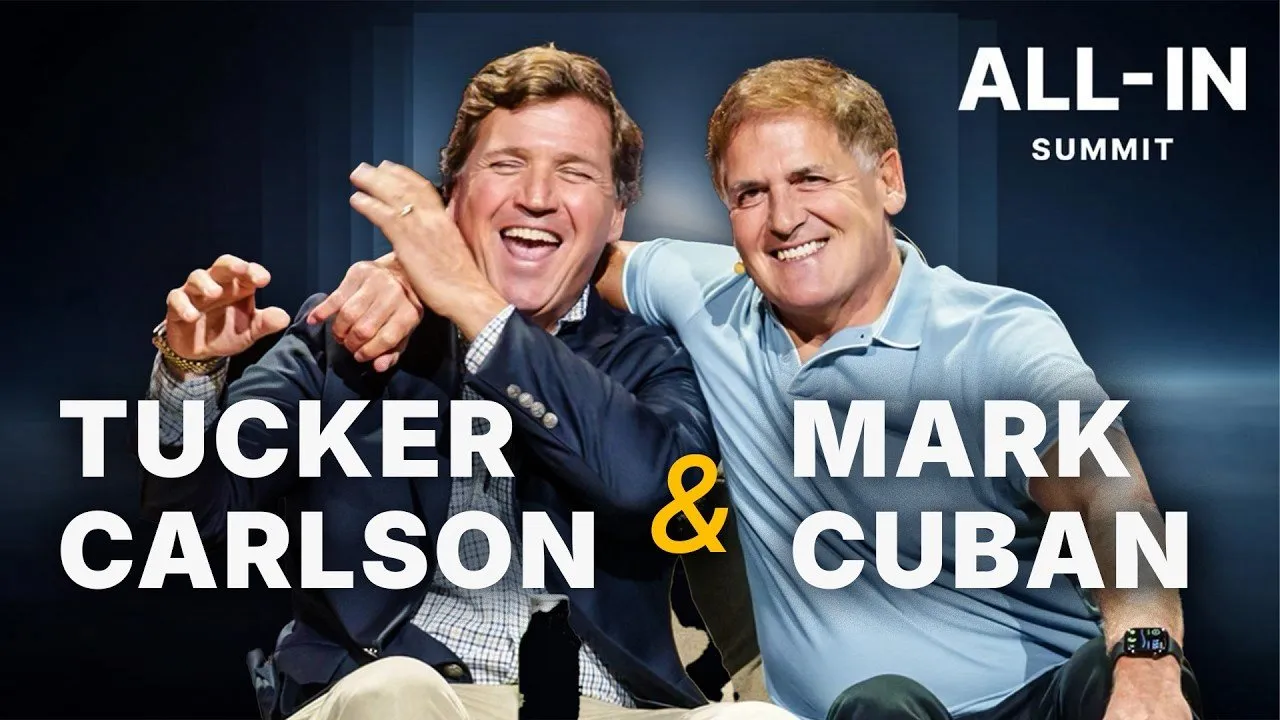
The 2025 All-In Summit brought together two of the most distinct voices in American public life: billionaire entrepreneur Mark Cuban and media personality Tucker Carlson. What began as a deep dive into healthcare disruption evolved into a spirited debate on the future of the American workforce, the ethics of foreign intervention, and the spiritual health of Western civilization. While Cuban focused on market-driven solutions to systemic inefficiencies, Carlson steered the conversation toward the philosophical and demographic crises facing the nation.
Key Takeaways
- The PBM Monopoly: Mark Cuban argues that "vertical integration" among Pharmacy Benefit Managers is the root cause of inflated US healthcare costs.
- Economic Populism: Both speakers agree that the housing crisis and stagnant wages are fueling a necessary rise in economic populism, though they differ on the solutions.
- The AI Disruption: A consensus emerged that Artificial Intelligence may threaten the "striving class" (lawyers and white-collar workers) more immediately than manual laborers.
- Demographic Collapse: Carlson argues that declining birth rates and assisted suicide programs signal a "civilizational suicide" in the West.
- Foreign Policy Clash: A tense exchange highlighted the divide between supporting allies like Ukraine versus prioritizing domestic economic stability.
Disrupting the Healthcare Monopoly
Mark Cuban opened the session by dissecting the opaque world of pharmaceutical pricing. His venture, Cost Plus Drugs, aims to dismantle the current system by bypassing the "middlemen" known as Pharmacy Benefit Managers (PBMs). Cuban posits that the healthcare industry is broken not because of a lack of medical innovation, but because of a deliberate lack of financial transparency.
The "Original Sin" of Healthcare
Cuban identified the consolidation of insurance companies and PBMs as the primary driver of cost. These vertically integrated giants control both the patient flow and the drug flow, allowing them to obscure true prices and maximize profits at the expense of the consumer.
"Trust is actually a formula in my mind. Trust equals transparency divided by self-interest."
By publishing his prices openly and capping markups at 15%, Cuban believes he can force the market to correct. He noted that while manufacturers are often willing to work with him, they are frequently threatened by major PBMs with removal from formularies—a practice he explicitly labeled as an antitrust violation.
The Pending Tax Cliff
Beyond the business of drugs, Cuban warned of a looming crisis for the middle class involving the Affordable Care Act (ACA). With enhanced subsidy credits set to expire, he highlighted that millions of Americans could see their premiums triple. He criticized both political parties for failing to address what effectively amounts to a massive tax increase on families earning between $100,000 and $150,000, arguing that the political class is too distracted by identity politics to solve basic economic math.
The Rise of Economic Populism
When Tucker Carlson joined the stage, the conversation shifted from mechanics to ideology. Despite their political differences, both men found common ground on the economic struggles of the average American. They agreed that the inability of the working class to afford housing is a fundamental failure of the current system.
Housing and Autonomy
For Carlson, the housing crisis is not merely a financial statistic but a barrier to human autonomy. He argued that when citizens cannot own property, they lose their stake in society, leading to delayed family formation and social instability.
"Where you live is one of the central questions of your life. I don't think it's actually about housing. It's about autonomy."
The Wage Gap and Inflation
The dialogue touched on the root causes of economic disparity. Cuban emphasized the need to support small businesses and entrepreneurs, suggesting that heavy-handed tariffs and regulations crush the "solopreneurs" who drive job creation. Carlson, conversely, pointed to federal spending and the devaluation of the dollar as the primary culprits, suggesting that printing money to fund efficient programs has eroded the savings of the working class.
The Geopolitical Divide: Ukraine and Intervention
The most contentious moment of the panel arose over foreign policy. While Cuban expressed a general sentiment that the United States should support Ukraine based on his heritage and democratic principles, Carlson challenged the premise of interventionism entirely.
Carlson pushed for a clear definition of the "goal" in any foreign conflict. He argued that without a defined objective, sending billions abroad while domestic infrastructure and healthcare crumble is a dereliction of duty. This exchange highlighted a broader fissure in American politics: the tension between maintaining global hegemony and embracing an "America First" isolationism.
The AI Revolution: White Collar vs. Blue Collar
Shifting to the future of work, the panel debated the impact of Artificial Intelligence. Contrary to the popular belief that automation will first displace factory workers, the speakers suggested that the "laptop class" is most at risk.
The Revolt of the Striving Class
Carlson offered a grim prediction regarding the displacement of lawyers, administrators, and mid-level corporate employees. He argued that while society might ignore the plight of displaced factory workers, displacing the educated, articulate, and entitled "striving class" is historically the catalyst for revolution.
Cuban’s Optimism
Cuban offered a more techno-optimistic view, suggesting that while Large Language Models (LLMs) will commoditize text-based work, there is a massive opportunity for small businesses to leverage these tools for efficiency. He also noted that robotics lags behind LLMs, meaning physical jobs—electricians, plumbers, and tradespeople—are safe for the foreseeable future due to the complexity of navigating the physical world.
Demographics, Mental Health, and the Crisis of the West
In a solo segment following the debate, Carlson pivoted to a critique of Western culture, focusing on what he perceives as a spiritual and demographic collapse.
The Population Collapse
Carlson argued that the most significant story in the West is not politics, but the refusal of populations to reproduce. He cited plummeting birth rates in secular nations as evidence of a deep-seated pessimism and a "war with nature." He contrasted this with the vitality of the Global South and religious communities, suggesting that a society that requires government incentives to have children is already in terminal decline.
The Over-Medication of Society
Linking mental health to spiritual health, Carlson launched a scathing critique of the widespread use of SSRIs (antidepressants). He argued that these drugs, rather than curing chemical imbalances, often limit emotional range and detach individuals from the human experience.
"Emotional range is your soul. You feel sad when someone dies. You feel joyful when something great happens. That's what it is to be alive."
He connected this emotional numbing to a broader societal apathy, where populations accept government-sponsored assisted suicide programs (such as Canada’s MAID program) and ignore rising ethnic tensions and violence.
Conclusion
The discussion between Mark Cuban and Tucker Carlson illustrated the bifurcated state of American discourse. Cuban represents the pragmatic, technocratic approach: fix the incentives, increase transparency, and unleash entrepreneurship to solve the nation's ills. Carlson represents the metaphysical critique: the belief that better policies mean nothing if the civilization has lost its will to live, reproduce, and maintain its spiritual core.
While they diverge on the "why" and the "how," their agreement on the "what"—specifically the unsustainable cost of living and the corruption of entrenched institutions—signals that economic populism will remain the dominant force in American politics for years to come.