
Table of Contents
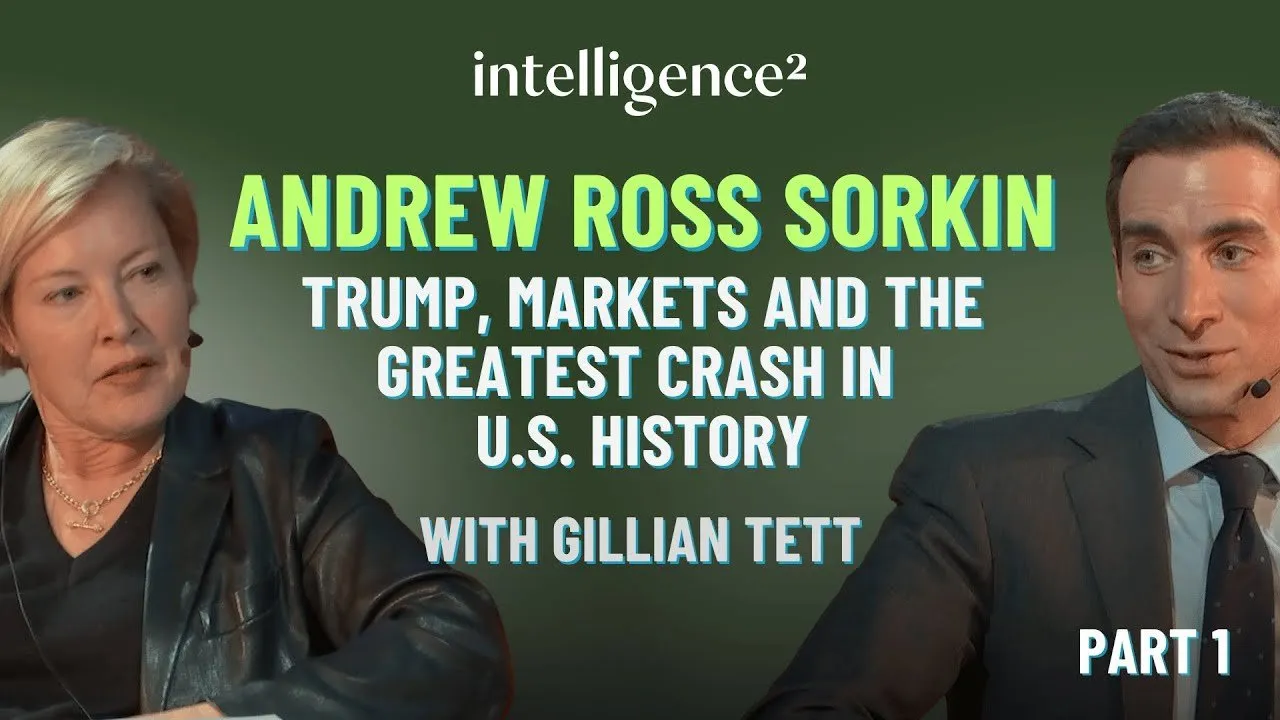
Financial markets today mirror the euphoric speculation that preceded the 1929 crash in unsettling ways. From AI-fueled bubbles to private credit booms, the parallels between our current moment and the Roaring Twenties are striking. Andrew Ross Sorkin, the CNBC anchor and bestselling author, spent eight years secretly researching his new book about the 1929 crash, uncovering never-before-disclosed Federal Reserve documents and piecing together archives from dozens of institutions to tell the complete story of how a market crash became the Great Depression.
Key Takeaways
- The 1929 crash was just the first domino—policy mistakes after the crash created the Great Depression, not the crash itself
- Modern debt-fueled speculation eerily parallels the 1920s, when consumer credit was first introduced and margin trading exploded
- Today's private credit markets may hide leverage risks similar to the margin loans that amplified 1929's damage
- While central banks can now print money to prevent depression-style collapses, unprecedented debt levels create new vulnerabilities
- Professional pessimists consistently lose money during bubbles—being right too early is still being wrong
The Eight-Year Detective Story Behind the Book
Sorkin's journey to write about 1929 began with a frustrating admission: despite writing the definitive account of the 2008 financial crisis in "Too Big to Fail," he couldn't properly compare it to 1929 because no one had written the kind of character-driven, fly-on-the-wall narrative he craved.
Discovering Hidden Archives
The breakthrough came during a Harvard lecture when Sorkin stumbled upon the archives of Thomas Lamont, who ran JP Morgan in 1929. Opening the first box, he found transcripts of Lamont's phone calls with Presidents Hoover and Roosevelt. When he asked the archivist about writing a comprehensive account, she delivered a crushing verdict: "You can't write that book."
"She said, 'You're never going to be able to write this book.' And that actually was probably why I wrote it."
The archivist proved partially correct. The material Sorkin needed was scattered across 30 to 40 different archives worldwide. He hired students in multiple locations, flew around the country hunting documents, and even convinced the New York Federal Reserve to release board minutes from 1929—the first time they'd ever disclosed such records.
The Challenge of Missing Records
The book's central character, Charlie Mitchell—nicknamed "Sunshine Charlie"—essentially invented modern consumer credit in America while running National City Bank (now Citibank). Yet Mitchell kept no personal notes or correspondence. Citigroup's own archives contained nothing from their former leader.
Sorkin used Fed meeting minutes as a treasure map, tracking Mitchell's movements and identifying his contacts, then hunting down their archives. Sometimes this detective work led to magical discoveries that energized him for weeks. Other times, dead ends left him deeply discouraged.
The Roaring Twenties: Technology, Credit, and Euphoria
The 1920s represented a perfect storm of technological revolution, financial innovation, and speculative mania that bears remarkable similarities to today's markets.
The Birth of Consumer Credit
Before 1919, taking loans was considered morally sinful in America—something proper people simply didn't do. This changed when John Raskob at General Motors realized he could sell more cars by lending customers money for purchases. Sears Roebuck followed with appliance financing.
Charlie Mitchell recognized the broader opportunity. Brokerage houses began appearing on street corners like Starbucks, allowing ordinary Americans to put down one dollar and borrow ten more to buy stocks. For the first time in American history, speculation was powered by massive debt.
Technology Fever and Market Mania
The 1920s witnessed genuine technological breakthroughs that justified investor excitement. Automobiles, telecommunications, and radio transformed the economy. RCA, trading under the ticker symbol "Radio," became the Nvidia of its era—a meme stock everyone wanted to own.
This technological euphoria created dangerous overconfidence. Anyone questioning market valuations was dismissed as old-fashioned or unpatriotic. Fear of missing out drove ordinary Americans into markets for the first time, armed with unprecedented leverage.
The Crash That Wasn't—Until It Was
Popular memory simplifies the 1929 crash into a single catastrophic day, but the reality was far more complex and prolonged.
Multiple Black Days
The market didn't collapse overnight. From mid-October through November 13th, stocks fell approximately 50% from their peak. Yet by year-end 1929, the market was down only 17% for the year—hardly the stuff of legend.
The true devastation came from leverage. Ordinary investors who had borrowed ten dollars for every one they invested didn't just lose their stock investments when markets fell 50%—they owed ten times their losses. Families lost homes as they scrambled to meet margin calls.
The Cassandra Problem
Several prescient observers issued warnings before the crash. Charles Merrill, founder of Merrill Lynch, told clients to exit markets in early 1928, predicting a great crash. He was right—eventually. But from early 1928 to September 1929, stocks soared another 90%.
"Here's the problem with being the Cassandra... if you're managing money and you keep coming up short against the index, you don't survive."
This dynamic persists today. Paul Tudor Jones recently told Sorkin we're in the equivalent of October 1999—but noted that stocks rose 40% from there before crashing. Over the past century, professional optimists have consistently outperformed professional pessimists.
How a Crash Became a Depression
The market crash of 1929 was merely the first domino in a cascade of policy failures that created the Great Depression. Understanding these mistakes reveals why modern economists believe they could prevent a similar catastrophe.
Herbert Hoover's Fatal Errors
President Hoover, who took office just months before the crash, made a series of devastating policy choices. He raised taxes during the economic downturn, pressured companies to maintain wages they couldn't afford, and implemented the Smoot-Hawley tariffs in 1930.
The tariff decision proved particularly destructive. Despite economists writing full-page newspaper letters begging him to reconsider, Hoover felt obligated to fulfill campaign promises to farmers. Global trade collapsed 60% within twelve months.
Federal Reserve Paralysis
The Fed sat on its hands for two critical reasons revealed in board members' diaries. First, they feared political backlash if they raised interest rates too aggressively before the crash, worrying that blame for any resulting recession would lead to the Federal Reserve's abolition—the central bank was still called "the experiment" sixteen years after its creation.
After the crash, the gold standard severely constrained their ability to flood the system with money. This policy straitjacket prevented the aggressive monetary response that Ben Bernanke would later deploy in 2008, having studied these exact mistakes.
Systemic Collapse
By 1932, unemployment reached 25%. Tent camps appeared in Central Park across from where banking elites lived. Nearly 9,000 banks failed as confidence evaporated from the system. Animal spirits imploded, investment ceased, and a vicious cycle of deflation and despair took hold.
Glass-Steagall: A Corrupt Solution
The famous Glass-Steagall Act, which separated commercial and investment banking, emerged four years after the crash began. Often cited today as progressive regulatory reform, the bill's true origins reveal a murkier reality.
The Elizabeth Warren of His Time
Senator Carter Glass of Virginia—whom Sorkin describes as "a racist Elizabeth Warren"—had long railed against what he called "Mitchellism," the speculative fever created by Charlie Mitchell. Glass wanted to break up the banks and separate casino-style investment banking from retail commercial banking.
However, the final bill bore little resemblance to Glass's vision. Parts were actually written by a banker, against Glass's wishes. The senator wrote bitter letters to friends complaining about how Roosevelt was being manipulated by Rockefeller interests seeking to damage JP Morgan.
"When you get underneath this story, it is almost shocking to me how corrupt that bill really is."
This revelation challenges the common perception of Glass-Steagall as pure progressive reform, revealing instead a web of banking rivalries and political maneuvering.
Today's Hidden Leverage: The Private Credit Time Bomb
While central banks' ability to print money provides crucial protection against 1930s-style depressions, new vulnerabilities have emerged in unexpected places.
The Migration to Private Markets
After 2008, regulators cracked down hard on traditional banks, forcing risk-taking into less regulated private credit markets. This migration created a shadow banking system that now funds much of the AI boom and related infrastructure investments.
The problem is opacity. Unlike public markets where prices are visible and crashes create immediate panic that forces clearing, private credit markets can hide problems for extended periods. Fund managers don't have to mark assets to market daily, allowing them to maintain fiction about valuations even as underlying conditions deteriorate.
The Pop Versus Hiss Dilemma
This opacity creates two potential crisis scenarios. A sudden "pop" would resemble a heart attack—painful but potentially clearing out excess quickly. A slow "hiss" would be more like cancer, creating zombie institutions and persistent uncertainty about true values, potentially leading to Japan-style stagnation.
The interconnectedness between private credit funds and traditional banks remains unclear. Many banks provide leverage and liquidity facilities to these funds, meaning problems could spread rapidly through the financial system when everyone tries to exit simultaneously.
Lessons for Today's Markets
Current market conditions display numerous parallels to 1929, from technological euphoria around AI to the explosion of leverage in private markets. However, key differences suggest outcomes may vary significantly.
Policy Tools and Political Will
Modern central banks possess tools their 1929 predecessors lacked. The ability to print money and provide unlimited liquidity prevents the banking system collapses that devastated the 1930s. Remarkably, when COVID-19 struck, there were no recriminations about massive government spending—people simply wanted more money.
This suggests political resistance to aggressive intervention may be lower than many assume, at least during acute crises.
The Debt Ceiling Problem
One major uncertainty involves America's unprecedented debt levels. In 1929, the federal government ran a budget surplus, providing ample fiscal space for stimulus. Today's massive deficits raise questions about whether bond markets would accept unlimited money printing during a crisis, potentially forcing higher interest rates that could worsen any downturn.
As Sorkin notes, we don't know if there's a point where investors would demand significantly higher rates to continue lending to heavily indebted governments, potentially constraining policy responses.
Conclusion
The story of 1929 offers both warnings and reassurance for today's investors and policymakers. While crashes seem inevitable given current market euphoria and hidden leverage, the policy mistakes that transformed a market crash into the Great Depression are well-documented and theoretically avoidable.
The key insight from Sorkin's research is that the crash itself wasn't the problem—it was the cascade of policy errors that followed. Modern central bankers and politicians have studied these mistakes extensively, though whether they'll have the tools and political will to respond effectively when crisis strikes remains an open question.
Perhaps most importantly, the parallel between 1920s speculation and today's AI bubble suggests that some degree of market correction is likely inevitable. The challenge for investors and policymakers alike will be managing the aftermath to prevent a crash from becoming something much worse.
![Bitcoin Is on Sale [How to Buy It in 2026]](/content/images/size/w1304/format/webp/2026/03/how-to-buy-bitcoin-2026.jpg)


)