Table of Contents
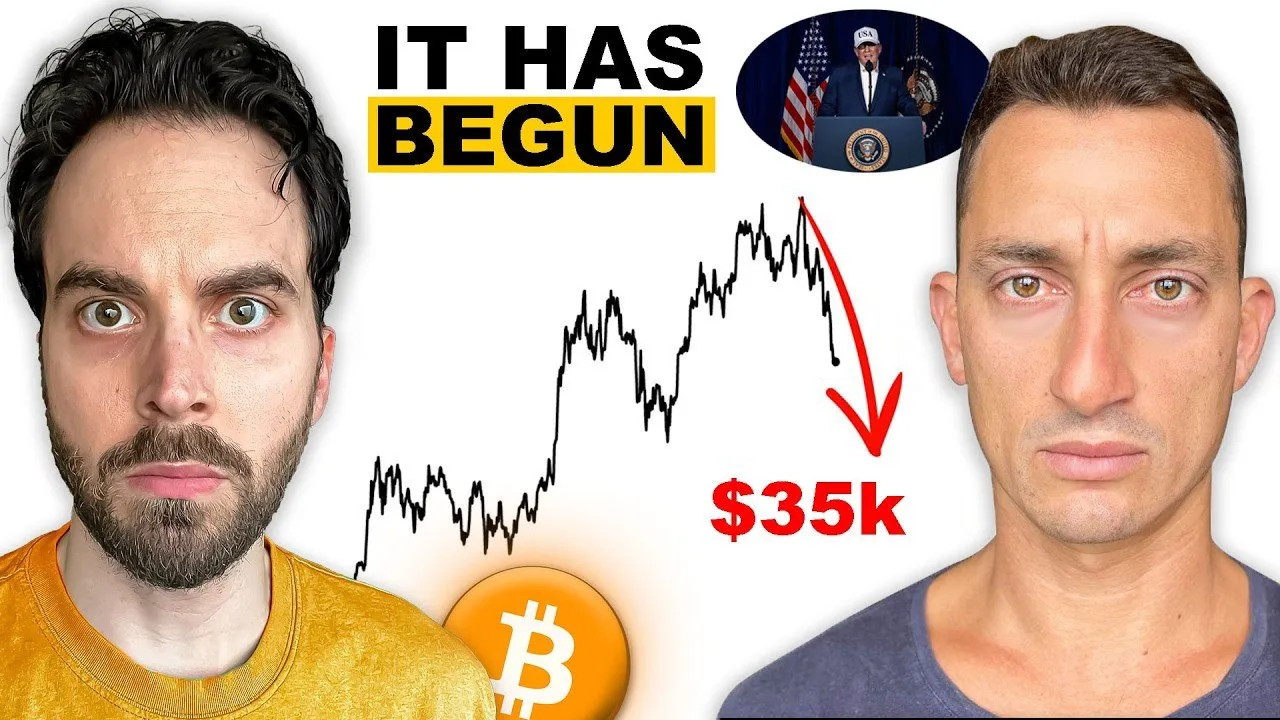
The cryptocurrency market faced a significant "flash crash" following reports of United States military operations in Iran, sending Bitcoin prices tumbling and triggering a wave of liquidations. Veteran trader Jason Pizzino, an 18-year veteran of the financial markets, warns that while geopolitical catalysts often spark immediate volatility, the underlying technical indicators suggest a deeper structural shift toward a prolonged bearish phase. As the market enters the U.S. summer months, investors are bracing for a period of "time decay" where sideways price action may prove more punishing than the initial crash.
Key Points
- Geopolitical Volatility: Recent military actions in Iran acted as a catalyst for a Bitcoin flash crash, exposing underlying weakness in the market's momentum.
- The 18-Year Cycle: Analysis of long-term U.S. real estate and land value cycles suggests a major economic peak in 2026, which could suppress speculative assets like Bitcoin for several years.
- Critical Indicators: Traders are monitoring USDT Dominance and the Fear & Greed Index for signs of a market bottom, noting that "time doldrums" often precede a true recovery.
- Worst-Case Scenario: A failure to hold the $30,000 support level could lead to a decline toward the $15,000 range, potentially invalidating the "up-only" institutional narrative.
- Institutional Divergence: Despite the launch of Spot Bitcoin ETFs and increased corporate adoption, Bitcoin remains below key technical resistance levels at $69,000 and $75,000.
Technical Weakness and the "Relief Rally" Failure
According to Pizzino, the current market structure reveals a loss of momentum that began well before the recent geopolitical headlines. Following the $20 billion flush out earlier in the cycle, Bitcoin attempted several relief rallies that failed to achieve follow-through. This pattern of "distribution" at the highs—where large holders sell into retail demand—suggests that the market has transitioned from a bullish environment to a macro bearish phase.
One of the primary metrics used to track this shift is USDT Dominance. When this percentage rises, it indicates that investors are moving out of volatile assets and into stablecoins, anticipating lower prices. Pizzino notes that the failure of USDT Dominance to break below the 3.7% level was a definitive signal that the bull run had stalled. Furthermore, the Fear & Greed Index has remained stuck in "extreme fear," but Pizzino argues that price doesn't necessarily need to crash further for a bottom to form; instead, the market may simply exhaust sellers through months of boring, sideways movement.
"The weakness began to form as it always does near the highs and of course sentiment continued to lag. We've gone longer term here... the midterm years do look like they take their time. The market's trying to digest what's going on."
The 18-Year Economic Cycle and Real Estate
A central pillar of the current bearish thesis is the 18-year cycle, a theory based on two centuries of U.S. real estate and land price data. This cycle typically consists of 14 years of expansion followed by a four-year contraction. With a projected peak in 2026, Pizzino warns that Bitcoin, which has never experienced a major multi-year collapse in traditional business cycles or land prices, may face unprecedented headwinds.
The concern for investors is that the "new echelon" of buyers—including pension funds, ETFs, and treasury companies—may have already completed their initial allocations. If the broader economy enters a period of contraction, the liquidity required to push Bitcoin toward the $150,000 or $500,000 targets may vanish as capital seeks the safety of bonds or cash.
"If this starts to turn down later this decade, it's going to be pretty hard-pressed to find any of that liquidity to come back into a speculative asset like Bitcoin to pump this price back up... everyone that's wanted to buy may have already bought."
Institutional Optimism vs. Technical Reality
While technical analysts highlight the risk of a breakdown to $30,000, fundamental bulls point to the "AI trade" and the Clarity Act as potential saviors. The integration of Bitcoin into financial products like mortgages and the emergence of digital credit models, such as those proposed by MicroStrategy's Michael Saylor, represent "pockets of capital" that did not exist in previous cycles. However, Pizzino counters that markets are forward-looking; often, the price "prices in" these developments long before they are officially implemented.
The divergence between Nvidia’s recent earnings—which beat expectations but were followed by a price dump—and Bitcoin's current struggle serves as a warning. Even the most bullish news can fail to move the needle if the market is overextended. For long-term investors, the focus is shifting toward capital preservation. Pizzino reveals that his personal long-term strategy involves land ownership as a hedge against government overreach and bank instability, while treating Bitcoin as a tactical trading instrument.
"If I see the low come in that I'm looking for, I would still look to put money into it to then ride this thing up in case I'm wrong. So that's how you can be wrong but still make money."
As the market moves into the second half of the year, the primary objective for traders is to identify a higher low in sentiment. If Bitcoin can establish a stable floor while the S&P 500 or NASDAQ continue to struggle, it may signal that the "digital gold" narrative is finally decoupling from traditional risk assets. Until then, the path of least resistance appears to be a "sideways grind" that will test the patience of even the most committed holders.