Table of Contents
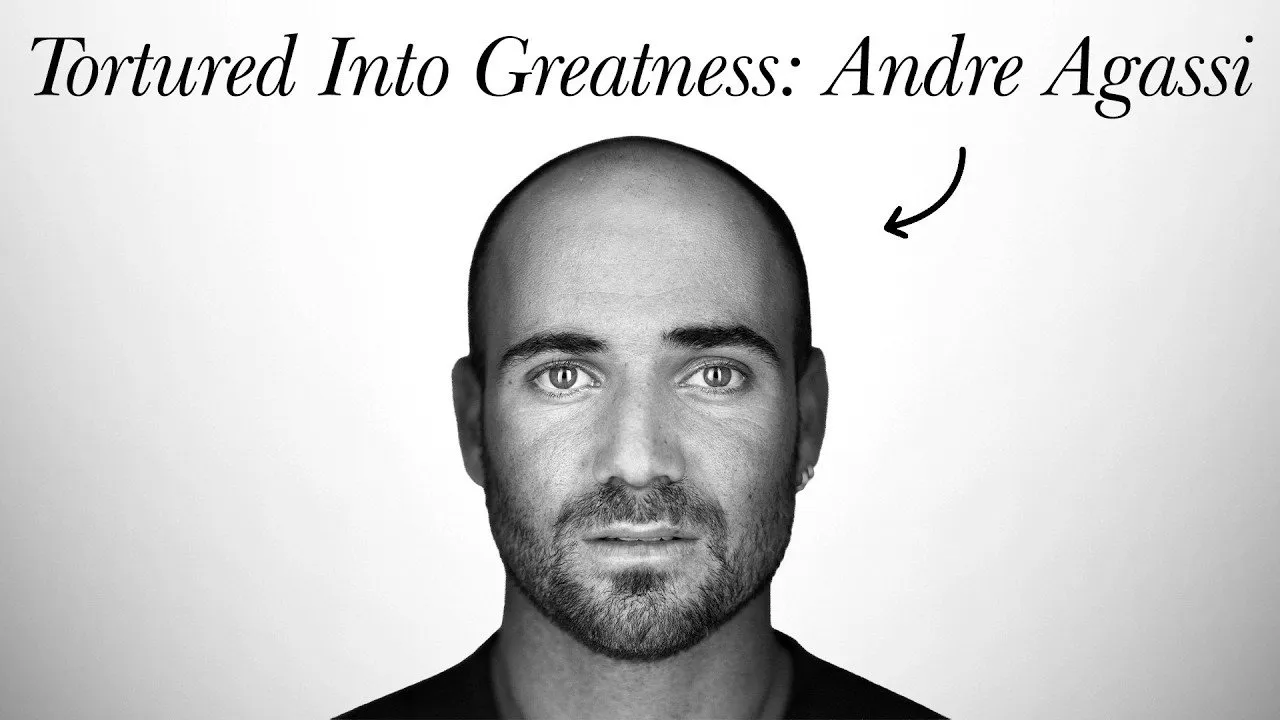
At thirty-six years old, Andre Agassi wakes up on the floor of a hotel room, his body so ravaged by decades of professional tennis that he has to slide to his knees just to stand. He is in New York for the 2006 US Open, his final tournament. As his identity clicks into place—father, husband, legend—a dark, secret truth whispers in his mind: he hates tennis. He hates it with a dark and secret passion, and he always has.
Open, Agassi’s autobiography, is more than a sports memoir; it is a harrowing psychological study of a man tortured into greatness. It explores the paradox of reaching the pinnacle of success in a field you despise and the arduous journey of dismantling a life built by others to reconstruct one of your own making. It is a story of trauma, rebellion, rock bottom, and ultimately, redemption.
Key Takeaways
- Greatness can be forced, but fulfillment cannot: Agassi was engineered by his father to be a champion through fear and repetition, proving that high performance does not equate to happiness.
- Perfectionism is a liability: The turning point in Agassi's career came when he stopped trying to hit the perfect shot and learned to simply be better than the person on the other side of the net.
- The danger of isolation: Tennis is described as "solitary confinement," and Agassi's darkest moments occurred when he internalized his struggles rather than leaning on his support system.
- Rock bottom provides a foundation: Agassi’s fall to world ranking #141 and his struggle with crystal meth became the necessary catalyst to rebuild his career on his own terms.
- Service creates meaning: Agassi found that the only time the emptiness subsided was not when he won trophies, but when he used his resources to help others.
The Architecture of a Tortured Genius
To understand Agassi, one must understand his father, Mike Agassi. An Olympian boxer with a violent temper, Mike decided long before Andre was born that his son would be the number one tennis player in the world. For the young Agassi, the tennis court was not a playground; it was a prison.
The Math of Excellence
Agassi’s childhood was defined by the relentless rhythm of a ball machine his father built, nicknamed "The Dragon." His father believed in the brute force of mathematics over talent. He calculated that if Andre hit 2,500 balls a day, that would equal 17,500 balls a week, and nearly one million balls a year. A child who hit one million balls a year, he reasoned, would be unbeatable.
This was not coaching; it was conditioning born of fear. Agassi recounts moments of extreme volatility, such as his father brandishing a gun at other drivers or carrying an axe handle in his car. The message was clear: obey or suffer the consequences. Even when Agassi won his first seven tournaments as a child, his father’s reaction was mute indifference. It was simply what was expected.
I hate tennis. I hate it with all my heart. And I still keep playing, keep hitting all morning and all afternoon because I have no choice. No matter how much I want to stop, I don't. I keep begging myself to stop and I keep playing. And this gap, this contradiction between what I want to do and what I actually do feels like the core of my life.
Internalizing the Tyrant
By the time Agassi was a teenager, he no longer needed his father to scream at him. He had internalized that voice. The impatience, the rage, and the demand for perfection became his own inner monologue. This created a fractured psyche where he was simultaneously the oppressor and the oppressed.
He rebelled in the only ways available to him—mohawks, denim shorts, earrings, and an attitude that shocked the conservative tennis world. Yet, this rebellion was merely cosmetic. Deep down, he was still the obedient child hitting balls to avoid punishment, driven by a fear of failure that outweighed any joy of winning.
The Hollow Victory and the inevitable Fall
The tragedy of Agassi’s early career was not that he failed, but that he succeeded. He won Wimbledon. He reached the number one ranking in the world. He achieved everything his father had demanded, and the result was a profound sense of emptiness.
When he finally knocked Pete Sampras off the mountaintop to take the top spot, he expected euphoria. Instead, he felt nothing. He realized that the goals he had chased were never his own. This existential vacuum led to a catastrophic decline.
Descent into Darkness
The years following his ascent were marked by a loss of motivation, physical injuries, and a spiral into depression. This culminated in 1997, a year that saw Agassi’s ranking plummet to #141. In a shocking admission, Agassi reveals that during this period, he used crystal meth to escape his reality.
He describes the drug use not as a party habit, but as a symptom of a life he desperately wanted to exit. He was trapped in a celebrity marriage to Brooke Shields that he knew was wrong, living a life that felt like a performance. At his wedding, he watched a "decoy bride" leave the church to distract the paparazzi and wished he had a "decoy groom" to take his place.
Rock bottom can be very cozy because at least you're at rest. You know, you're not going anywhere for a while.
Redemption and the Art of "Winning Ugly"
The turning point came when Agassi faced a binary choice: retire in disgrace or rebuild from scratch. He chose the latter, embarking on a humiliating tour of "Challenger" tournaments—lower-tier events usually reserved for up-and-comers, not former Grand Slam champions.
Crucial to this comeback was the introduction of Brad Gilbert as his coach. Gilbert, known for his scrappy style, identified Agassi’s fatal flaw: perfectionism. Agassi was trying to hit a winner on every shot, a high-risk strategy driven by his need to prove his worthiness.
The Probability of Success
Gilbert introduced a philosophy that revolutionized Agassi’s game. He argued that you don't need to be perfect; you just need to be better than one person—the guy across the net. He urged Agassi to stop chasing the impossible shot and instead rely on his high-percentage conditioning.
When you chase perfection, when you make perfection the ultimate goal, do you know what you're doing? You're chasing something that doesn't exist. You're making yourself miserable... You don't have to be the best in the world every time you go out there. You just have to be better than one guy.
This advice liberated Agassi. By letting go of the need to be perfect, he regained his confidence. He realized that "winning ugly" was still winning.
Finding Purpose Beyond the Court
As Agassi climbed back up the rankings, eventually returning to number one and completing a Career Grand Slam at the French Open, his motivation shifted. He was no longer playing out of fear of his father, nor for the hollow applause of the crowd.
He began to find solace in the team around him—his trainer Gil Reyes, his coach Brad Gilbert, and his spiritual advisor JP. He realized that while tennis was a lonely sport, his life didn't have to be lonely. Furthermore, he discovered that helping others provided the satisfaction that winning never did.
Whether it was setting up a college fund for a restaurant manager’s children or building a charter school for at-risk youth in Las Vegas, Agassi found that service was the "only perfection there is." This shift in perspective allowed him to tolerate the sport he hated because it became a vehicle for the life he wanted to build.
Conclusion
Andre Agassi’s story is a testament to the resilience of the human spirit. It serves as a stark reminder that external success—money, fame, rankings—does not cure internal trauma. However, his journey also offers a roadmap for redemption.
By accepting his flaws, dismantling his perfectionism, and surrounding himself with people who loved him for who he was rather than what he could do, Agassi transformed his life. He masterfully pivoted from a "tortured genius" to a man who, while he may never have loved tennis, learned to respect it as the tool that allowed him to master his own fate.