Table of Contents
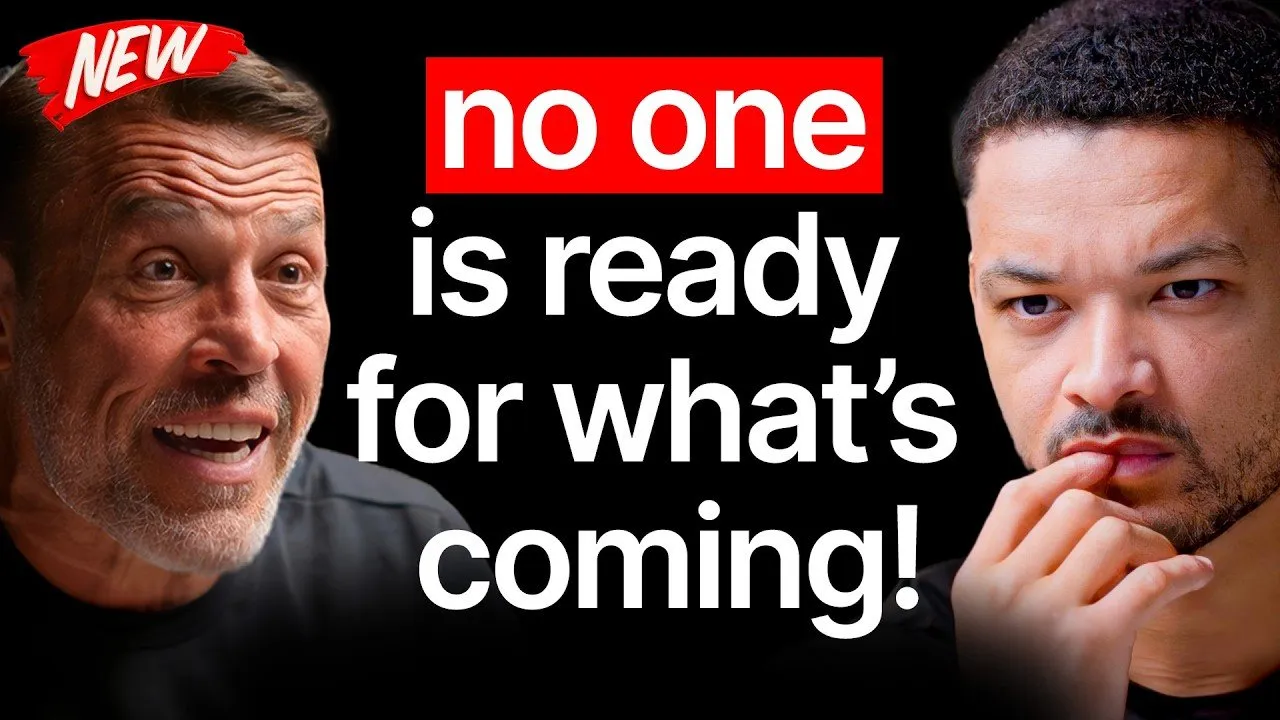
We are standing on the precipice of a shift so radical that most people are psychologically unprepared for the fallout. According to Tony Robbins, the nation’s leading life and business strategist, the next decade will not just be defined by technological advancement, but by a crisis of meaning and displacement. From the rapid acceleration of artificial intelligence to the silent epidemic of emotional suffering, the rules of the game are changing.
However, history teaches us that winter is always followed by spring. While many will be broken by the coming changes, those who master their internal psychology and adopt specific strategies for wealth and adaptation will not just survive—they will dominate. This article breaks down the core insights from Robbins on how to navigate the impending economic shifts, master the science of achievement, and secure the art of fulfillment.
Key Takeaways
- The AI Disruption is imminent: We are moving from a world where technology aids labor to one where it replaces it, threatening not just income but human identity and meaning.
- Retooling is non-negotiable: To survive the next decade, you must transition from a consumer to an owner, and from a passive observer to a "pattern creator."
- The Six Human Needs drive everything: Understanding whether you are driven by Significance or Contribution dictates your long-term happiness and resilience.
- Wealth requires asymmetrical risk: The ultra-wealthy do not gamble; they seek investments with limited downside and exponential upside.
- State determines outcome: Success is not a matter of ability, but of emotional state and leverage. You cannot strategize your way out of a poor physiological state.
The Crisis of Meaning and The Rise of AI
The most pressing threat facing society today isn't just economic inflation or political polarization; it is the collision of advanced technology with human identity. Robbins argues that we are facing a "post-work" world faster than policymakers realize. Unlike the agricultural or industrial revolutions, which played out over generations, the AI revolution is exponential.
The danger lies in the speed of displacement. When millions of truck drivers, coders, and white-collar professionals lose not only their income but their sense of agency, the societal friction will be immense. Work provides more than a paycheck; for many, it provides their primary source of significance.
Jobs are not just money. Jobs are meaning. It’s not the only form of meaning, but it’s meaning.
Robbins highlights that the development of AI is currently driven by a "carrot and stick" dynamic that ignores safety. The carrot is the potential for trillion-dollar wealth; the stick is the geopolitical fear that if the West doesn't develop it first, a rival power like China will. This race ensures that safety guardrails and social safety nets (like retooling the workforce) remain afterthoughts.
The Solution: Psychological Retooling
Universal Basic Income (UBI) may solve the caloric requirement of survival, but it cannot solve the hunger for purpose. The antidote to this disruption is not just learning to code—since AI can do that, too—but learning to manage the human mind. We must decouple our identity from our labor and reconnect it to our capacity to create and contribute.
The Three Skills That Future-Proof Success
Regardless of technological changes, Robbins identifies three meta-skills that allow individuals to thrive in any environment. These are the skills that separate those who react to history from those who shape it.
1. Pattern Recognition
Fear often stems from the belief that a crisis is unprecedented. However, history is cyclical. By studying history, economics, and human behavior, you develop pattern recognition. When you realize that market crashes, political polarization, and technological shifts follow predictable cycles (like the seasons), panic is replaced by strategy.
2. Pattern Utilization
It is not enough to see the pattern; you must use it. Successful entrepreneurs and investors don't just observe trends; they apply established frameworks to new contexts. This is the "science of achievement"—following the proven recipes that have worked for others.
3. Pattern Creation
This is the highest level of mastery. Once you have absorbed enough patterns, you synthesize them to create something entirely new. This is where you become the "GOAT" (Greatest of All Time) in your industry. In an AI-dominated world, the ability to create novel patterns—distinct from the derivative patterns of an algorithm—will be the most valuable human asset.
Understanding the Seasons of Life
To navigate the coming decade, one must also understand the context of their own life. Robbins utilizes the metaphor of the four seasons to describe human development:
- Spring (Age 0–21): The time of growth and accumulation. You are protected and fed, absorbing information.
- Summer (Age 22–42): The season of testing. You test your beliefs against reality. This is often the most stressful period, where you realize the world doesn't care about you, and you must forge your own path.
- Fall (Age 43–63): The power season. If you planted in spring and worked hard in summer, this is when you reap. You have relationship capital, skills, and resources. You become a leader.
- Winter (Age 64+): The season of mentorship and legacy. You know exactly who you are. The frantic need to prove yourself dissipates, replaced by a desire to give back.
The Invisible Force: The Six Human Needs
Why do people do what they do? Why do some turn to violence while others turn to philanthropy? Robbins argues that every human being is driven by six fundamental needs. While we all have these needs, the top two that you prioritize determine the trajectory of your life.
- Certainty: The need for safety, stability, and comfort.
- Uncertainty/Variety: The need for surprise and challenge (because total certainty is boring).
- Significance: The need to feel unique, important, and special.
- Connection/Love: The need for intimacy and belonging.
- Growth: The need to expand emotionally, intellectually, and spiritually.
- Contribution: The need to give beyond oneself.
The Trap of Significance
In the age of social media, Significance has become the dominant driver for the majority of the population. People signal virtue, attack others online, or obsess over likes to feel important. The tragedy is that pursuing significance often kills Love. The more you try to prove you are special and separate from others, the harder it is to connect with them.
Robbins suggests a radical shift: prioritize Love and Contribution above all else. When these become your primary drivers, significance and certainty follow naturally as byproducts, but without the anxiety and disconnection.
Success without fulfillment is failure. And fulfillment is an art, not a science.
Financial Resilience: From Consumer to Owner
The economic landscape is shifting, and the disparity between the wealthy and the working class is widening. Robbins, having interviewed 50 of the world's greatest investors (from Ray Dalio to Carl Icahn), identifies a critical mindset shift: You must move from being a consumer to being an owner.
Instead of buying the iPhone, buy the stock. Instead of reacting to inflation, own assets that inflate. The wealthy do not focus solely on "making money"; they focus on not losing money. Their strategy relies on "asymmetrical risk/reward."
The Asymmetrical Bet
Amateurs look for high returns and accept high risks. The pros look for low risk and high returns. A classic example is risking $1 to make $5. If you are wrong four times (losing $4) but right once (making $5), you are still profitable. In a volatile decade, survival depends on structuring your life and business to limit downside while keeping upside open.
Conclusion: Managing State Over Circumstance
The next decade will break people who attempt to "manage" their circumstances. You cannot control AI, geopolitics, or the economy. The only thing you can control is your State (your physiology and focus) and your Story (the meaning you give to events).
Robbins emphasizes that most people try to solve problems by thinking their way out, but thinking is limited by your current emotional state. To change your life, you must first change your physiology—move your body, change your breathing, plunge into cold water—to break the hypnotic loop of fear. Only from a peak state can you see the patterns, make the asymmetric bets, and find the meaning that makes life worth living.
We are entering a winter. But for those who prepare, who retool, and who shift their focus from significance to service, it will be the greatest season of their lives.