Table of Contents
Tim McGraw is more than a country music star; he is an institution. With over 100 million records sold and a career spanning more than three decades, McGraw has navigated the treacherous waters of the music industry with a rare combination of artistic intuition and business acumen. But his longevity isn’t an accident. It is the result of deliberate reinvention, physical discipline, and the courage to take absolute ownership of his trajectory.
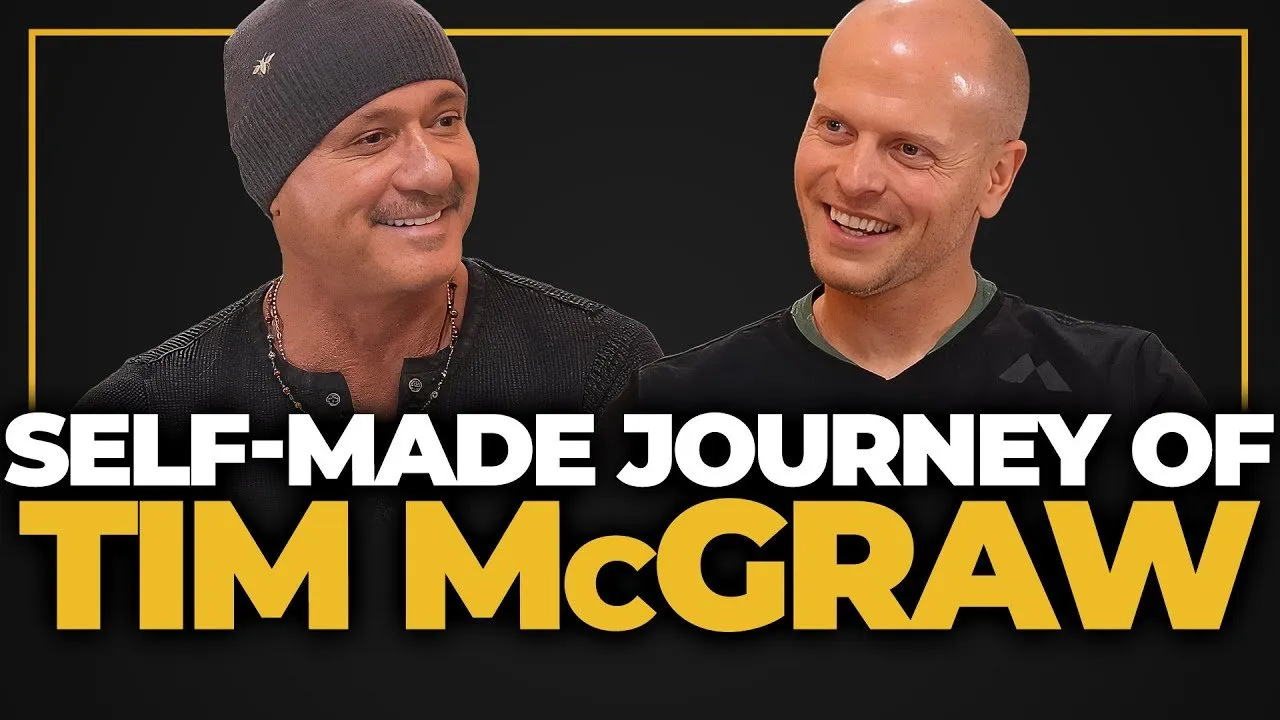
In a wide-ranging conversation with Tim Ferriss, McGraw pulls back the curtain on the systems and philosophies that have kept him at the top of the charts. From the "sliding doors" moment that almost sent him to the Marine Corps instead of Nashville, to the grueling physical regimen that sustains his high-energy performances, McGraw offers a masterclass in creative endurance. This discussion reveals how a boy who discovered his father was a professional baseball player through a document in a closet grew up to become a man who defines his success on his own terms.
Key Takeaways
- Career Ownership is Non-Negotiable: Longevity requires making the hard decisions yourself—hiring, firing, and choosing the creative direction—rather than deferring to a committee.
- The "Anti-Role Model" Concept: McGraw used a difficult upbringing to define exactly what kind of father and husband he didn't want to be, proving that negative examples can be powerful teachers.
- Physicality Equals Longevity: Treating touring like a professional sport, McGraw shifted from brutal, high-volume training to focused, mobility-centric work to survive decades on stage.
- Testing Material Live: Much like comedians testing jokes, McGraw validates songs in front of live audiences before committing them to records, using real-time feedback to guide his choices.
- Reframing Trauma as Hope: Discovering his father was Tug McGraw could have bred resentment; instead, Tim used it as proof that greatness was in his DNA, fueling his ambition.
The Art of Song Selection and Creative Intuition
For McGraw, the foundation of a 30-year career is simple: the song always wins. Regardless of who wrote it or where it came from, the material must resonate deeply with the artist before it can connect with an audience. This intuition is honed not just in the studio, but through a rigorous process of testing and listening.
- The "God Walked Through the Room" Moment: The recording of "Live Like You Were Dying" occurred just weeks after McGraw’s father passed away. Late at night in an upstate New York studio, with his uncle Hank—a "pothead" coping with grief—watching from the corner, the band captured a lightning-in-a-bottle performance. McGraw attributes the magic of that track to the palpable emotion and melancholy in the room, a vibe that technical proficiency alone cannot replicate.
- The One-Two Punch Strategy: McGraw launched his career by pairing the controversial "Indian Outlaw" with the emotionally heavy "Don't Take the Girl." He understood that the former would generate attention and noise, while the latter would cement his status as a storyteller with emotional depth. This calculated risk prevented him from becoming a novelty act.
- Audience as the Ultimate filter: Similar to how stand-up comedians work out material in small clubs, McGraw tests new songs during live shows. He looks beyond polite applause, scanning the crowd for genuine engagement versus distraction. If the audience checks their phones, the song doesn't make the cut.
- Trusting the Gut over the Committee: Early in his career, labels and executives often rejected songs that went on to become his biggest hits. McGraw learned that while you should listen to experts, you must never let them override your visceral reaction to a piece of art. If he cannot find himself in the song, he knows he cannot sell it to a crowd.
- The Evolution of Taste: As he has aged, McGraw’s selection criteria have shifted. While he still enjoys fun, up-tempo tracks, he acknowledges that singing about "tailgates" becomes less authentic over time. He now gravitates toward songs with deeper layers of meaning that reflect his current station in life.
- Avoiding the "Flu": Quoting Kurt Vonnegut, the conversation highlighted the danger of trying to appeal to everyone. Attempting to "make love to the world" usually results in catching the flu. McGraw focuses on the "audience of one"—if it resonates with him, it has a chance to resonate with millions.
You can have the greatest song in the world, greatest band in the world, greatest singer in the world... and it's still not at work. And we always say sometimes God just walks through the room.
Physical Resilience: Training for the Long Game
Touring is not merely singing; it is an athletic event requiring immense stamina. McGraw’s approach to fitness has evolved from obsessive intensity to strategic preservation. He treats his body as the instrument that allows the music to happen, and his training regimen reflects the necessity of performing at a high level into his late 50s.
- The "Three-a-Day" Era: In his younger years, McGraw’s routine was punishing. It included a two-hour morning weight session, running stadium stairs before lunch, and a 90-minute outdoor CrossFit-style session with his band in the afternoon. While this built an impressive physique, he admits it likely hastened his orthopedic injuries.
- The Wake-Up Call: In his early 40s, McGraw saw a trailer for his film Four Christmases. His daughter bluntly told him, "Dad, you need to do something," noting that his face looked swollen. This moment catalyzed a complete lifestyle overhaul, cutting out alcohol and prioritizing nutrition and elite fitness.
- Adapting to Injury: Following multiple back surgeries and double knee replacements, McGraw had to relearn how to move. There were periods where he could barely stand, forcing him to walk on a treadmill while leaning over just to keep moving. This struggle redefined his relationship with pain and recovery.
- The Modern Regimen: Today, his training is about focus and alignment. He utilizes red light therapy, hot/cold contrast plunges, and extensive mobility work. He avoids heavy spinal loading (like heavy deadlifts) in favor of bodyweight circuits, kettlebells, and exercises performed with "intent and purpose."
- The "Hungry Wolf" Mentality: McGraw prefers to perform on an empty stomach. Drawing a parallel to falconry, where a bird must be hungry to hunt effectively, he finds that physical hunger translates to a sharper mental edge and higher energy output on stage.
- Focus as the Metric: The biggest casualty of injury or aging isn't just strength; it's focus. McGraw notes that when his body is right, his "brain fog" clears, allowing him to command the stage. The physical work is the meditation that centers his mind for the performance.
Reframing the Past: The Origin Story
McGraw’s childhood was complicated, marked by poverty and a shocking discovery about his parentage. At age 11, while searching for coins in his mother's closet, he found his birth certificate. The name crossed out was "McGraw," and the occupation listed was "Professional Baseball Player." This discovery changed the trajectory of his life, not by providing instant access to wealth, but by shifting his perspective on what was possible.
- The Initial Rejection: After discovering his father was Tug McGraw, Tim and his mother arranged a meeting. Tug initially denied paternity, offering a brief lunch and tickets to a game before disappearing again. Years later, he essentially offered a contract: he would pay a pittance for college in exchange for Tim never contacting him again.
- The Choice of Hope over Hate: Despite the rejection, McGraw did not succumb to bitterness. He viewed his father's success as biological proof that he, too, could escape his circumstances. He reasoned, "If he has that in him, I have it in me." This reframe turned a potential source of trauma into a source of hope.
- The Final Confrontation: Upon graduating high school, McGraw demanded one final meeting before signing the "stay away" contract. He asked Tug directly, "Do you think you're my dad?" When Tug admitted he likely was, they tore up the contract. This initiated a relationship that grew until Tug's death.
- Escaping Dysfunction: McGraw grew up in an abusive household with a stepfather. The discovery of his biological father provided a mental escape hatch—an affirmation that he didn't belong in that dysfunction and was destined for something different.
- The "Anti-Role Model": McGraw’s approach to fatherhood was shaped by what he lacked. He delayed starting a family until he felt ready to do it differently. He realized that knowing exactly what you don't want to do is often more valuable guidance than a perfect role model.
- Processing via Success: McGraw admits that for a long time, he didn't tell people his origin story, fearing he would be seen as a "throwaway." Success, and the stability of his own family with Faith Hill, allowed him to eventually embrace and share the complexity of his background.
He gave me something that was so precious... and that was hope. Whether he meant to and he didn't or knew it or any of those things, he gave me a reason to think that I can get out of the situation that I was in.
Taking Absolute Charge of the Career
One of the most potent themes in McGraw’s philosophy is the refusal to be a passenger in his own life. He uses the metaphor of a monkey riding a dog at a rodeo—hanging on for dear life while the dog runs wild. McGraw decided early on he would not be the monkey.
- The First Album Flop: McGraw’s debut album "went wood," failing to produce a hit. The label ignored him, assuming his career was over. Instead of waiting for permission, he gathered songs from friends and recorded his second album on spec, essentially betting his financial future on his own taste.
- The "Indian Outlaw" Gamble: He forced the label to release "Indian Outlaw," a song they hated and deemed offensive. McGraw’s stance was clear: if he was going to fail, he would fail on his own terms. The gamble paid off, launching his career.
- Battling the Label: Later in his career, McGraw entered a prolonged legal battle with Curb Records to gain his independence. The label kept releasing "Greatest Hits" albums to artificially extend his contract. He chose to fight in court rather than remain contractually beholden, a move he describes as a "dark period" that required rebuilding his momentum from scratch.
- The Power of "No": McGraw emphasizes that saying "no" is the most critical skill for longevity. The temptation to please everyone or chase every paycheck dilutes an artist's brand. He learned to decline opportunities that offered high visibility but low alignment with his long-term vision.
- Rebuilding Momentum: After his legal battles and surgeries, McGraw felt the fear that the "ball had stopped rolling." He countered this by partnering with Scott Borchetta (Big Machine) and ensuring he had a killer album ready to drop the moment the dust settled. He turned the adversity into "piss and vinegar," cranking his intensity up to 12.
- Strategic Partnerships: Taking charge doesn't mean working alone. It means choosing the right partners. McGraw highlights his relationship with producer Byron Gallimore and his shift to Big Machine Records as examples of surrounding himself with people who understood his vision, rather than those who just wanted to control it.
The "Sliding Doors" Moments
McGraw’s life is defined by pivotal moments where a single decision altered everything. His journey to Nashville wasn't a calculated master plan; it was a leap of faith fueled by intuition and a mother’s tough love.
- The Marine Corps Paperwork: In college, McGraw excelled in a military strategy class and was voted platoon leader. An instructor convinced him to join the Marines. He sold everything he owned, packed a bag, and left the enlistment papers on his dresser next to his guitar. He told himself he would decide in the morning. Upon waking, he tore up the papers and bought a bus ticket to Nashville.
- The Mother’s Blessing: Terrified to tell his mother—who had sacrificed everything to put him through pre-law—that he was dropping out to play music, he called her from the road. Instead of scolding him, she said, "I'm surprised you haven't done it already. If you don't go, you'll never know." That validation gave him the confidence to persist.
- The Half-Song Record Deal: McGraw’s persistence led him to Curb Records executive Mike Borchetta. After sneaking into the office, McGraw convinced Borchetta to listen to his demo. Borchetta listened to half of the first song, stopped the tape, and said, "You got a record deal, kid."
- The Meeting with Faith Hill: McGraw describes meeting his wife, Faith Hill, as the ultimate turning point. He admits he was "burning it wide open" with alcohol and excess. Hill didn't just provide love; she provided a reason to pump the brakes. He credits her with saving his life and extending his career by decades.
- The "Humility" of Failure: Not every risk pays off perfectly. McGraw recounted a mortifying moment on stage with Bruce Springsteen at the Grammys, where he forgot the words to "Glory Days" in front of the entire music industry. He uses these moments to keep his ego in check and remind himself that preparation is paramount.
- The Magic of Live Performance: McGraw describes the flow state of a great concert as a "symbiotic electrical relationship." On those nights, the venue becomes a self-contained universe, a "utopia" where the outside world ceases to exist. This feeling is the drug that keeps him touring despite the physical toll.
If you just coast, you might have a career for a little while, but if you want a long career, you're going to have to take charge and ownership of it... You're going to have to be have your finger on the button all the time.
Conclusion
Tim McGraw’s journey is a testament to the power of agency. Whether it was choosing to view his father’s absence as a source of hope, choosing to rebuild his body after crippling injury, or choosing to fight a record label for his independence, McGraw has never been a passive participant in his own life. His philosophy is grounded in a blend of "humble and kind" humanity and a ruthless dedication to his craft.
For artists, entrepreneurs, and leaders, McGraw’s advice is clear: Listen to experts, but trust your gut. Prepare your body and mind for the long haul. And above all, when you find yourself merely hanging on for dear life, let go, take the reins, and ride the path you choose for yourself.