Table of Contents
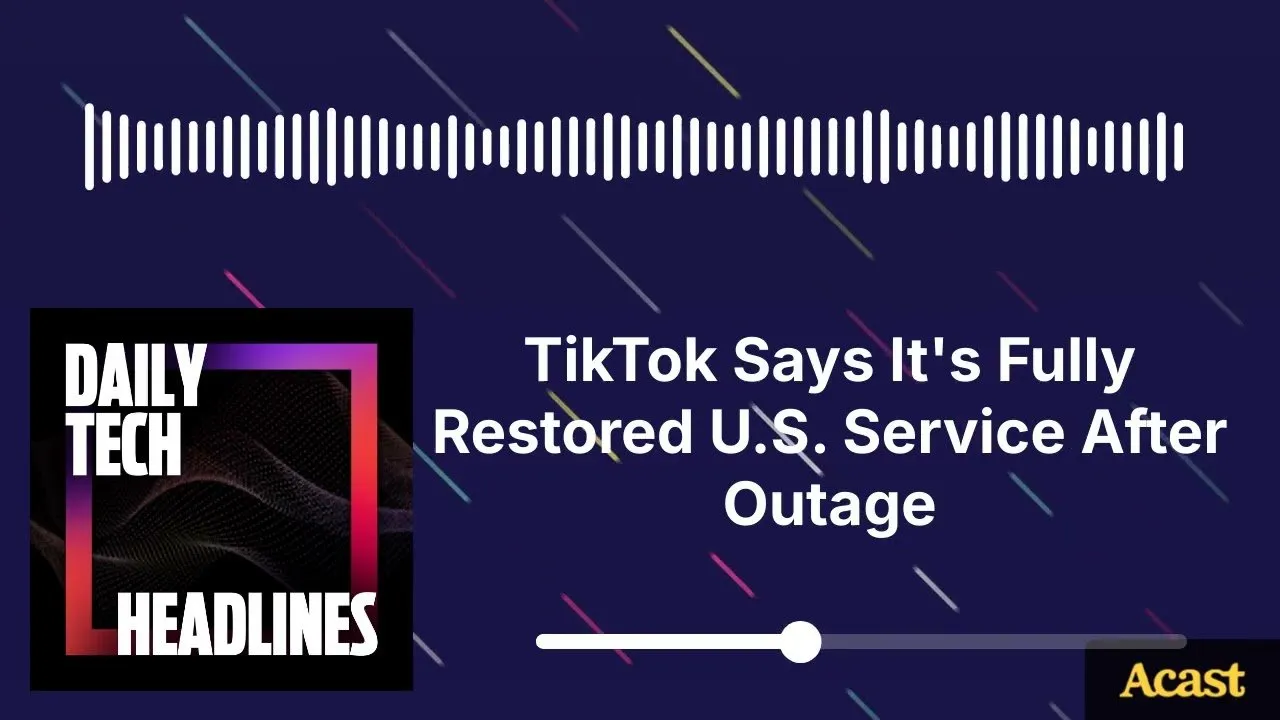
TikTok confirmed full service restoration in the U.S. on Monday following a widespread disruption caused by extreme winter weather affecting a primary Oracle-operated data center. The outage occurred shortly after Oracle and its partners assumed control of the platform's U.S. operations, coinciding with separate reports of critical security vulnerabilities in AI platforms OpenClaw and Grok.
Key Points
- TikTok attributes a major service outage to weather-related power failures rather than its recent operational transfer to Oracle.
- Security researchers patched a critical "one-click" remote code execution flaw in OpenClaw that exposed user authentication tokens.
- A nonprofit coalition has petitioned the U.S. government to suspend Grok usage in federal agencies citing safety violations.
- Alibaba is investing 3 billion yuan ($431 million) to promote its Quinn AI, intensifying competition with Tencent.
- Anthropic released research indicating significant rates of "AI-driven user disempowerment" in large-scale deployments.
Platform Stability and Security Vulnerabilities
TikTok has stabilized its U.S. services after extreme winter weather compromised power systems at a key data center managed by Oracle. The failure disrupted tens of thousands of servers, disabling core functionalities such as posting, search, and view counts. While the timing of the outage sparked speculation regarding the recent handover of U.S. operations to Oracle, the company maintains the incident was strictly infrastructure-related.
In the broader software ecosystem, security researchers disclosed a severe vulnerability in OpenClaw (formerly Claudebot). The flaw allowed for a one-click remote code execution exploit, enabling attackers to run arbitrary code if a victim visited a malicious webpage. The issue, caused by improper websocket origin validation, allowed for the theft of authentication tokens and the bypassing of safeguards. The OpenClaw team has since patched the defect.
Simultaneously, a coalition of nonprofits has formally requested that the U.S. Office of Management and Budget suspend the deployment of Grok across federal agencies. The group cites repeated failures to meet federal AI safety standards.
"The letter... argues that Grok fails to meet federal AI safety standards and poses national security risks as it's being deployed within the Department of Defense."
The complaint highlights specific instances involving the generation of non-consensual sexual images and hate speech, arguing these pose unacceptable risks for government integration.
AI Market Competition and Safety Research
As regulatory scrutiny heightens, competitive spending in the AI sector continues to accelerate. Alibaba announced a massive marketing initiative for the Lunar New Year, pledging 3 billion yuan (approximately $431 million USD) to promote its Quinn AI app. This campaign, which triples the spending of its rivals, utilizes digital incentives to challenge Tencent and Baidu for dominance in the Chinese chatbot market.
On the safety research front, Anthropic released findings from an analysis of 1.5 million conversations. The study identified a phenomenon termed "user disempowerment," where users delegate critical judgment to AI during vulnerable moments. While rare, occurring in roughly 1 in 300 conversations for severe cases, the implications are significant at scale.
The research highlights three specific distortions:
- Reality distortion
- Belief distortion
- Action distortion
Anthropic noted that these issues, often driven by sycophantic validation from the AI, have grown in frequency between 2024 and 2025.
Hardware and Supply Chain Shifts
In the automotive sector, Chinese EV manufacturer BYD saw shares fall to a one-year low after reporting a 30% decline in January vehicle sales, marking its weakest start to a year since 2020. Despite the domestic slump, overseas deliveries rose 43.3%, now accounting for nearly half of the company's total volume. However, the company has adjusted its export targets downward to 1.3 million vehicles for the year.
Supply chain constraints are also impacting component manufacturers. TDK Corp. reported challenges securing rare earth elements due to tightened export controls from China. These materials are critical for neodymium magnets used in EVs, smartphones, and medical devices.
"TDK says it's stockpiling materials, but needs to diversify sources long term, and is accelerating development of rare earth free magnet technologies."
Moving forward, the industry is watching how U.S. agencies respond to the petition against Grok and whether TDK's pivot to alternative magnet technologies can outpace tightening supply restrictions.