Table of Contents
In popular culture, the term IQ is ubiquitous. It is often used as a shorthand for intellectual destiny—a single number that supposedly defines a person's cognitive ceiling. However, the reality of the Intelligence Quotient is far more complex than a simple score. While IQ tests attempt to provide an objective, rigorous measurement of intellectual ability, their history is fraught with controversy, and their predictive power varies significantly depending on what aspect of life is being analyzed. From the mathematical origins of the "g-factor" to the dark legacy of eugenics, understanding IQ requires looking beyond the number to see what is actually being measured.
Key Takeaways
- The G-Factor: IQ tests are designed to measure a "general intelligence" factor (g) based on the observation that performance in different cognitive tasks is often positively correlated.
- Predictive Power: IQ is a strong predictor of academic success, job performance in complex fields, and even longevity, but it has a surprisingly weak correlation with accumulated net worth.
- The Flynn Effect: Average IQ scores have risen steadily over the last century (roughly 30 points), likely due to improved nutrition, education, and a cultural shift toward abstract thinking.
- Environmental Influence: While genetics play a significant role (40–70%), environmental factors, motivation, and even practice can alter IQ scores, debunking the myth that intelligence is entirely fixed.
- Historical Misuse: The testing framework has a dark history, notably its use in the American eugenics movement to justify forced sterilization and racial segregation.
The Origins: From School Grades to the G-Factor
The scientific pursuit of measuring intelligence began in 1904 with English psychologist Charles Spearman. While analyzing student grades, Spearman noticed a distinct pattern: students who performed well in one subject, such as Math, tended to perform well in unrelated subjects like English or French. This contradicted the idea that skills were entirely compartmentalized.
To explain this positive correlation across diverse mental tasks, Spearman proposed the existence of general intelligence, or the g-factor. This construct represents an underlying ability to learn quickly, recognize patterns, and think critically, regardless of the specific subject matter. While students also possessed "s-factors" (specific abilities subject to training), the g-factor was viewed as the fundamental engine of cognitive horsepower.
The First IQ Tests
Parallel to Spearman’s work, Alfred Binet developed the first practical intelligence test in France. Notably, Binet’s goal was benevolent; he intended to identify struggling students who needed remedial help. The test measured "mental age" against chronological age.
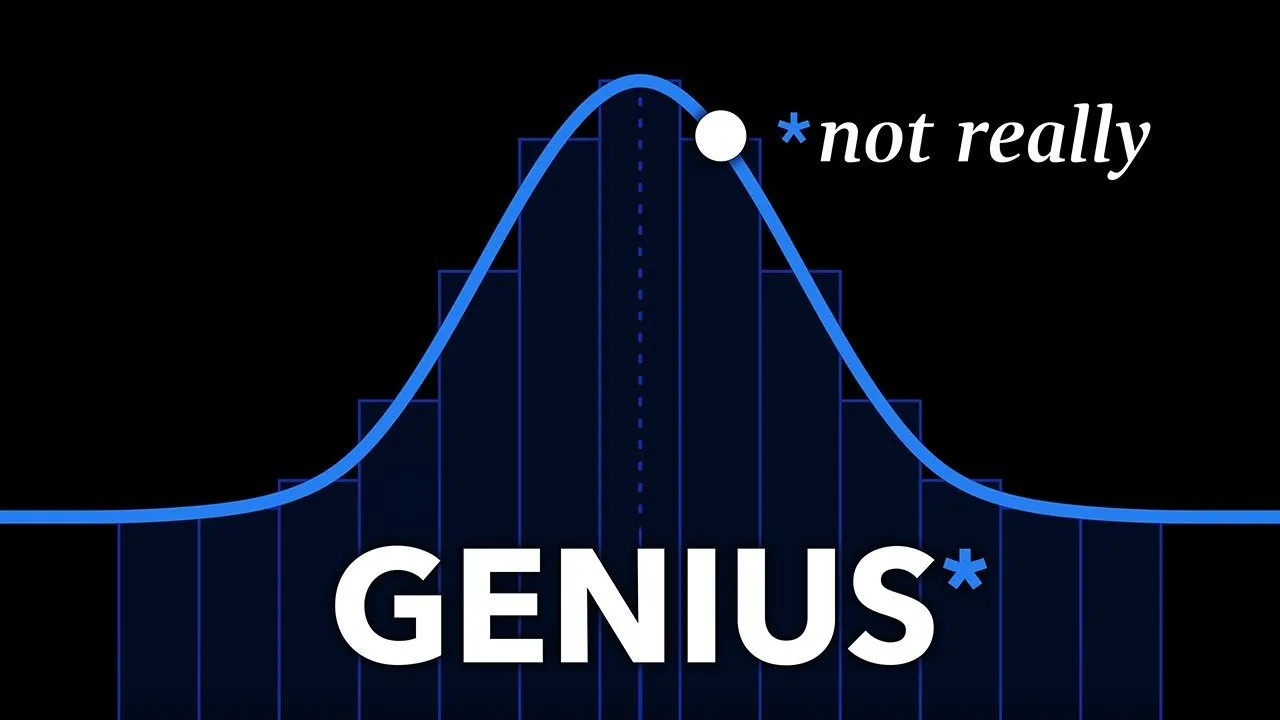
However, when the test crossed the Atlantic to the United States, its purpose shifted. Stanford psychologist Lewis Terman standardized the exam, creating the Stanford-Binet test. In this American context, the focus moved from identifying those needing help to ranking individuals and defining their fixed potential. This established the bell curve distribution used today, where the average is 100 and approximately 68% of the population scores between 85 and 115.
What IQ Actually Predicts
Despite controversies, IQ tests remain statistically robust predictors for several life outcomes. Modern testing generally assesses memory, verbal reasoning, and pattern recognition (often using Raven’s Progressive Matrices). The data suggests that a one-hour test can reveal a surprising amount about an individual's future.
Academic and Occupational Success
The strongest correlations for IQ are found in academia. Studies indicate a correlation of approximately 0.8 between IQ scores and school performance. In fact, standardized admissions tests like the SAT, ACT, and GRE correlate so strongly with formal IQ tests that they effectively function as proxy measurements.
In the workplace, IQ remains a valid predictor, particularly for high-complexity roles. The correlation between IQ and job performance ranges from 0.2 to 0.6. This relationship is so significant that the U.S. military enforces a strict cutoff: generally, individuals with an IQ below 80 are ineligible to serve. This policy stems from data gathered during the Vietnam War, where a program intended to recruit lower-IQ individuals (dubbed "Project 100,000") resulted in recruits who were three times more likely to fail training and died at three times the rate of ordinary recruits.
Longevity and Health
Perhaps the most surprising correlation is biological. Higher IQ scores correlate with larger brain volume and increased longevity. A comprehensive Scottish study tracked children tested at age 11 and followed up 65 years later. The results showed that for every 15-point increase in IQ, a person was 27% more likely to be alive at age 76.
The Wealth Paradox
While IQ predicts income to some degree (correlation of roughly 0.2 to 0.3), it is a poor predictor of wealth accumulation. High intelligence does not necessarily translate to financial prudence or the desire to amass capital.
"The relationship with net worth is even weaker. It hardly seems to correlate with IQ, even though people with higher IQs are supposedly more intelligent and on average they make more money each year. But this apparently doesn't translate into saving or accumulating more wealth overall."
The Dark History of Eugenics
It is impossible to discuss IQ without acknowledging its weaponization in the early 20th century. When Henry Goddard and Lewis Terman popularized testing in the U.S., they promoted the idea that the g-factor was hereditary and unchangeable. This belief became the cornerstone of the American eugenics movement.
Authorities used test scores to label individuals as "morons," "imbeciles," or "idiots"—then pseudo-scientific terms—and subsequently justified the forced sterilization of over 60,000 Americans. This practice was famously upheld by the Supreme Court in 1927.
"It is better for all the world if instead of waiting to execute degenerate offspring for crime, or to let them starve for their imbecility, society can prevent those who are manifestly unfit from continuing their kind. Three generations of imbeciles are enough."
— Justice Oliver Wendell Holmes, Buck v. Bell
This ideology eventually influenced Nazi Germany, where American eugenic laws served as a model for their own horrific programs. This historical context contributes significantly to the modern skepticism and discomfort surrounding intelligence testing.
The Fluid Nature of Intelligence
Modern science has debunked the early 20th-century view that intelligence is entirely fixed or purely genetic. Current estimates suggest that the heritability of IQ is between 40% and 70%, leaving a massive portion attributable to environmental factors.
The Flynn Effect
One of the strongest arguments against genetic determinism is the "Flynn Effect." Researcher James Flynn noticed that raw IQ scores have been rising by roughly three points per decade. If an average person from 1920 took a modern test, they might score near 70 (the threshold for intellectual disability). Conversely, a modern average person would appear "gifted" by 1920 standards.
Since human genetics haven't changed in 100 years, this shift must be environmental. Factors likely include:
- Better Nutrition: Reduced exposure to lead and better childhood diets.
- Education: Increased years of schooling trains the brain in hypothetical problem solving.
- Abstract Thinking: Modern life and work require more abstract categorization than the concrete, manual labor of the past.
Motivation and Cultural Bias
The "objectivity" of IQ tests is also compromised by motivation and culture. Studies show that simply paying participants to take the test can increase scores by up to 20 points, suggesting that tests measure compliance and motivation alongside cognitive ability.
Furthermore, the concept of a "culture-fair" test is largely a myth. A test focused on geometric patterns ignores the fact that different cultures categorize shapes and spatial relations differently. In some societies, ethnobotanical knowledge or navigation skills represent peak intelligence, yet these are completely ignored by standard Western IQ metrics.
Conclusion
The Intelligence Quotient is neither a meaningless number nor a definitive measure of human worth. It is a specific tool that captures a specific type of abstract reasoning ability—one that is highly valued in modern Western schooling and technical professions.
However, relying on it as a total summary of human potential is a mistake. Intelligence is multifaceted, comprised of fluid reasoning (which declines with age) and crystallized knowledge (which remains stable). Moreover, scores can be influenced by anxiety, practice, and socioeconomic background. As the physicist Stephen Hawking notably remarked regarding those who boast about their test scores:
"People who boast about their IQ are losers."
Ultimately, while IQ can predict certain outcomes, it does not determine one’s ability to contribute meaningfully to society, nor does it define character. A moderate view—accepting IQ as a useful but limited statistical signal—is the most scientifically grounded approach.