Table of Contents
Home robotics startup Sunday has officially reached unicorn status, securing a valuation of $1.15 billion following its latest funding round. The company, which specializes in general-purpose household robots, intends to utilize the new capital to accelerate its beta testing program and scale the deployment of its flagship model, Memo, into real-world home environments.
Key Points
- Sunday achieved a $1.15 billion valuation, marking a significant milestone for consumer-focused robotics.
- The company has opened a beta program that already counts over 3,000 applicants eager to integrate the robots into their daily chores.
- Sunday plans to launch Memo with an initial price point of $10,000, positioning it as a premium Minimum Viable Product (MVP) that will scale in affordability over time.
- The technology relies on a proprietary "skill capture" glove system, allowing humans to teach the robot complex tasks like laundry by recording real-time movements.
The Path to Household Automation
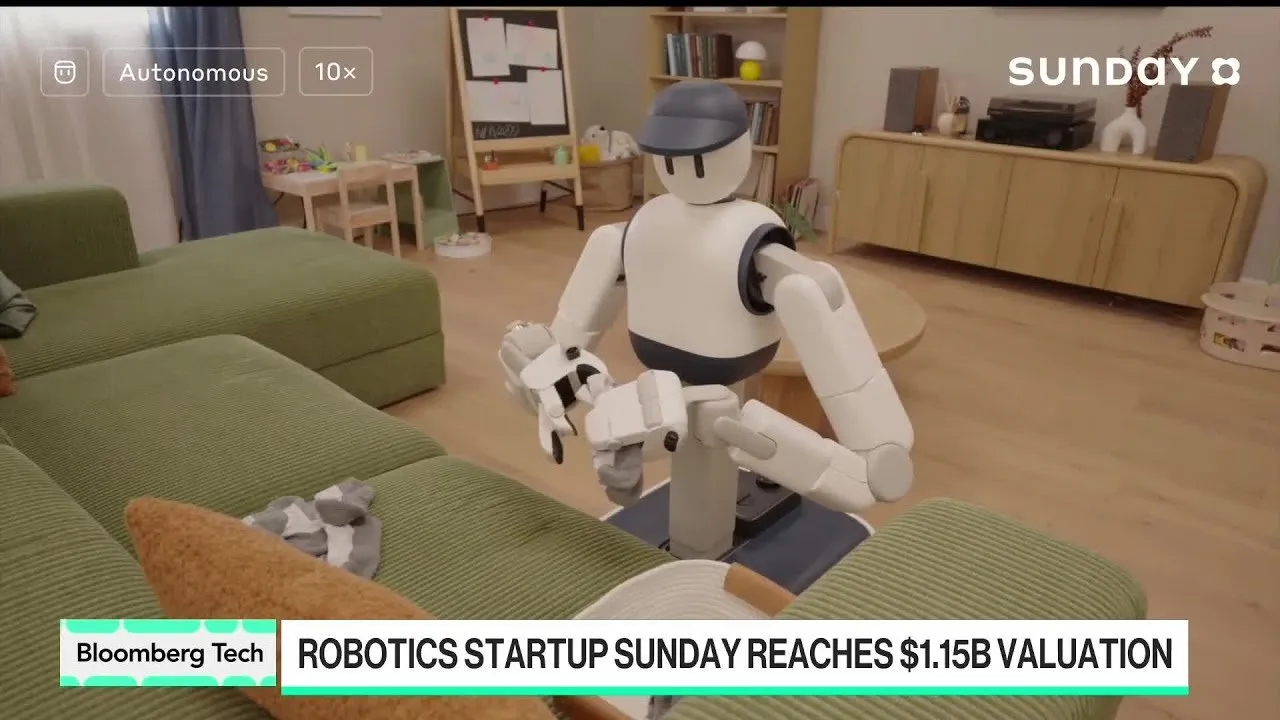
The core innovation behind Memo lies in the shift from traditional scripted robotics to generative AI. While many industry competitors struggle with the dexterity required for unstructured home tasks, Sunday is tackling the challenge by focusing on how AI generates physical actions rather than text or images. To train these systems, the company utilizes "skill capture" gloves, which record the nuanced hand movements of human users performing chores.
This data-gathering approach bypasses the limitations of training robots solely on synthetic datasets. By deploying Memo into homes, the company aims to move beyond lab-based testing. Addressing the transition from research to real-world utility, company leadership emphasized that the current beta phase is designed to exercise their deployment capabilities while deepening internal research. Despite the high interest, the company is carefully selecting participants to ensure the robots operate effectively in diverse, unscripted domestic settings.
The breakthrough is really about the AI that is behind it. You think about GenAI as an AI that generates images and text, but we use it to generate actions. I think one of the most important parts is how we gather the data to train this really powerful AI.
Hardware Design and Market Strategy
A notable feature of the Memo unit is its unconventional aesthetic—specifically, a hat that conceals the robot’s camera systems. By housing sensors under a brim rather than within traditional ocular sockets, the design team aims to foster a more natural, "human-centric" interaction, allowing users to make comfortable eye contact with the machine.
Regarding the business model, Sunday is positioning Memo as a high-end entry point for early adopters. The $10,000 price tag reflects the current costs of high-performance hardware and sophisticated AI integration. The company draws comparisons to the early evolution of the personal computer and smartphone, suggesting that as manufacturing processes mature and the GenAI models become more efficient, the cost of ownership will decrease significantly.
The company maintains a pragmatic view of its robot’s performance. While observers have noted that current prototypes operate at speeds slower than human counterparts, developers argue that speed is secondary to autonomy. As long as the robot can complete a cycle of household chores while the owner is away, it provides immediate value. Sunday is now moving forward with its selection process for the initial 3,000-person beta group, an effort that will serve as a bellwether for the future of domestic robotics and the firm's ability to transition from a venture-backed startup to a household fixture.

![URGENT: This Next Market Rotation Will Go Parabolic! [& It’ll Be Quick]](/content/images/size/w1304/format/webp/2026/03/market-rotation-parabolic-shift-forecast.jpg)