Table of Contents
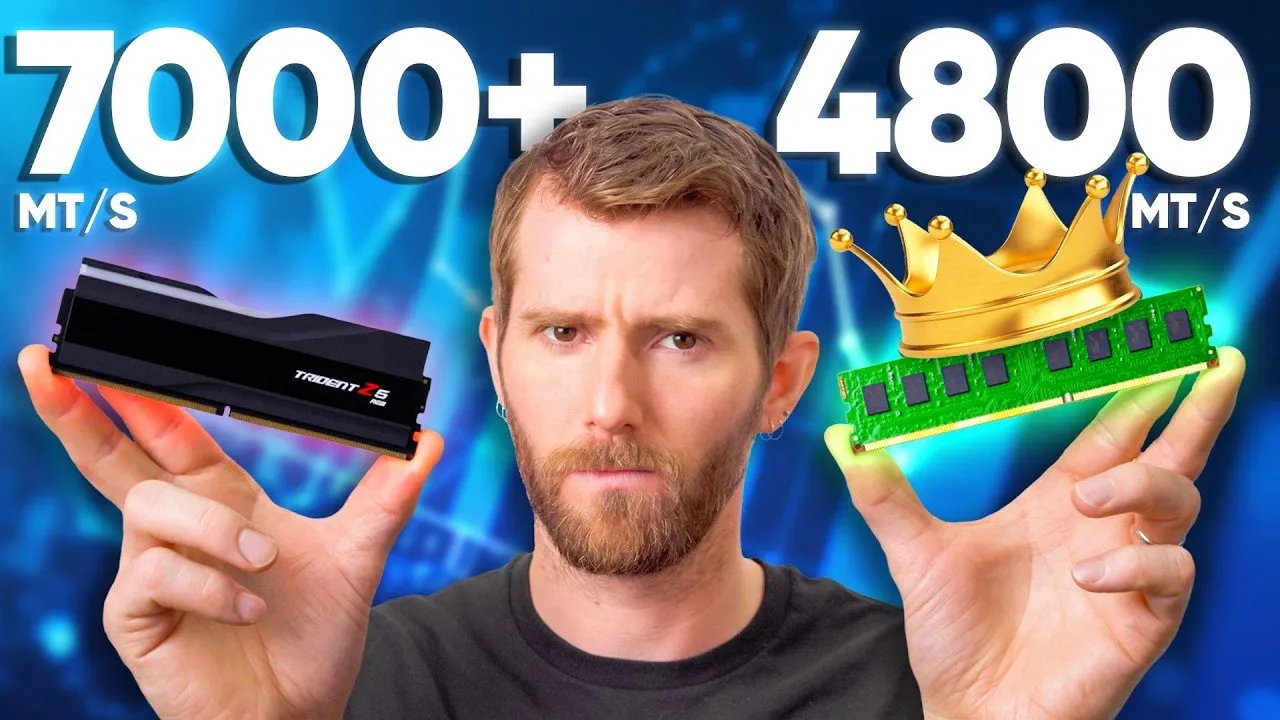
A comprehensive performance analysis by Linus Tech Tips has revealed that the soaring costs of enthusiast-grade DDR5 memory are no longer justified by marginal performance gains for the vast majority of PC users. As market prices for high-speed kits have surged, recent testing across both Intel and AMD platforms suggests that "sweet spot" or even entry-level memory modules provide nearly identical gaming experiences to kits costing hundreds of dollars more. The findings indicate a significant shift in the value proposition of PC hardware, particularly for those utilizing AMD's latest X3D processors.
Key Points
- AMD’s X3D architecture remains largely indifferent to memory speeds, with the 9800X3D showing negligible gains above standard frequencies.
- While Intel’s 14900K demonstrates the highest sensitivity to DDR5 speeds at 1080p, the real-world impact diminishes significantly at higher resolutions.
- The price delta for high-end RAM has expanded from a historical $20–$30 premium to as much as $300, altering the cost-to-performance mathematics for builders.
- Professional productivity workflows, such as code compilation in Godot, remain the only sectors where expensive, high-speed memory offers a measurable return on investment.
The Shifting Economics of Memory Performance
For years, the recommendation for PC enthusiasts was to spend a modest premium for faster memory to squeeze an extra 2–5% of performance from their systems. However, a "RAM crisis" involving significant price hikes has transformed a negligible upsell into a major budgetary hurdle. Analysis of current market trends shows that the gap between JEDEC (standard) speeds and high-end overclocked kits has widened to the point of being "extortionate."
According to the report, the context of the recommendation has changed because the financial stakes have risen. When a few percentage points of performance cost $30, it was an easy recommendation; at $300, the logic fails for everyone except the most specialized users.
"When we were talking about 20 or 30 bucks to get a few percent performance improvement on your $1,500 or $2,000 gaming PC, that's a no-brainer. But we're not talking 20 or 30 bucks. We're talking $200 or $300 for a higher speed kit. That changes the math completely."
Platform Disparities: AMD vs. Intel
The impact of memory speed varies wildly depending on the CPU architecture. Testing involved four different processors across eight different DDR5 speeds, starting as low as 4,800 MT/s. The results highlight a clear distinction between how the two major chipmakers handle data.
AMD’s V-Cache Advantage
AMD’s 9800X3D proved to be the most resilient to slower memory. Thanks to its massive L3 V-Cache, the processor does not need to access system RAM as frequently as traditional chips. While 6,000 MT/s CL30 remains the technical "sweet spot" for AMD’s Infinity Fabric, the testing showed that even at the slowest JEDEC speeds, gaming performance remained remarkably stable, especially when ray tracing was enabled or resolutions were increased to 4K.
Intel’s Raptor Lake and Core Ultra
On the Intel side, the Core i9-14900K (Raptor Lake) showed the most benefit from ultra-fast memory, such as 8,400 MT/s CL40 kits. However, this benefit was primarily observed in specific titles like Cyberpunk 2077 and Ashes of the Singularity at 1080p. Interestingly, the newer Core Ultra 285K struggled with stability on the fastest kits, and the performance delta for 1% lows—the key metric for game smoothness—was often within a handful of frames per second.
Productivity and Professional Implications
While gamers can safely opt for budget-friendly RAM, the story is more nuanced for creative and technical professionals. In tests involving Blender, memory speed had almost no impact. However, in Godot engine code compilation, faster memory yielded meaningful time savings. This creates a difficult environment for independent developers and contract professionals who must weigh the high cost of entry against their daily billable efficiency.
"If you're an at-home developer or you're a contract creative professional, it is a super sucky time to need an upgrade. The only good news I have for you is that you can shave a few bucks off of your budget for now and then with the money you saved, hopefully get something a little faster once the bubble pops."
As the industry waits for memory pricing to stabilize, the current advice for builders is to prioritize capacity and platform stability over raw frequency. For those building gaming-centric rigs around AMD X3D processors, the data suggests that expensive "gaming" RAM is currently one of the least efficient ways to spend a hardware budget. Future hardware iterations may eventually bridge this value gap, but for now, the most prudent move is to wait for the "RAM bubble" to burst before investing in high-speed kits.