Table of Contents
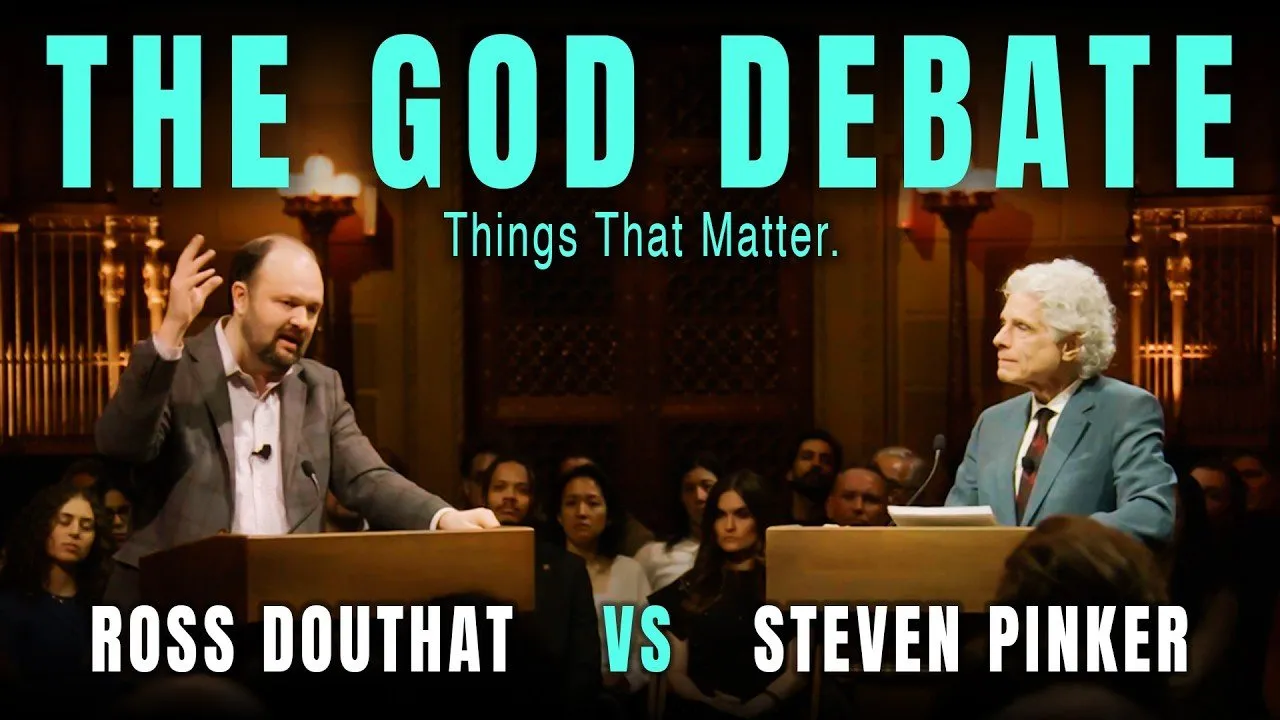
The question of whether humanity needs God is not merely a theological inquiry; it is a fundamental challenge to the stability of modern society. As the United States approaches its 250th anniversary, we are forced to grapple with the observation made by John Adams that our Constitution was designed for a "moral and religious people." With nearly one-third of Americans now claiming no religious affiliation, we are witnessing a profound shift. This transition prompts a critical debate between cognitive psychologist Steven Pinker and New York Times columnist Ross Douthat regarding the necessity of faith in an age of reason, science, and secular governance.
Key Takeaways
- The Purpose of Religion: Proponents of faith argue that religion provides an essential "cosmic horizon," anchoring human morality in universal truths rather than arbitrary cultural constructs.
- Secular Flourishing: Critics of religion, led by figures like Steven Pinker, contend that human progress—evidenced by longer lifespans and reduced poverty—is the result of reason, science, and secular institutions rather than supernatural belief.
- The Community Factor: Research shows a correlation between religious attendance and personal satisfaction, though secularists argue this is a result of "fellowship" and social engagement rather than the validity of religious doctrine.
- The Problem of Tribalism: Both sides debate whether the "quantum of tribalism" previously found in religion has simply migrated to the realm of secular politics, fueling modern polarization.
The Moral Scaffolding of Society
Ross Douthat suggests that the decline of religious institutions has not led to the rational paradise predicted by "new atheists." Instead, he argues that a post-religious society has become more polarized and prone to tribal hatreds. Douthat posits that religion provides a unique, non-negotiable standard for human value—the belief that every individual is created in the image of the divine—which serves as a necessary check against the utilitarianism of the modern technological age.
It's good for people to believe that the idea that you should love your neighbor as yourself isn't just a kind of utilitarian construct.
Steven Pinker counters that God is not the source of morality, nor is he the solution to our modern problems. He maintains that morality is born from a recognition of our shared humanity and the logical consistency required to live in a functioning society. For Pinker, the "miracles" of the modern era—antibiotics, digital connectivity, and democratic human rights—are products of human ingenuity, not divine intervention.
Is Secularism Inherently Destabilizing?
The debate touches on the uncomfortable reality that as church attendance drops, secular community groups like Rotary or Lions clubs have not seen a commensurate rise in participation. This leaves a vacuum in American civic life. Douthat describes this as a broader institutional decline, where the average unchurched American feels disconnected from both familial and social networks. Pinker admits that social engagement is vital, but he rejects the idea that this engagement must be "bundled" with theology. He points to societies like the Netherlands and Norway as evidence that high levels of secularism can correlate with low levels of crime and social dysfunction. He argues that we must foster secular institutions that prioritize human well-being and empirical truth over archaic dogmas that have historically caused social harm.
The Intersection of Reason and Belief
A significant portion of the tension between these two views involves the origin of human rights. Douthat argues that secular humanism often "imports" moral values from the very Christian tradition it seeks to abandon, noting that the Universal Declaration of Human Rights relies on concepts that cannot be proven under a microscope or through mathematical theorem.
You cannot show me a human right under a microscope. You cannot prove to me in a mathematical theorem why segregation was wrong.
Pinker maintains that our capacity for reason is sufficient to justify moral norms. He argues that if we observe the world through the lens of cause and effect, we can conclude that certain behaviors—like murder, rape, and slavery—are objectively destructive to human flourishing. He suggests that by "unbundling" the positive aspects of religion (community and music) from the harmful ones (misogyny and archaic scientific claims), humanity can continue its trajectory of progress.
Looking Toward the Future of Human Purpose
As the discussion turned toward the rise of artificial intelligence, the divide between the two thinkers sharpened. Douthat views the human capacity to create AI as further evidence that our minds are part of a designed order. Conversely, Pinker views the development of AI as proof that intelligence is a byproduct of information processing rather than an immaterial soul.
If you do enough information processing at high enough speeds, some kind of ghost like us, some kind of direct self-aware being can come live inside the silicon.
Ultimately, the debate leaves us with an enduring question about the nature of our future. Whether we view ourselves as products of an accidental evolutionary process or as intentional participants in a cosmic design significantly colors how we treat our neighbors and how we build our institutions. While both Pinker and Douthat concede points—that religious institutions have often failed, yet they remain a potent force for moral community—the path forward requires a balance between the critical inquiry of science and the foundational human need for purpose. Whether that purpose is found in the pursuit of secular knowledge or in the mysteries of the divine remains the central, unresolved tension of our age.