Table of Contents
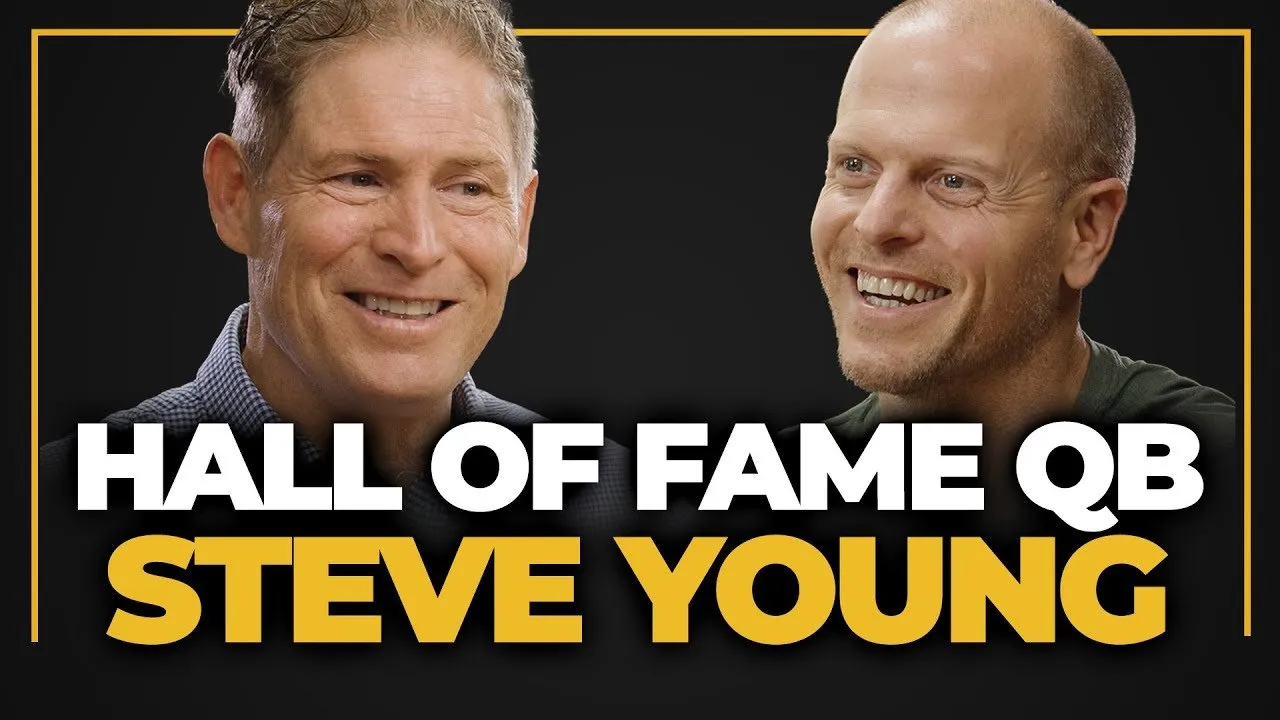
Steve Young is best known as the Hall of Fame quarterback who stepped out of Joe Montana’s shadow to win a Super Bowl and multiple MVP awards. However, his journey was defined less by athletic prowess and more by a relentless internal battle with anxiety, imposter syndrome, and the search for authentic leadership. Today, Young applies those same hard-won lessons as the co-founder of HGGC, a multi-billion dollar private equity firm.
In a revealing conversation with Tim Ferriss, Young deconstructed the psychology behind high performance. From a life-altering conversation with Stephen Covey to the "death" required to transition careers, Young offers a masterclass in shifting from a fear-based existence to one of radical ownership.
Key Takeaways
- Ownership cures victimization: A chance meeting with Stephen Covey taught Young that true performance begins only when you stop mitigating failure and start owning the outcome.
- Anxiety can be a double-edged sword: Young’s undiagnosed separation anxiety fueled his hyper-focus but nearly derailed his career until he identified and managed it.
- Talent requires technical refinement: Even elite athletes have blind spots; Young had to fundamentally relearn how to throw a football midway through his college career to unlock his power.
- Career transition requires mourning: To succeed in his second act in private equity, Young had to treat his football career as a death, mourn it, and fully "run away" toward his new identity.
- The "Law of Love" over transactions: Long-term success in business and life depends on moving from transactional interactions to unfeigned, non-self-interested relationships.
The Covey Moment: Moving from Victim to Author
In 1991, Steve Young was arguably in the most difficult position in sports: the backup quarterback to Joe Montana on the San Francisco 49ers. despite his talent, the pressure was suffocating. He felt the weight of expectations and believed the world was conspiring against him. He describes this period as being at the "bottom of a hole," engaging in a cycle of blame regarding his coach, the owner, and his situation.
The trajectory of his life changed during a flight from Salt Lake City to San Francisco, where he found himself seated next to Stephen Covey, the renowned author of The 7 Habits of Highly Effective People. After Young spent 30 minutes unloading his grievances, Covey offered a perspective that shattered Young's worldview.
Covey pointed out that Young was on perhaps the greatest platform in sports history—playing for a supportive owner and an innovative coach (Bill Walsh), and sitting behind a legend he could learn from. Covey asked a piercing question: was Young willing to find out how good he truly was?
"He took his finger and he kind of looked at me... and said, 'Then be about it.' And I was like, 'Oh my gosh.' I realized right there that the hole I was in, that I thought so many people had dug, that I had dug it... It was the realization that I had played the victim and had jumped in a hole, dug it and jumped in, and I am the author of it."
This realization moved Young from a state of "mitigation"—constantly explaining why things went wrong—to a state of accountability. He realized that living in mitigation is a form of death. The only way forward was to accept that he might fail, but he would no longer be a victim of the process.
Navigating Anxiety and High Performance
While the Covey conversation addressed his mindset, Young was also battling a physiological opponent: severe undiagnosed anxiety. As a child, he suffered from separation anxiety so intense that he couldn't spend the night at friends' houses. While he masked this in adulthood, it manifested as a grueling, fear-based drive to perform.
The Diagnosis as Relief
The turning point came when the 49ers' team doctor, Reggie, noticed Young's distress. After a successful game where Young played through a mental fog, he confessed his struggles to the doctor. This led to a diagnosis of adult separation anxiety rooted in childhood.
For many, a diagnosis is a burden, but for Young, it was data. It explained why he operated the way he did and removed the stigma. He realized that his "hyper-focus" was a coping mechanism for his anxiety. This allowed him to stop self-medicating with worry and start managing his mental health proactively.
The Physiology of Greatness
Young argues that what separates good quarterbacks from great ones isn't arm strength or IQ, but a specific neurological response to adrenaline. In most humans, adrenaline narrows focus but reduces awareness—a survival instinct. However, elite quarterbacks (and high-stakes operators in business) have a genetic predisposition where adrenaline creates focus without sacrificing peripheral awareness.
"The best quarterbacks have a genetic predisposition to when adrenaline runs, it doesn't do the normal things that [it does] for most humans... I wish there was a test for that because I could promise you I could tell you who's going to be great."
Technical Mastery: Relearning the Basics
Despite his natural athleticism, Young’s career was almost derailed by a fundamental flaw: he didn't know how to throw a football correctly. Growing up, he threw the ball by "spinning it" out of his hand to ensure a tight spiral, a mechanic similar to a golf swing that relies on timing rather than power.
It wasn't until his freshman year at BYU, watching Jim McMahon throw, that he realized he was doing it wrong. He discovered that power comes from internal arm tension and turning the wrist, not spinning the fingers. This technical epiphany was akin to "discovering fire."
This highlights a critical lesson for professionals in any field: natural talent can only carry you so far. There is often a technical unlock—a fundamental skill gap—that, once addressed, allows raw potential to become consistent performance.
The Art of Transition: "Running Away"
Retirement for professional athletes is often described as a "little death." Young navigated this transition better than most, largely due to advice from Roger Staubach, another legendary quarterback who found success in real estate.
Staubach’s advice was simple: Run.
He told Young that the game would never leave him, but he had to leave the game. Young interpreted this as a mandate to mourn his career as if it were a death. He had to bury the identity of "Steve Young, NFL Quarterback" to make room for his next chapter.
From Gridiron to Private Equity
Young’s transition wasn't an overnight pivot. He laid the groundwork during his playing days by attending law school in the off-seasons—a grueling schedule that involved flying back and forth between Super Bowl parades and contracts classes. While his father pushed for the law degree as a safety net, it ultimately served as his ticket to credibility in the business world.
Today, as a partner at HGGC, Young applies the same rigor to private equity that he did to football. He acknowledges that the adrenaline of the NFL is impossible to replicate, but the "full contact" nature of startups and high-stakes investing offers a similar arena for "emotional athleticism."
The Law of Love vs. Transactional Living
Perhaps the most profound shift in Young’s life has been spiritual and philosophical. He observes that the modern world, including the high-finance circles of Silicon Valley, is dominated by transactional relationships. These relationships are inherently self-interested and, according to Young, subject to entropy—they eventually rot.
Young proposes an alternative: The Law of Love. This is the idea that to see the full measure of a relationship or an endeavor, one must lose the self-interest. It is a move from asking "What can I get?" to "How can we learn and grow?"
"If you and I have a transactional relationship, it's going to feel that way and there's a lot of bounty in it... But in the end, if it's purely transactional, if my marriage is purely transactional, at some point it's going to break. It has to in self-interest."
In his private equity firm, this manifests as a partnership model built on trust rather than just capital. He views his partners not as tools for wealth accumulation, but as collaborators in a shared laboratory of learning. Young argues that while transactional living is rational in a short-term, "eat what you kill" world, it is ultimately irrational if the goal is a durable, fulfilling existence.
Conclusion
Steve Young’s journey from a fear-based athlete to a hall-of-fame leader is a testament to the power of rewriting one's own narrative. Whether it was refusing to accept the role of a victim on a plane ride with Stephen Covey, or refusing to let anxiety define his ceiling, Young consistently chose growth over safety.
His success in business suggests that the skills required to navigate 80,000 screaming fans are not so different from those required to navigate market volatility: distinct clarity, radical accountability, and the courage to abandon transactional shortcuts in favor of enduring relationships.
For more insights from Tim Ferriss and his interviews with world-class performers, visit The Tim Ferriss Show.