Table of Contents
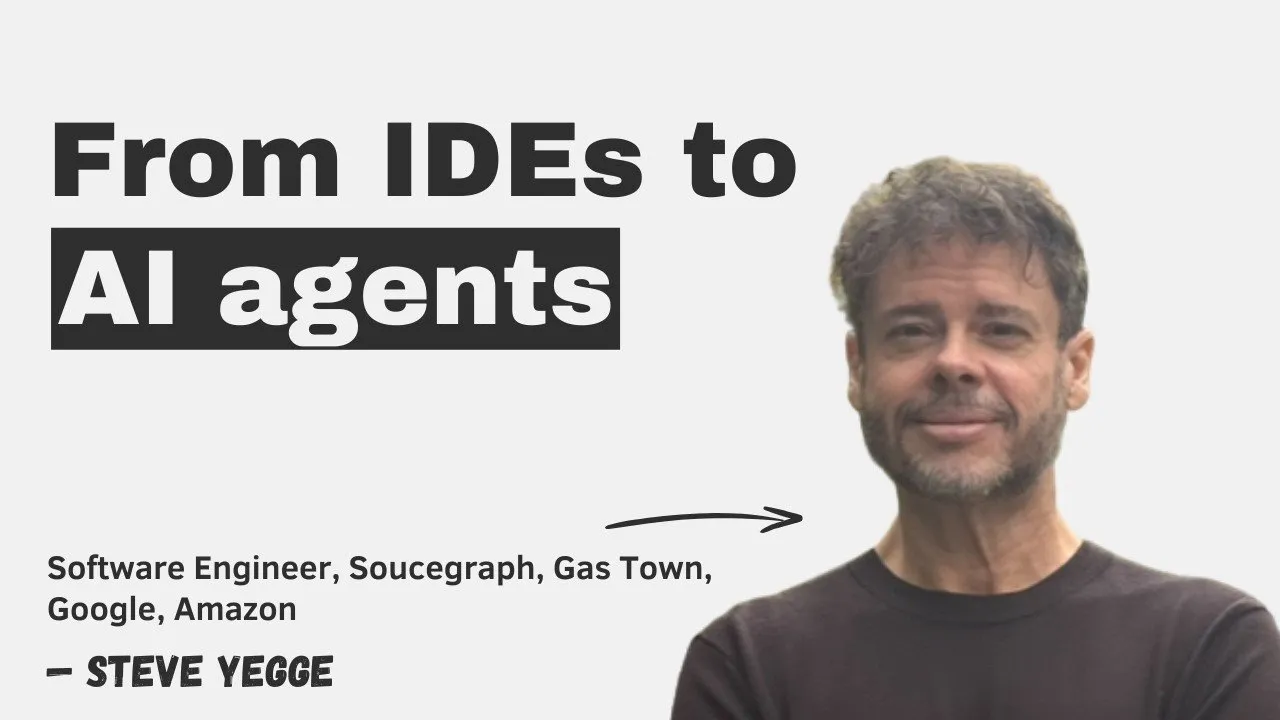
The landscape of software engineering is undergoing its most significant transformation since the dawn of the internet. Steve Yegge, a veteran engineer with four decades of experience at giants like Amazon and Google, suggests that the era of manual coding is effectively ending. As we shift from writing raw syntax to orchestrating AI agents, the industry is entering a period of rapid, chaotic, and exhilarating change. For those willing to adapt, this transition promises a future where personal productivity multiplies exponentially—but only if you are willing to let go of the traditional tools and identities that have defined the profession for years.
Key Takeaways
- The Shift in Abstraction: Similar to how computer graphics evolved from manual pixel calculation to complex game engines, software engineering is moving away from low-level implementation toward high-level agentic orchestration.
- The Vampire Effect: AI is so effective at generating code that it can lead to burnout, forcing engineers to redefine their relationship with "work-life balance" and value capture.
- The Death of the Monolith: Large, rigid codebases are becoming a liability. Success in the AI era favors modularity, transparency, and smaller, highly agile teams.
- Embrace the Curve: The industry is on an exponential trajectory. Those who refuse to adopt AI or cling to traditional IDE workflows risk becoming obsolete as the "barbarian horde" of AI-empowered developers scales output at unprecedented speeds.
The Evolution of the Software Engineer
For decades, the definition of a "good" programmer was tied to a deep understanding of low-level mechanics—compilers, memory management, and bit manipulation. Yegge notes that these requirements have constantly moved up the ladder. Just as early graphics engineers had to calculate the position of every pixel, modern developers are now moving away from the "Kingdom of Nouns" toward an era where AI agents perform the heavy lifting.
The transition is not just about using better tools; it is about a fundamental change in how we view the "craft" of coding. When the inventor of languages like Visual Basic and C admits that we are done writing code by hand, it signals that the industry has reached a point of no return. We are no longer building software one line at a time; we are curating the output of an increasingly sophisticated, agentic workforce.
The days of coding by hand are over.
The Agentic Orchestration Era
Steve Yegge’s open-source project, Gas Town, serves as a blueprint for this new reality. It is an orchestrator that manages multiple AI agents, essentially creating a "factory" of workers that talk to one another to achieve complex goals. Yegge describes the levels of adoption, ranging from "Level One: No AI" to "Level Six: Boredom," where the engineer spends their time multiplexing between multiple autonomous agents.
Navigating the Chaos
Working with agents is not without its pitfalls. Yegge warns of "heresy"—incorrect architectural patterns that agents might adopt and propagate throughout a codebase. Because agents can be non-deterministic, engineers must move from being "code authors" to "system maintainers" who document constraints and guardrails within their prompts. The goal is to provide enough structure that the agents can operate autonomously without veering off into invalid patterns.
The Vampire Effect and Value Capture
One of the more uncomfortable truths in the current AI transition is the burnout risk. Yegge describes a "vampiric effect" where the sheer efficiency of AI encourages developers to push harder, leading to a state where they are hyper-productive for three hours and then mentally exhausted for the rest of the day.
This creates a massive economic tension: if you are 100 times more productive, who captures that value? If you continue to work an eight-hour day, the company reaps the entire benefit. If you work only ten minutes to achieve the same results, you capture the value yourself. This power dynamic is forcing a re-evaluation of how we compensate knowledge workers in an era where output is no longer tethered to hours clocked in front of an IDE.
The Decline of Large Tech Institutions
Yegge offers a provocative take on the current state of "Big Tech." He argues that large companies often suffer from a scarcity of meaningful work compared to their headcount, leading to political stagnation, territorialism, and, eventually, a decline in innovation. In contrast, small teams of two to twenty people are now capable of rivaling the output of these massive organizations.
Big companies can't innovate. They're all running into this problem. They may have hyper-productive engineers... but the company itself can't absorb that work.
The "innovator's dilemma" is exacerbated by AI. Because large enterprises are often built around monolithic architectures that cannot fit into an AI's context window, they are effectively locked out of the rapid iteration cycles available to smaller, more nimble players. The future, according to Yegge, belongs to those who build, iterate, and fork aggressively.
Conclusion
The journey into AI-driven engineering is not merely a technical upgrade; it is a psychological transition. It requires shedding the ego associated with "being a coder" and embracing the role of an architect and curator. While the change can feel like a loss of the craft we once loved, the reality is that the new era allows for more creativity, more rapid prototyping, and the ability to solve problems that were previously unthinkable. As Yegge concludes, the future is arriving whether we are ready for it or not; the most pragmatic path forward is to stop fighting the current, climb onto the ride, and start building.