Table of Contents
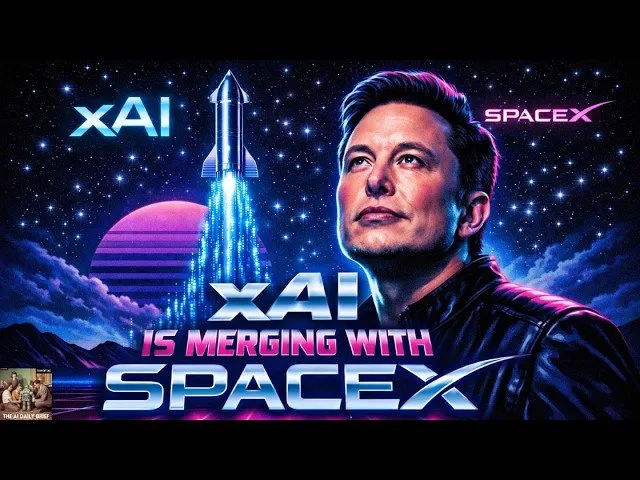
Elon Musk has officially initiated a massive consolidation of his business empire, announcing a merger between his aerospace company, SpaceX, and his artificial intelligence venture, xAI. The deal creates a new entity valued at approximately $1.25 trillion, aiming to combine orbital launch capabilities with advanced generative AI to develop "orbital data centers." While the move promises to create a vertically integrated innovation engine capable of challenging major tech giants, it also raises significant questions regarding regulatory hurdles, financial sustainability, and the physical feasibility of launching massive compute infrastructure into space.
Key Takeaways
- Valuation and Structure: The combined entity is valued at $1.25 trillion, with SpaceX contributing $1 trillion and xAI accounting for $250 billion.
- The "Orbital Compute" Vision: Musk predicts that space-based data centers will become the lowest-cost method for AI training within 2 to 3 years due to solar efficiency and radiative cooling.
- Scale of Ambition: SpaceX has filed an FCC application to launch 1 million AI satellites, a move that would increase current orbital density by two orders of magnitude.
- Financial Scrutiny: Critics argue the merger is financially motivated to cover xAI’s high burn rate, noting the company recorded a $1.46 billion net loss in the September quarter.
- Product Updates: Amidst corporate restructuring, xAI continues to ship products, recently launching Grok Imagine 1.0 with advanced video and audio generation capabilities.
The Trillion-Dollar Consolidation
The merger represents the latest stage in what industry observers call "Muskian consolidation." Following the integration of xAI with the X (formerly Twitter) platform, this new deal brings Musk’s primary hardware and software ventures under one roof. The deal values the new combined entity at $1.25 trillion. Specifically, SpaceX is valued at a flat $1 trillion, while xAI is valued at $250 billion—a slight premium over its rumored $230 billion valuation following a Series E round earlier this month.
According to the official announcement, the acquisition is designed to create a singular force in deep technology. SpaceX described the goal as forming a comprehensive ecosystem spanning rockets, space-based internet, and artificial intelligence.
"This marks not just the next chapter, but the next book in SpaceX and xAI's mission, scaling to make a sentient sun to understand the universe and extend the light of consciousness to the stars."
This consolidation allows for the sharing of resources between the capital-intensive demands of rocketry and the compute-intensive demands of training large language models (LLMs). By merging, the companies aim to leverage SpaceX’s launch capabilities to deploy xAI’s infrastructure directly into orbit, bypassing terrestrial limitations.
The Thesis: Orbital Data Centers
The core strategic justification for the merger is the development of orbital data centers. Musk has argued that the future of AI compute lies in space due to energy and thermal dynamics. In the announcement note, Musk offered a bold prediction regarding the timeline of this technology.
"My estimate is that within 2 to 3 years, the lowest cost way to generate AI compute will be in space. This cost efficiency alone will enable innovative companies to forge ahead in training their AI models and processing data at unprecedented speeds and scales."
The technical argument for space-based compute rests on two pillars: energy access and cooling. Without atmospheric interference, satellites can harness solar energy at significantly higher efficiencies than Earth-bound panels. Furthermore, the vacuum of space allows for radiative cooling—venting heat directly into deep space—potentially eliminating the massive water and electricity consumption required by terrestrial data centers.
To execute this, SpaceX filed an application with the Federal Communications Commission (FCC) earlier this week to launch one million AI satellites. For context, there are currently only about 15,000 active satellites in orbit. Critics point out that no entity has launched more than a single test case for orbital compute, making the regulatory approval for a network of this magnitude uncertain. However, SpaceX has a history of successful negotiation; regulators recently approved an increase in Starlink satellites to 15,000 by 2031.
Financial Engineering vs. Innovation
While the technological vision is expansive, financial analysts suggest the merger is also driven by the harsh economic realities of the AI arms race. Developing frontier models requires tens of billions of dollars in capital, a challenge for xAI as it competes against cash-rich incumbents like Google and Meta, which fund their research through lucrative advertising monopolies.
Reports indicate that xAI remains in a "cash incinerator" phase. Bloomberg reported that xAI recorded a net loss of $1.46 billion for the quarter ending in September on just $107 million in revenue. While revenue doubled quarter-over-quarter, the company reportedly spent $7.8 billion over the first three quarters of the last year.
Skeptics argue that merging xAI with the profitable SpaceX may be a mechanism to subsidize AI development. SpaceX generated $15 billion in revenue last year with an EBITDA profit of $8 billion. However, high depreciation costs associated with rocketry mean that actual free cash flow may be tighter than EBITDA suggests.
"An 80/20 split for SpaceX and xAI seems like a horrible deal for SpaceX. Giving the number five, if that, AI company with limited real revenue... ownership of 20% of a truly world-changing rocket company is ridiculously bad for SpaceX shareholders." — @compound248, Financial Analyst
Despite the skepticism, supporters argue that applying terrestrial accounting to Musk’s ventures has historically been a losing bet. They point to Starlink, which began as an economically questionable project with high launch costs. Since its inception, SpaceX has reduced launch costs by nearly 20x, turning satellite internet into a viable, revenue-generating utility.
Technological Progress and Future Outlook
Beyond the financial structuring, xAI continues to push its technical roadmap. The company recently released Grok Imagine 1.0, a significant update introducing 10-second video generation, 720p resolution, and improved audio capabilities. Industry observers noted that xAI’s release competed directly with Google’s recent Genie 3 launch, signaling that despite the merger distractions, the engineering team remains focused on model performance.
The merger also raises the stakes for a potential public offering. Financial newsletters have dubbed the prospective combined listing as potentially "the biggest IPO in history." While competitors like OpenAI and Anthropic navigate their own paths to liquidity, the SpaceX-xAI merger creates a unique hardware-software hybrid that defies traditional categorization.
Ultimately, the success of this merger hinges on whether orbital compute is a physical necessity or a sci-fi distraction. If future AI models require hundreds of terowatts of power—levels that would strain Earth's power grids—space-based infrastructure may be the only viable solution. As the regulatory process for the one-million-satellite constellation begins, the tech world watches to see if Musk can once again bridge the gap between "uncomfortable idea" and economic reality.