Table of Contents
The tech and financial landscape is shifting at an unprecedented velocity, characterized by historic IPO valuations, geopolitical instability, and the rapid convergence of artificial intelligence with traditional industries. As industry leaders evaluate the next wave of public offerings—led by the potential massive debut of SpaceX—investors are weighing the long-term potential of emerging technologies against the harsh realities of global market volatility and supply chain shocks. This moment marks a pivot point for the global economy, as businesses move from speculative growth to a focus on structural resilience.
Key Takeaways
- SpaceX's IPO Path: SpaceX is positioning itself as a massive, infrastructure-heavy entity whose eventual merger with Tesla could create a multi-trillion-dollar industrial powerhouse.
- The AI IPO Wave: While companies like OpenAI and Anthropic are eyeing massive valuations, market appetite may be limited; investors should prioritize early movers to avoid the risks of a cooling IPO market.
- Global Supply Chain Fragility: Geopolitical tensions, particularly in the Middle East, are threatening critical resource flows, including natural gas and nitrogen-based fertilizers, potentially triggering further food supply crises.
- The Quantum Threat: The rapid acceleration of quantum computing theory poses an existential risk to current encryption standards, creating an urgent need for the cryptocurrency and financial sectors to adopt quantum-resistant architectures.
The SpaceX and Tesla Singularity
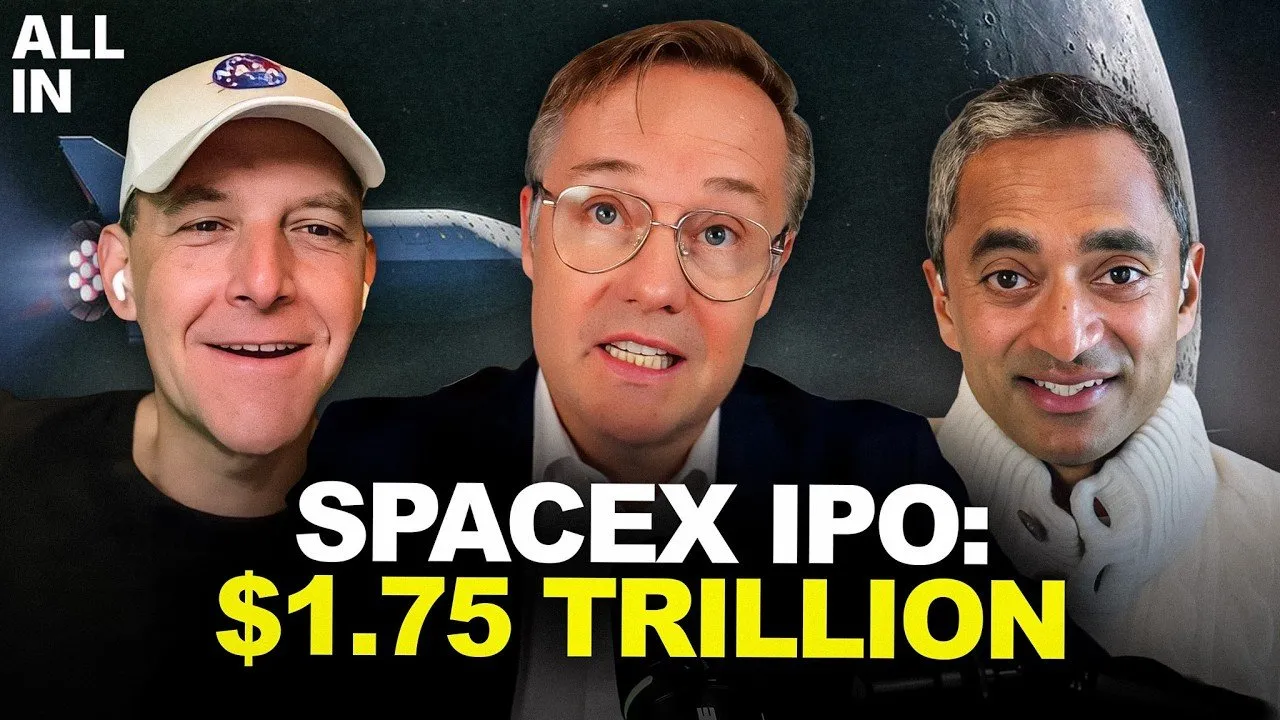
SpaceX’s move toward a public offering is set to be a landmark event for capital markets. With a targeted valuation approaching $1.75 trillion, the company is not merely a launch provider but a foundational infrastructure layer for the next century. By combining SpaceX’s launch and connectivity capabilities with Tesla’s expertise in robotics and AI, the potential for a merged entity is viewed by many market participants as nearly inevitable.
The market every day in real time gives you a valid mark-to-market assessment of the value of Tesla. And this allows you to put these two things together to minimize these losses.
This integration aims to streamline resource allocation—using the same "brain trust" and materials science breakthroughs across multiple sectors. From developing autonomous robots for terrestrial manufacturing to creating industrial frontiers on the moon, the synergy between these companies represents a move toward deep-tech consolidation rather than singular product development.
Space as the Next Industrial Frontier
Beyond the stock market, the long-term vision for space centers on utilizing the moon as an industrial hub. The combination of low gravity and a lack of atmosphere creates an environment where manufacturing processes—previously impossible on Earth due to cost and friction—can thrive. Utilizing mass drivers to accelerate materials off the lunar surface could allow for the production of precious metals, semiconductors, and other goods at a fraction of the energy cost required for terrestrial logistics.
Robotics as the Catalyst
The transition to space-based production is fundamentally tied to the robotics revolution. As autonomous systems become more sophisticated, they will serve as the workforce for lunar manufacturing. This development is not a zero-sum game; it is an expansion of human potential. By offloading resource-intensive processes to space, humanity can foster an entirely new layer of economic activity, ranging from orbital data centers to energy generation systems that operate in parallel with Earth’s infrastructure.
Navigating the IPO Liquidity Crunch
While the prospect of massive IPOs from companies like SpaceX, OpenAI, and Anthropic is exciting, market participants face a significant "appetite problem." The surge in capital-intensive tech companies arriving on the public markets creates a risk that investor demand will become saturated.
The Risk of Being Last
There is a distinct advantage to being early in the current IPO cycle. As more companies enter the market, the cost of capital is likely to rise, and institutional appetites may wane. Critics point to the secondary market as a potential canary in the coal mine, noting that some investors are already struggling to find liquidity at current private valuations. The result may be a necessary "re-rating" of tech stocks, where the multiple compression seen in traditional software sectors begins to bleed into the high-valuation AI category.
Geopolitical Fallout and Food Security
Global instability, particularly in the Middle East, is revealing the fragility of our supply chains. The conflict near the Strait of Hormuz has direct consequences for the global food supply, as natural gas—a key input for nitrogen-based fertilizer—is often sourced from the region. When supply chains for these critical inputs are disrupted, the downstream impact on agricultural productivity is severe, leading to price spikes that threaten the profitability of farmers and increase the risk of global malnourishment.
The choke point in the strait of Hormuz is turning out to be a real critical global food supply crisis yet again similar to Ukraine.
To combat this, nations must prioritize energy independence and consider building domestic stockpiles of critical agricultural inputs. Relying on single-source suppliers in geopolitically volatile regions is no longer a viable long-term strategy for global food security.
The Quantum Challenge for Digital Assets
A looming, yet often overlooked, risk is the advancement of quantum computing. As computational power grows, the encryption standards that protect the modern internet and the cryptocurrency ecosystem may soon become vulnerable to quantum-assisted decryption. This creates an immediate need for the ecosystem to migrate toward quantum-resistant standards.
If a non-state actor gets a hold of quantum technology that can defeat crypto as we know it, a non-state actor's incentive will first be to drain the obvious honeypots.
The responsibility now lies with developers to architect these systems with future-proof security. Failure to adapt within the next five to seven years could leave digital assets and traditional financial records exposed, turning these technological hubs into major targets for exploitation.
Conclusion
The current environment is one of extreme transition. Whether it is the industrialization of the moon, the evolution of AI-driven companies, or the geopolitical realignments necessitated by resource scarcity, the next few years will test the durability of our current economic models. Success in this era requires a shift away from short-term speculation toward building resilient, diversified, and technologically secure foundations. As we move forward, the focus must remain on progress—creating new value, solving critical infrastructure problems, and ensuring that the systems supporting our society can withstand the pressures of a rapidly changing world.