Table of Contents
The cryptocurrency market is currently navigating a period of intense structural shift. While price action often dominates the headlines, the underlying battle for layer-1 (L1) supremacy has entered a new phase. Solana, once the underdog challenger to Ethereum, now finds itself at a crossroads. As Ethereum attempts to self-correct its roadmap and high-performance newcomers like Hyperliquid gain traction, the question remains: How will Solana maintain its momentum in an increasingly crowded field?
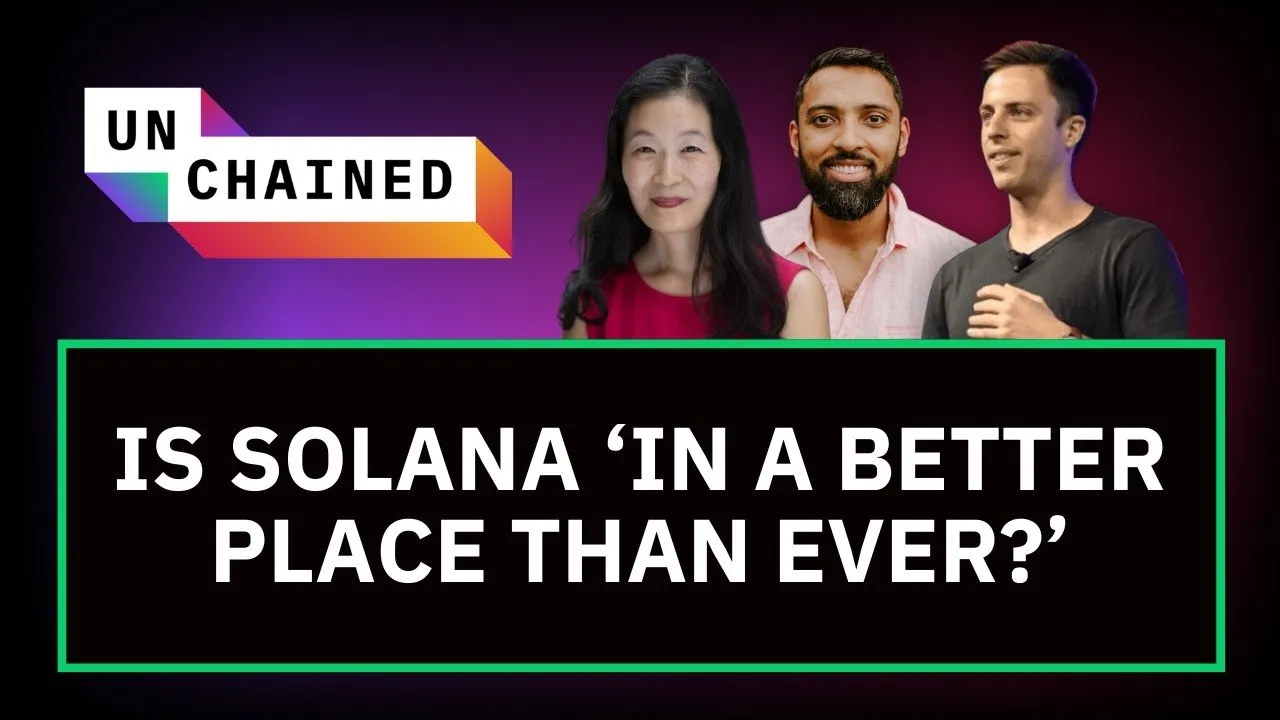
Industry experts Tushar Jain, co-founder of Multicoin Capital, and Mike Ippolito, co-founder of Blockworks, recently shared their insights on the Unchained podcast. Their analysis suggests that Solana’s future depends less on raw speed and more on market microstructure, credible neutrality, and its ability to serve as the "Internet Capital Markets" substrate. By examining technical milestones like Alpenlow and the cultural shift toward "entertainment finance," we can better understand Solana's trajectory in the coming years.
Key Takeaways
- Technical Evolution: Upcoming upgrades like Alpenlow and Application Controlled Execution (ACE) are designed to dramatically improve transaction finality and enable more sophisticated on-chain trading environments.
- Strategic Pivots: Ethereum’s recent shift away from an L2-centric roadmap back toward L1 scaling validates the integrated approach Solana has pioneered, though significant scalability hurdles remain for the former.
- Credible Neutrality: The rollout of Fire Dancer is viewed as a "quantum leap" for Solana, not just for performance, but for providing the multi-client resilience necessary for institutional adoption.
- New Verticals: "Entertainment finance"—encompassing memecoins, prediction markets, and social apps—along with the rise of AI agents, represents the next major wave of organic on-chain activity.
The Strategic Duel: Solana vs. Ethereum’s New Roadmap
For years, the primary criticism against Solana was its perceived centralization compared to Ethereum. However, the narrative is shifting as Ethereum begins to acknowledge the limitations of its rollup-centric strategy. Critics argue that the L2 roadmap fragmented liquidity and failed to accrue value back to the Ethereum mainnet. Notably, many in the Ethereum community are now advocating for a return to scaling the base layer—a move that brings its philosophy closer to Solana’s integrated model.
The L2 Failure and Ethereum’s Self-Correction
Tushar Jain notes that while he originally found crypto through Ethereum, he believes the ecosystem's recent focus was misguided. The L2 strategy, he suggests, has not delivered the promised value. While Ethereum is attempting to pivot, it faces substantial architectural challenges. Jain explains that without a complete re-architecture, Ethereum L1 may struggle to be competitive for high-frequency applications like trading or borrow-lend markets, where liquidations must happen near-instantaneously to prevent bad debt.
Solana as Internet Capital Markets
Solana is positioning itself as the "Internet Capital Markets," a neutral platform designed to internalize trades and host consumer applications. While Ethereum is often viewed as a "money market" or asset management chain, Solana aims to be the venue for active price discovery. Mike Ippolito suggests that Solana’s brand is now firmly established as the go-to for entrepreneurs building high-throughput applications, ranging from decentralized exchanges (DEXs) to social platforms.
Using the market price as an indicator of fundamentals is a bad heuristic. You have to really look under the hood.
Technical Milestones: Alpenlow and ACE
Beyond the marketing and business development efforts, Solana’s technical roadmap is focused on refining the user experience and developer flexibility. Two specific advancements, Alpenlow and Application Controlled Execution (ACE), are expected to be game-changers for the network’s performance and utility.
Alpenlow: A Step-Change in Finality
Alpenlow is a consensus upgrade aimed at reducing the time to finality. Jain compares it to the evolution of SpaceX engines—a move from a complex, "wired-up" system to a streamlined, hyper-efficient one. For the average user, this translates to a higher probability of transactions landing exactly when expected and a significant boost in throughput during periods of network congestion.
Application Controlled Execution (ACE)
ACE allows individual applications to control the order of transactions within a block. This is a departure from the traditional first-come, first-served or fee-priority models. For example, a borrow-lend platform could prioritize liquidators who stake the protocol's native token, or a DEX could implement "price-stake priority" for its order book. This level of customization enables a new design space for market microstructure that is currently unavailable on other major chains.
The Impact of Fire Dancer and Client Diversity
The successful deployment of Fire Dancer, an independent validator client written from scratch by Jump Crypto, marks a significant milestone in Solana’s quest for resilience. While it currently only powers a small percentage of the network, its value extends beyond simple adoption metrics.
Competition Breeds Performance
The existence of Fire Dancer has fostered a competitive environment among core developers. Jain observes that the Agave team (formerly Solana Labs) significantly improved their own client’s performance in response to the progress of Fire Dancer. This competition ensures that no single development team has a monopoly on the protocol’s direction.
Resilience and Institutional Trust
From a security perspective, having two independent clients protects the network against "day zero" bugs. If a vulnerability is found in one client, validators can switch to the other, preventing a total network shutdown. This multi-client architecture is a prerequisite for "credible neutrality," making the network a more attractive substrate for large-scale institutional asset issuance.
Credible neutrality really matters. I'm pretty bearish on corporate chains. Mastercard is not going to build on Visa's chain.
The Rise of Entertainment Finance and AI Agents
The types of activity occurring on-chain are evolving. Solana has become the epicenter of "entertainment finance," a category that includes memecoins, NFTs, and gamified trading. While often dismissed by critics, this activity represents a fundamental shift in how people interact with financial systems.
The Psychology of High-Velocity Trading
Platforms like Pump.fun have generated significant revenue by leaning into the entertainment aspect of crypto. Jain argues that trading has become a form of amusement for younger generations, similar to sports betting. This organic demand drives liquidity and tests the network’s limits, ultimately hardening the infrastructure for more "serious" financial applications in the future.
AI Agents: The New Power Users
AI agents are increasingly becoming significant participants in the crypto economy. Because these agents are "optimization machines," they naturally gravitate toward chains with the lowest costs and highest speeds. As AI agents lack traditional identification to open bank accounts, crypto provides the only viable financial rails for them. Solana’s low-latency environment is uniquely positioned to capture this emerging "agentic" flow.
Governance and the Path to Institutional Adoption
As Solana matures, its governance and tokenomics are coming under increased scrutiny. The proposal of a "Solana Constitution" seeks to codify "soft governance"—the framework for how community debates and straw polls are conducted—without interfering with the "hard governance" of validator stake.
Addressing Tokenomics and Inflation
There is an ongoing debate regarding Solana’s inflation rate and staking rewards. Some proponents argue for a dynamic inflation rate and "long-term staking" rewards that incentivize holders to lock up tokens for extended periods. While these discussions were sidelined during the network’s early technical struggles, the current stability of the chain has reopened the door for economic refinement.
The Competitive Landscape of RWAs
While Ethereum currently leads in the total value of Real-World Assets (RWAs), such as tokenized treasuries and gold, Jain and Ippolito believe the race is far from over. Most of the growth in RWAs is expected to occur in the future, following greater regulatory clarity. Solana’s "token extensions" and efficient market microstructure make it a formidable competitor for the next generation of institutional issuers.
Conclusion
Solana’s journey through the current market "air gap" is defined by a focus on technical refinement and market-leading innovation. While the competition from Ethereum and emerging DEX-chains like Hyperliquid is fierce, Solana’s integrated approach and commitment to permissionless experimentation provide a unique advantage. By doubling down on market microstructure through tools like ACE and Prop AMMs, and ensuring network resilience with Fire Dancer, Solana is building more than just a fast blockchain—it is constructing the architecture for a global, on-chain capital market.
The coming 12 to 18 months will likely see a consolidation of winners in the layer-1 space. In this environment, the chains that offer the most "useful things to do"—whether that is entertainment-driven trading or institutional asset management—will emerge as the dominant platforms of the next era of finance.