Table of Contents
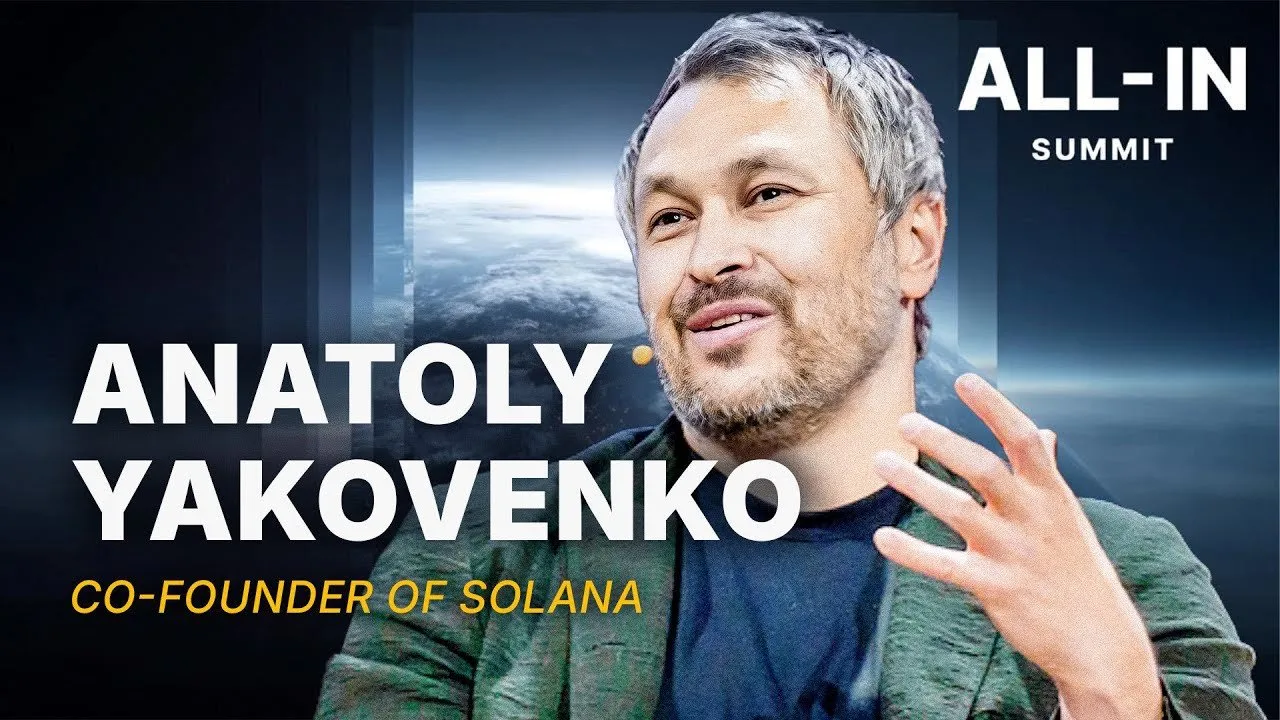
In the rapidly evolving landscape of Web3, few figures command as much attention as Anatoly Yakovenko. As the co-founder of Solana and CEO of Solana Labs, Yakovenko isn't merely building a blockchain; he is engineering a fundamental shift in how the world processes value. In a recent wide-ranging discussion, he laid out a vision that extends far beyond current market cycles, touching on everything from the physics of financial latency to the existential threats posed by quantum computing.
Yakovenko’s perspective is distinct because it is rooted in hard engineering. He views the global economy not just as a series of markets, but as a physics problem—a challenge of synchronizing information at the speed of light. From the dominance of stablecoins to the inevitable disruption of traditional banking, his insights offer a roadmap for the next decade of digital finance.
Key Takeaways
- Solana as the Execution Layer: While Ethereum focuses on settlement, Solana aims to be the "Google of Finance," acting as the world’s high-speed execution engine capable of synchronizing global markets in milliseconds.
- The Stablecoin Superpower: Yakovenko predicts that within five years, the internet itself—via stablecoins—will become one of the largest holders of US Treasuries, effectively exporting the US dollar and American financial stability globally.
- Quantum Computing Imminence: There is a forecasted 50/50 chance of a major quantum computing breakthrough within five years, necessitating an immediate migration to quantum-resistant cryptography for Bitcoin and tech giants alike.
- Regulatory Friction vs. Innovation: The current dominance of meme coins is largely a byproduct of regulatory stagnation; clear laws would unlock the tokenization of real-world assets like real estate and insurance.
- The Vulnerability of Banks: Contrary to popular belief, Visa and Mastercard are not the primary targets for disruption—traditional issuer and receiver banks, with their high margins and legacy infrastructure, are the entities most at risk.
The Physics of Finance: Building the "World Computer"
Yakovenko’s primary thesis for Solana is built on a vision of a single, giant, synchronized ledger for the entire world. This is not merely about transaction throughput; it is about reducing the latency of finance to the limits allowed by physics. He describes a "science fiction" version of finance 20 to 50 years in the future, where a single computer manages every market globally.
The engineering challenge is synchronization. A signal traveling via fiber optics or Starlink satellites takes approximately 120 milliseconds to circle the globe. Yakovenko argues that for a truly efficient global market, the velocity of money must match this physical limit.
"A dollar can be in New York, in London, in Singapore, in Nairobi in 120 milliseconds. So velocity of money, velocity of assets are as fast as physics allow. This is what nerdpilled me on building this... it's a massive finance problem."
Execution vs. Settlement
This focus on speed highlights the fundamental divergence between Solana and Ethereum. Yakovenko acknowledges the success of Ethereum as the world's settlement layer, where transactions can take minutes to finalize without catastrophic consequences. However, he positions Solana as the world's execution layer.
In this framework, execution is where value is generated and where opportunities are seized. By prioritizing high-performance architecture, Solana attempts to capture the activity that requires Nasdaq-level speed, leaving slower settlement layers to handle finality. The ultimate goal is for traditional financial engines, like Nasdaq itself, to eventually run purely on Solana nodes, leveraging the protocol’s global reach while maintaining their own regulatory compliance.
The Regulatory Bottleneck and the Rise of "Meme Coins"
A common criticism of high-throughput blockchains is that much of their bandwidth is currently consumed by speculative assets, specifically meme coins. Yakovenko offers a counter-intuitive explanation for this phenomenon: meme coins dominate not because they are the pinnacle of crypto innovation, but because they are the only assets that can flourish in a regulatory vacuum.
The original tagline for Solana was "blockchain at Nasdaq speed," with the intention of onboarding stocks, bonds, and treasuries. However, digitizing real-world assets (RWAs) presents significant legal hurdles that engineering cannot solve alone. Because anyone can create a market for anything on a permissionless chain, and because regulation has been slow to provide pathways for legitimate securities, meme coins have filled the void.
The Need for Uncorrelated Assets
Moving beyond speculation requires what Yakovenko calls the "Clarity Act"—legislative frameworks that allow founders to launch tokens without exorbitant legal fees. He notes that in his own experience, over 10% of his initial seed round was consumed by legal costs just to determine how to launch in the US.
The introduction of regulated real-world assets is critical for the maturity of DeFi (Decentralized Finance). Currently, most crypto assets are highly correlated; when the market crashes, everything crashes. To build robust financial systems, the chain needs uncorrelated assets—real estate, commodities, or insurance contracts—to allow for true hedging and risk management.
Geopolitics and the Stablecoin Export
One of the most transformative aspects of crypto adoption is the role of stablecoins in global finance. Yakovenko views stablecoins not just as a trading tool, but as a vehicle for spreading Western financial infrastructure. Estimates suggest that anywhere from $1 trillion to $10 trillion worth of stablecoins could eventually reside on public permissionless chains.
This shift has massive geopolitical implications. Currently, nations like China and Japan are major holders of US debt. Yakovenko predicts a shift where the "internet"—comprising millions of individuals and businesses holding USD-pegged stablecoins—becomes a top-five holder of US Treasuries.
"I think within 5 years the internet is going to be the largest holder of US treasuries... I think it’s a huge opportunity to really accelerate American innovation and spread American finance around the world."
By building a financial stack on top of the open internet rather than legacy banking APIs (which Yakovenko likens to "fax machine" technology), the US can export its financial reliability and transparency to the rest of the world, reinforcing the dollar's dominance through technological superiority rather than mere policy.
The Quantum Threat and AI Convergence
Looking further toward the horizon, Yakovenko identifies two converging technologies that will reshape the industry: Artificial Intelligence and Quantum Computing. While AI's intersection with crypto is often discussed in terms of automated agents paying for compute resources, his views on quantum computing are more urgent.
He estimates a 50% chance of a quantum computing breakthrough within the next five years, driven largely by AI's ability to accelerate material science and research. Such a breakthrough poses an existential threat to current cryptographic standards.
Preparing for a Post-Quantum World
The implication of a quantum leap is that the cryptographic locks securing Bitcoin, banking systems, and military communications could be broken. Yakovenko urges the industry, particularly Bitcoin, to migrate to quantum-resistant signature schemes immediately. He views the adoption of these standards by tech giants like Google and Apple as the signal for the rest of the world to follow.
Despite the risks, he remains optimistic about the economic potential. Just as AI has unlocked massive wealth, a functional quantum computer would represent a staggering leap in processing power, creating a new era of wealth generation for those who adapt.
Disrupting the Banking Monolith
Finally, Yakovenko addresses the competitive landscape of payments. Often, blockchain proponents view Visa and Mastercard as the enemies. Yakovenko disagrees, characterizing them as efficient technology companies with razor-thin margins (roughly 10 basis points on volume). The real inefficiency—and the profit pool ripe for disruption—lies with the banks.
Issuer and receiver banks often capture significantly higher margins (upwards of 2%) while providing legacy infrastructure. Yakovenko suggests that if Visa and Mastercard were to bypass banks and settle directly via stablecoins, they could increase their own efficiency while cutting out the "fat" of the traditional banking sector.
His financial advice, delivered with a mix of humor and conviction, summarizes the sentiment of the Web3 era regarding legacy finance:
"Long stable coin, short banks."
Conclusion
Anatoly Yakovenko’s roadmap for the future involves a convergence of high-speed engineering, regulatory clarity, and macroeconomic shifts. Whether it is preparing for the quantum era or exporting the US dollar through code, the goal remains consistent: to upgrade the world’s financial operating system. As the barriers between traditional finance and decentralized execution erode, the question is no longer if crypto will win, but rather how quickly the world can adapt to a financial system that moves at the speed of light.
![Bitcoin Is on Sale [How to Buy It in 2026]](/content/images/size/w1304/format/webp/2026/03/how-to-buy-bitcoin-2026.jpg)