Table of Contents
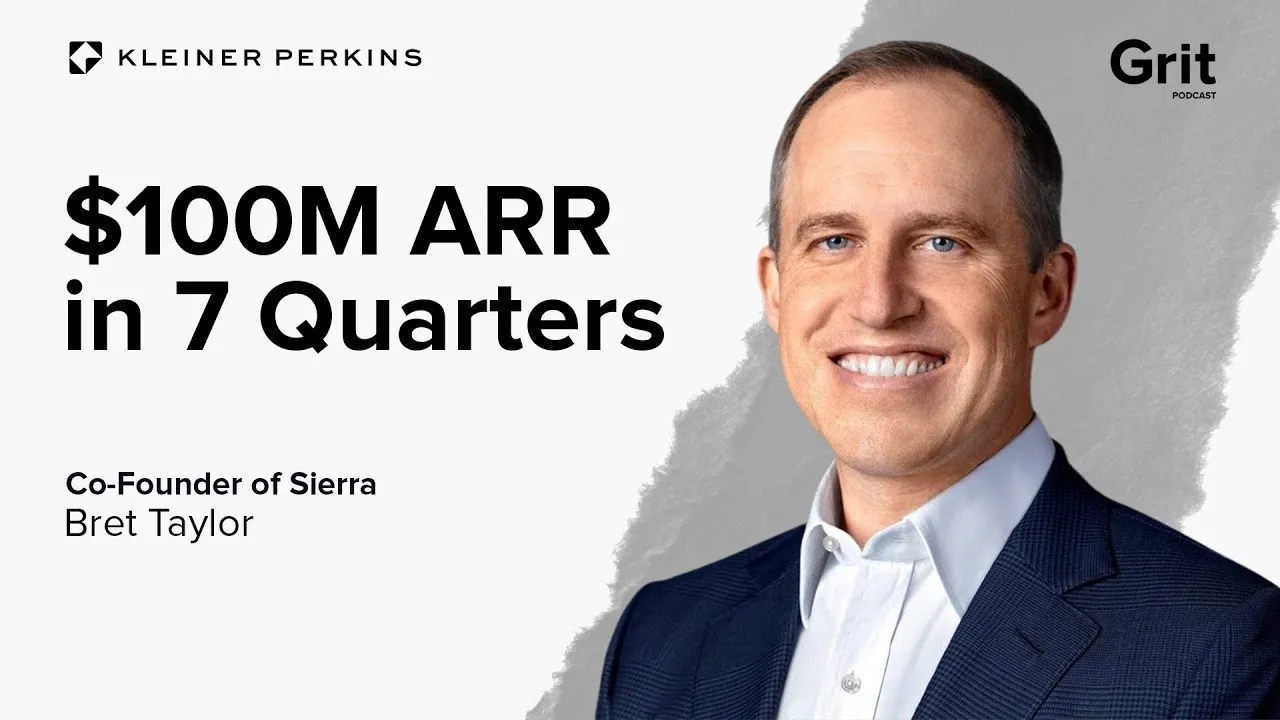
In the rapidly evolving landscape of artificial intelligence, few leaders have navigated the transition from big-tech veteran to high-growth startup founder as effectively as Bret Taylor. As co-founder of Sierra, Taylor has steered the company to a remarkable $150 million in annual recurring revenue (ARR) in just seven quarters. In a candid conversation with Kleiner Perkins partner Jubin, Taylor shared his philosophy on building enterprise-grade AI, the danger of internal narratives, and why competitive intensity is a cornerstone of modern business.
Key Takeaways
- Focus on Enterprise Impact: Sierra prioritizes the Fortune 100 as its primary market, emphasizing the need for credibility and deep knowledge of legacy systems.
- Combating Organizational Storytelling: Taylor warns against internal narratives that mask failure. He advocates for root-cause analyses that treat failure as a collective responsibility rather than an individual burden.
- The "Constellation" of Models: The future of applied AI isn't a single "God-model" but a variety of specialized models optimized for latency, throughput, and specific business tasks.
- High-Agency Recruitment: Success depends on hiring individuals with "competitive intensity"—people who obsess over outcomes rather than maintaining the status quo of corporate politics.
The Anatomy of a High-Growth AI Startup
Many founders struggle when transitioning from executive roles at companies like Salesforce or Google to the early-stage trenches. Taylor argues that the secret to Sierra’s rapid growth lies in intentionality. By targeting the largest, most complex organizations from day one, Sierra forced itself to build software that handles massive scale, regulatory hurdles, and legacy integrations immediately.
Balancing Experience with Agility
Taylor notes that hiring "big company" talent often gets a bad rap, but it is essential when you are selling to the Fortune 20. The key is to avoid "big company people"—those who prioritize politics over results—and instead recruit high-agency individuals who possess startup-level grit within a professional, experienced framework.
"The sweet spot for us was to find people who had experience who weren't big company people. We want people who relentlessly focus on outcomes more than anything else."
Fighting the "Storytelling" Trap
One of the most profound insights from Taylor is the danger of corporate narratives. When a product succeeds, everyone claims a role in its development. When it fails, everyone points fingers. Taylor refers to this as failure being an orphan, a phenomenon that can paralyze decision-making.
Operationalizing Paranoia
To combat this, Sierra utilizes a rigorous, blame-free "lessons learned" process. Modeled after engineering root-cause analyses, this approach shifts the focus from "who messed up" to "what system allowed this to happen." By institutionalizing this transparency, Taylor ensures the company stays grounded on the "surface of the sphere"—remaining connected to customer reality rather than internal office politics.
Capitalization and the AI Market
Addressing the firm’s $10 billion valuation, Taylor emphasizes that capital is a strategic tool, not just a financial cushion. Scaling globally requires physical presence in key markets like Singapore, Tokyo, and London to serve multinational clients properly. In his view, the velocity of innovation is more important than the product itself; capital allows Sierra to maintain the fastest pace of development in a field where today's state-of-the-art can easily become tomorrow's legacy.
The Case for Market Correction
Taylor remains a realist regarding the venture ecosystem. He acknowledges that the current abundance of capital has created an "AI tourism" phase where too many companies chase the same outcomes. He believes a market correction is not only likely but healthy, as it will inevitably lead to consolidation and allow the true winners to emerge.
The Future of Applied AI
Contrary to the "all-or-nothing" hype surrounding AI, Taylor envisions a constellation of models. Just as engineers choose different database architectures for different tasks, future AI stacks will use a mix of models—some reasoning-heavy for complex logic, others optimized for speed and low-latency interaction. He remains an optimist, believing that AI is a tool that will eventually be absorbed into every profession, driving economic value that we are only beginning to calculate.
Building a company in this era of unprecedented technological change is less about searching for the "magic" of AI and more about relentless execution, customer empathy, and the courage to fight the internal narratives that kill progress. As Taylor continues to scale Sierra, his approach serves as a masterclass for founders aiming to bridge the gap between breakthrough research and massive, real-world utility.