
Table of Contents
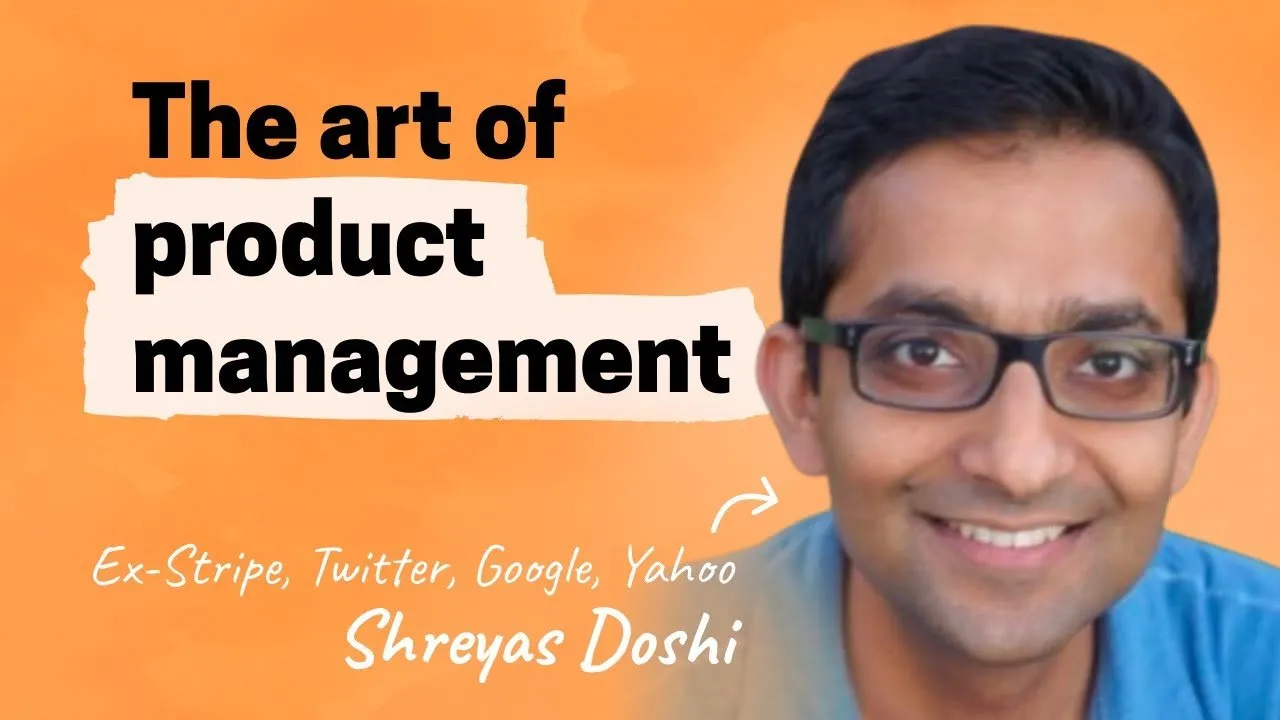
Shreyas Doshi has built a reputation as one of the most insightful voices in modern product management. With a resume that includes leadership roles at Stripe, Twitter, Google, and Yahoo, Doshi has navigated the complexities of product development at every stage of growth. Unlike many thought leaders who deal in platitudes, his advice is often contrarian, grounded in specific mechanics, and painfully relatable to anyone who has ever managed a product roadmap.
In a wide-ranging conversation with Lenny Rachitsky, Doshi deconstructs the art of product management into five core frameworks (plus a bonus mindset). From the psychology of "pre-mortems" to the mathematical fallacy of chasing ROI, these concepts offer a blueprint for moving from a good product manager to a high-leverage leader. This deep dive explores how to audit your time, diagnose team dysfunction, and cultivate the high agency required to build world-class products.
Key Takeaways
- Invert the planning process with Pre-mortems: Instead of asking what might go wrong, assume the project has already failed six months from now and work backward to identify the causes.
- Apply the LNO Framework to your schedule: Categorize tasks into Leverage (10x impact), Neutral (1x impact), and Overhead (<1x impact) to stop treating all work as equal.
- Align on the Three Levels of Product Work: Conflict often arises when one person is speaking from "Impact" while another is stuck in "Execution." Recognizing "Optics" as a valid work stream is crucial for team momentum.
- Diagnose root causes accurately: Most persistent execution problems are actually strategy problems, culture problems, or interpersonal issues in disguise.
- Shift from ROI to Opportunity Cost: In high-leverage roles, maximizing ROI often leads to filling time with "quick wins" rather than pursuing the optimal, albeit riskier, opportunities.
The Art of the Pre-Mortem
Most organizations rely on post-mortems—reviews conducted after a project has failed or a site has gone down. While these are valuable for learning, they are reactive. Doshi argues that the highest-value activity a team can engage in before a launch is a pre-mortem. This is not merely a risk assessment; it is a psychological game designed to surface hidden doubts.
The Prompt Matters
The effectiveness of a pre-mortem hinges on the specific prompt used to open the meeting. Do not ask, "What could go wrong?" This invites optimism bias. Instead, Doshi suggests stating:
Imagine this project has failed six months from now. Let’s work backwards. What went wrong?
This subtle shift creates psychological safety. It gives team members permission to be negative and voice concerns they might otherwise suppress to appear supportive.
Tigers, Paper Tigers, and Elephants
To organize the feedback from a pre-mortem, Doshi categorizes risks into three distinct buckets:
- Tigers: These are legitimate threats that will kill the project if not addressed. They require immediate mitigation plans.
- Paper Tigers: These are perceived threats that people are worried about but are actually harmless. Identifying these prevents the team from wasting resources on non-issues.
- Elephants: These are the "elephants in the room"—the uncomfortable truths nobody wants to discuss (e.g., "We are assuming users actually want this feature, but we haven't validated it").
By creating a shared vocabulary around these risks, teams can debate issues objectively rather than emotionally. If done correctly, a pre-mortem eliminates the need for an ugly post-mortem later.
The LNO Framework for Time Management
One of the most common pitfalls for ambitious product managers is perfectionism. Early in his career at Google, Doshi found himself overwhelmed and dissatisfied because he applied the same high standard to every item on his to-do list. The realization that cured this burnout was the LNO Framework: the understanding that not all tasks are created equal.
Categorizing Your Tasks
Tasks should be divided into three categories based on the return on effort:
- Leverage (L) tasks: Activities where high effort yields 10x or 100x impact. Examples include drafting a product strategy, hiring a key engineer, or aligning two conflicting teams.
- Neutral (N) tasks: Activities where you get out exactly what you put in (1x return). These are necessary but rarely move the needle significantly.
- Overhead (O) tasks: Administrative duties where the return is often less than the effort invested, such as expense reports or routine status updates.
The Trap of Uniform Perfectionism
The error most PMs make is trying to do an A+ job on Overhead tasks. Doshi advises that for L tasks, you should let your inner perfectionist shine. Lock yourself in a room, change your environment, and iterate until it is flawless. However, for O tasks, good enough is truly good enough. Spending three hours perfecting meeting notes for a routine sync is a misallocation of finite energy that should have been spent on high-leverage strategy.
The Three Levels of Product Work
Doshi introduces a model to explain why misalignment happens so frequently between Product Managers and executives. Product work occurs on three levels:
- Impact: The business outcome (revenue, customer retention, brand equity).
- Execution: The tactical steps to get there (sprints, features, bug bashes).
- Optics: The internal awareness and perception of the work.
Diagnosing Communication Breakdowns
Conflict arises when stakeholders operate at different levels. A common scenario involves a PM presenting a launch plan detailed with Execution metrics (dates, features), while the CEO is asking questions from an Impact perspective (customer experience, brand risk). The PM feels the CEO "doesn't get the complexity," while the CEO feels the PM "doesn't see the big picture." Recognizing which level is being discussed allows you to switch gears and align the conversation.
The Importance of Internal Optics
Many product people view "optics" as a dirty word, associating it with politics or posturing. Doshi reframes this: internal optics are essential for generating team energy. If a team is doing great Execution work that creates high Impact, but the Optics are poor (i.e., nobody knows about it), the team loses momentum, funding, and morale. A great PM ensures that the narrative of the team's success is communicated effectively to the broader organization.
Most Execution Problems are Strategy Problems
In high-growth environments, leaders often find themselves playing "whack-a-mole" with execution issues. Teams miss deadlines, dependencies break, and engineers burn out. The default reaction is to treat these as execution failures—add more process, more stand-ups, or more managers.
Doshi suggests that if you apply a "band-aid" solution (like a new sync meeting) and the problem recurs a month later, it is likely not an execution problem. It is usually one of two deeper issues:
- A Strategy Problem: The teams are misaligned because the strategy is unclear. They are running in different directions because leadership hasn't made the hard choices about what not to do.
- A Culture Problem: The organization incentivizes the wrong behaviors. For example, if you want teams to collaborate but performance reviews only reward individual team delivery, no amount of "collaboration meetings" will fix the friction.
Before implementing a new process, ask: Is this a skills gap (true execution), or is this a lack of clarity (strategy)?
Minimizing Opportunity Cost vs. Maximizing ROI
Perhaps the most counterintuitive advice Doshi offers is to stop obsessing over ROI (Return on Investment). In finance, ROI is calculated as (Value - Cost) / Cost. Because "Cost" (time/effort) is in the denominator, the easiest way to increase ROI is to reduce the denominator—to do quick, easy tasks.
The "Quick Win" Trap
High-leverage roles should not be optimized for quick wins. By filling a roadmap with low-effort, positive-ROI features, product teams often crowd out the difficult, ambiguous projects that define a company's future. Doshi argues for a shift in mindset:
You should stop doing work that simply provides a positive return on investment and start focusing on work that minimizes opportunity cost.
Opportunity cost is the difference between the value of the option you chose and the value of the best possible option. To minimize opportunity cost, you must pursue the highest-value opportunities, even if they are expensive and time-consuming. To balance this, Doshi recommends the classic Google resource allocation model: 70% on core tasks, 20% on adjacent bets, and 10% on transformative moonshots.
Bonus: The High Agency Mindset
Finally, the defining trait of the most successful product managers is high agency. Borrowing the term from Eric Weinstein, Doshi defines high agency as the ability to get what you want without waiting for conditions to be perfect.
Low agency individuals blame their environment: "I can't ship because we don't have enough engineers," or "The legacy code is too messy." High agency individuals accept the constraints as part of the game. They possess a high degree of ownership, creative resilience, and the ability to navigate through "no" to find a "yes." They don't just execute; they reverse adverse conditions to achieve their goals.
Conclusion
Shreyas Doshi’s approach to product management moves beyond standard methodologies like Agile or Scrum. It focuses on the cognitive and psychological aspects of the role—how to think about time, how to perceive risk, and how to navigate organizational dynamics. By mastering pre-mortems, categorizing work through the LNO framework, and prioritizing opportunity cost over simple ROI, product managers can elevate themselves from task-masters to strategic leaders.
For more of Shreyas Doshi’s insights, you can follow him on Twitter or LinkedIn.
)