
Table of Contents
Every founder faces a critical dilemma early in the startup journey: strictly follow a predefined product vision or pivot based on every piece of customer feedback. Scrambling to meet every request leads to feature bloat and a lack of direction, yet ignoring users entirely often results in building a solution for a problem that doesn't exist.
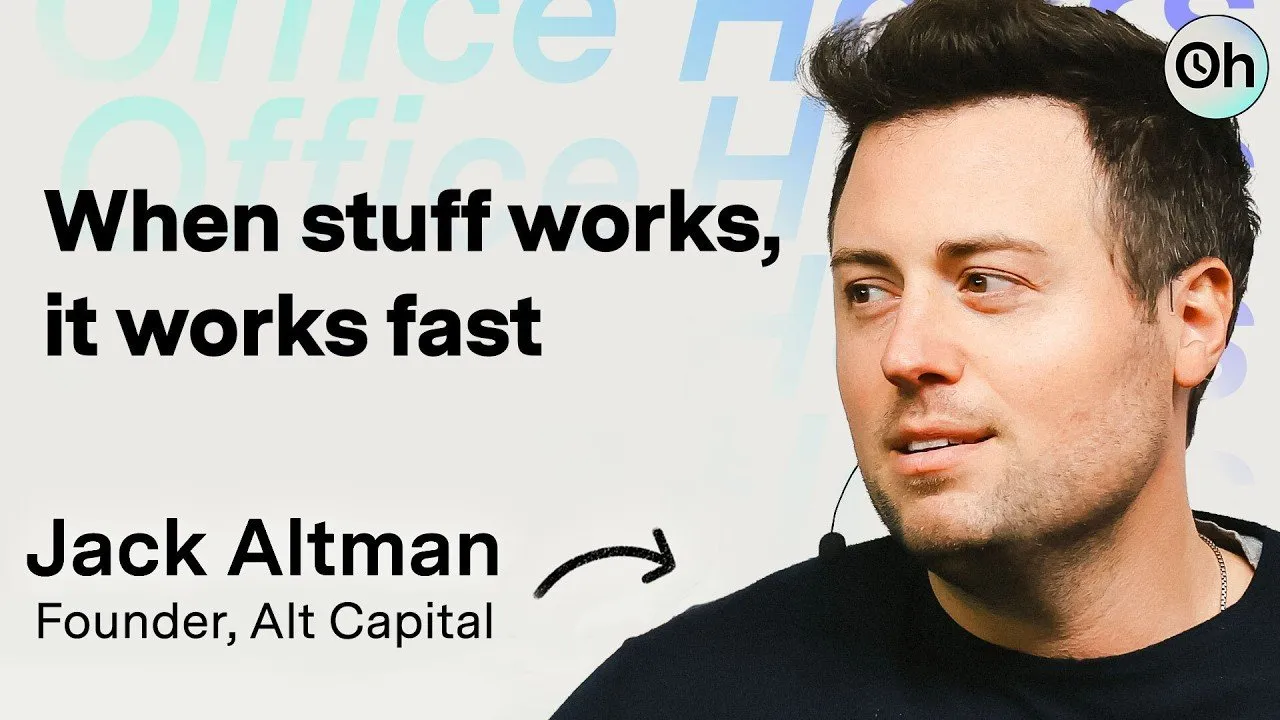
Jack Altman, co-founder of the multi-billion dollar platform Lattice and managing partner at Alt Capital, suggests the answer lies in a difficult balance. Drawing from his experience scaling Lattice to over 5,000 customers and his transition into venture capital, Altman offers a nuanced perspective on product-market fit, the realities of founder-led sales, and the pressure to chase revenue at the expense of the roadmap.
Key Takeaways
- Maintain a North Star vision: Use customer feedback to "color in the lines" of your product outline, not to draw the outline itself.
- Product-market fit usually happens fast: If you are struggling to find traction after multiple iterations, the core solution may be wrong.
- Sell ahead of the roadmap: Founders should sell features that are 6 months out to gauge true market appetite, provided they deliver on those promises.
- Hire "diamonds in the rough": Early-stage startups cannot always attract "obviously great" talent; look for high-potential individuals who haven't yet been discovered by the market.
- Control the fundraising timeline: Do not let investors drag you into a long diligence process without a term sheet; run the process on your own terms.
Balancing Customer Demands with a North Star Vision
The tension between a founder's intuition and customer demands is constant. In the early days of a B2B startup, the temptation to derail a product roadmap for a significant contract is immense. When an enterprise customer offers a contract that could triple a startup's annual recurring revenue (ARR) in exchange for a custom feature, the pressure to say "yes" is often overwhelming.
However, Altman warns against becoming a custom development shop for early clients. While it is obviously wrong to ignore customers, it is equally dangerous to scramble for every request. Founders must have a "North Star" vision—a rigid outline of what the company is trying to build.
"It's obviously wrong to scramble to every single customer request. It's also wrong to ignore it all... You've got to have some northstar vision of your product... I think customers are good at helping fill in the gaps... within this outline, what's the color in the blanks."
The strategic approach involves listening to customers to refine the details of the product rather than the direction. If a request fits within the existing vision and helps "color in the blanks," it is valuable. If a request pulls the engineering team off the roadmap for a feature that no other customer wants, it likely distracts from long-term scalability. These judgment calls are rarely black and white, but they define the trajectory of the company.
The Speed and Signals of Product-Market Fit
One of the most debated topics in the startup ecosystem is how long it takes to find product-market fit (PMF). For Lattice, success came after two failed pivots. The first attempt was an OKR (Objectives and Key Results) management tool that suffered from feature bloat, and the team struggled to get traction.
Altman’s experience led him to a controversial conclusion: when a product is right, it usually works quickly. While there are exceptions where perseverance pays off after years of grinding, true market pull is often immediate and visceral. If a founder finds themselves constantly needing "just one more feature" to close deals, it is often a signal that the core problem-solution set is misaligned.
The Role of Founder-Led Sales
To truly understand PMF, the founder must remain the primary salesperson for as long as possible. Altman continued selling well past $2 million in ARR and stayed involved in deals up to $100 million in revenue. The reason is not just closing deals, but information gathering.
Sales conversations are the highest-bandwidth channel for product feedback. A hired sales representative will often ask for a playbook or a script. A founder, however, can dynamically adjust the pitch, identify exactly where a prospect’s eyes light up, and feel the friction in the sales process. This intuition is impossible to delegate in the early stages.
Selling Ahead of the Product
Altman admits to selling the product "six months ahead" of its actual capabilities. This strategy serves a dual purpose:
- Validation: By pitching a feature that doesn't exist yet, a founder can gauge if that feature actually drives a purchasing decision. If the customer is indifferent, the feature shouldn't be built.
- Commitment: It forces the engineering team to deliver.
While this approach carries reputational risk if the company fails to deliver, it is a potent tool for steering the roadmap. However, Altman notes that the bar for "Minimum Viable Product" (MVP) has raised significantly. In 2015, a "clunky" cloud product was acceptable if it solved a core problem. In the current market, the baseline for design and user experience is much higher, making it riskier to launch broken or incomplete software.
Building the Early Team and Culture
Hiring the first 10 employees is arguably the most critical task for a founder post-PMF. A common mistake is trying to hire individuals with perfect resumes—people who have already been executives at successful companies or top engineers at major tech firms.
Altman argues that pragmatic founders must accept a hard truth: the "obviously great" candidates—those with flawless track records and high market visibility—are likely to start their own companies or take high-paying roles at established giants like OpenAI or SpaceX. They rarely join a risky seed-stage startup as the sixth employee.
Finding Diamonds in the Rough
The goal is to find "diamonds in the rough." These are people who are exceptionally talented but not yet "legibly" great to the wider market. They might be younger, coming from non-traditional backgrounds, or looking for their breakout role. This requires the founder to assess raw slope and potential rather than relying on credentials.
Co-Founder Dynamics
The relationship between co-founders often dictates the company's resilience. For Lattice, the partnership worked because of a combination of personal friendship and professional trust. This allowed for "high-trust arguing." The co-founders could engage in heated debates about strategy without it becoming ad hominem or emotional.
"We didn't hold back from telling each other the truth. Like we would get into loud arguments... but it was always over the ideas at hand, never like attacks at each other."
Furthermore, they employed a "divide and conquer" strategy. By trusting each other's domain expertise entirely, they avoided the inefficiency of two founders trying to solve the same problem simultaneously.
Fundraising and Founder Psychology
Transitioning from operator to investor, Altman notes that the current fundraising environment is momentum-driven, particularly with the surge in AI. However, the fundamental advice for raising capital remains consistent: treat it as a sales funnel.
Founders should avoid being dragged into a "process" by investors who are not ready to commit. Investors often use soft language like "we want to get to know you" to buy time without making an offer. Altman emphasizes that until a term sheet is presented, there is no deal. Founders should run a tight process on their own timeline, creating scarcity and momentum rather than waiting for investors to dictate the pace.
Proactive vs. Reactive Leadership
As a company scales, the CEO's role shifts from "doing the work" to "building the machine that does the work." This transition usually occurs around the 20-employee mark. The greatest danger at this stage is slipping into reactive work.
Most people spend 90% of their time reacting—answering emails, taking meetings requested by others, and putting out fires. A high-performing CEO must flip this ratio, spending the majority of their time on proactive tasks: setting the agenda, defining the strategy, and ensuring the "micro" details of the company still align with the vision.
Conclusion
Building a company like Lattice requires navigating a series of contradictions. Founders must listen to customers but trust their own vision; they must sell a dream that doesn't exist yet but ensure they can build it; they must hire great people but accept that the "best" on paper might not be available to them.
Ultimately, the journey requires a shift in mindset from pure execution to organizational design. As Altman suggests, the early obsession with product-market fit eventually gives way to an obsession with culture and process. Whether in 2015 or today, the founders who succeed are those who can maintain their "North Star" while rapidly adapting to the feedback loops of the market.

![Is it Really Worth Holding Altcoins in 2026? [The Truth]](/content/images/size/w1304/format/webp/2026/02/is-holding-altcoins-in-2026-worth-it.jpg)


)