Table of Contents
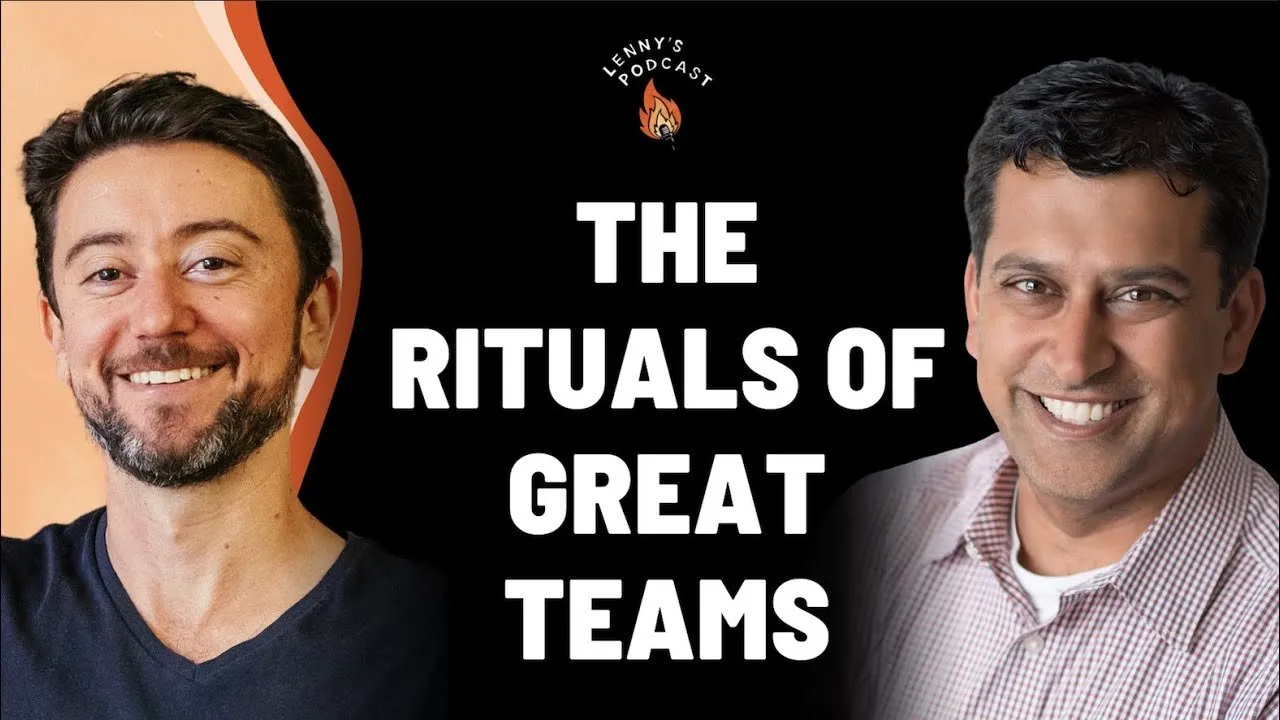
Shishir Mehrotra has one of the most impressive resumes in Silicon Valley. Before founding Coda, the all-in-one doc platform, he led product at YouTube for six years, overseeing its rise to global dominance, and spent another six years at Microsoft. He also sits on the board of Spotify.
But Mehrotra isn’t just an executive with a strong pedigree; he is a first-principles thinker who has developed distinct frameworks for growth, team management, and decision-making. In a wide-ranging conversation, he breaks down the specific systems he uses to build products and high-performing teams, from the "loops" that drive viral growth to the "eigenquestions" that solve impossible strategic debates.
Here is a deep dive into the rituals and frameworks that define great teams.
Key Takeaways
- Loops, not funnels: Sustainable growth comes from "Black Loops" (internal sharing) and "Blue Loops" (external publishing), not just linear marketing funnels.
- The 3 rules of Golden Rituals: To be effective, a team ritual must be named, known by every employee by their first Friday, and templated.
- Eigenquestions: When facing complex decisions, identify the one question that, if answered, renders all subsequent questions irrelevant.
- The PSHE Talent Framework: Evaluate employees based on their ability to handle Problems, Solutions, How, and Execution—not just the scope of their role.
- Reference checks over interviews: The most reliable signal for hiring is a blind reference check that asks peers to rank a candidate’s strengths against the PSHE framework.
Rethinking Growth: Black Loops and Blue Loops
Many companies visualize their growth as a linear funnel: acquisition, activation, retention. However, Mehrotra argues that the most successful products grow through loops. At Coda, they visualize their ecosystem through two distinct mechanisms: the Black Loop and the Blue Loop.
The Black Loop: Viral Sharing
The Black Loop represents the natural viral spread of a productivity tool. It mirrors the growth mechanism of Microsoft Office or Google Docs.
The cycle is simple: a user creates a doc, shares it with a team to get work done, and the recipients—exposed to the tool’s utility—eventually create their own docs to share with others. This loop drove Coda’s unique pricing model, known as "Maker Billing." unlike most SaaS products that charge per seat, Coda only charges for the person who creates the doc, not the editors or viewers.
"I wanted no friction on the share end. That’s the moment of, 'Hey look, I’m doing this thing, it’s so cool.' If you had to pay for people you shared with, nobody would ever share anything."
The Blue Loop: Content Publishing
The Blue Loop is what Mehrotra calls the "YouTube loop." It occurs when a user creates a doc not for a specific team, but to publish an idea to the world. This turns the product into a publishing platform. When someone shares a template for "How to run an offsite" or a tracker for a board game, they are effectively marketing the product to a broad audience of problem-solvers.
This loop captures a different type of user: the problem solver. Most people don't wake up looking for a "new blinking cursor"; they wake up trying to solve a specific problem. By facilitating the Blue Loop, Coda allows users to discover the product through solutions rather than features.
The Rituals of Great Teams
Every company has a culture, but great companies operationalize that culture through rituals. Mehrotra cites a framework developed by Bing Gordon, a legendary investor and Electronic Arts co-founder, to define what makes a ritual stick.
According to Gordon, a "Golden Ritual" must meet three criteria:
- It must be named.
- Every employee must know it by their first Friday.
- It must be templated.
Dory and Pulse
At Coda, the defining ritual is "Dory and Pulse." It was designed to solve the problem of loud voices dominating meetings and the inefficiency of round-robin feedback.
- Pulse: Rather than discussing a proposal immediately, everyone reads the document silently and writes down their sentiment/vote anonymously. The results are hidden until everyone has submitted. This prevents groupthink and anchoring bias.
- Dory: Named after the fish who asks too many questions, this involves listing questions in a shared document and voting on them. The team then addresses questions in order of popularity, ensuring the most important topics are covered regardless of who asked them.
Implementing Change with "Switch"
When introducing new rituals, Mehrotra recommends the framework from the book Switch by Chip and Dan Heath. The book posits that to change behavior, you must do three things:
- Direct the Rider: Give clear, rational instructions (e.g., teaching the ritual during onboarding).
- Motivate the Elephant: Appeal to emotion and identity (e.g., giving the ritual a catchy name so people feel proud using it).
- Shape the Path: Remove friction (e.g., providing templates so the ritual is the easiest way to work).
Eigenquestions: Solving Strategic Deadlocks
In 2008, YouTube faced a difficult decision. Users were constantly searching for "Modern Family," but YouTube didn't have the rights to the show. The company was split: should they link out to ABC.com to satisfy the user (the product view), or refuse to link out to protect the ecosystem (the business view)?
Rather than debating the specific instance of "Modern Family," Mehrotra reframed the debate using a concept he calls "Eigenquestions." Borrowed from the mathematical concept of eigenvectors, an Eigenquestion is the single question that, when answered, eliminates the need to ask subsequent questions.
For YouTube, the Eigenquestion was:
"In a decade, is the online video market more likely to be about consistency or comprehensiveness?"
If the market valued comprehensiveness, YouTube needed to link out to everything, essentially becoming a video search engine. If the market valued consistency, YouTube needed to control the experience, ensuring playback and quality were uniform, even if that meant having a smaller catalog.
The team decided the future was consistency. Once that Eigenquestion was answered, the "Modern Family" decision made itself: do not link out. This also clarified other massive decisions, such as removing the YouTube app from the original iPhone because Apple’s build couldn't support the consistent ad and feature experience YouTube required.
To practice this skill, Mehrotra suggests using low-stakes hypothetical scenarios. For example, ask a candidate: "Scientists have invented a teleporter. You have to bring it to market, but the scientists will only answer two questions about how it works. What two questions do you ask?" The goal is to find the few variables (e.g., "Is it safe for humans?" and "Is it expensive to operate?") that determine the entire business model.
The PSHE Framework for Talent Evaluation
As organizations scale, titles and "scope" (the number of people managed or P&L size) often become poor proxies for actual talent. To evaluate high performers, specifically in product roles, Mehrotra utilizes the PSHE framework. It maps career progression not by scope, but by how a person interacts with problems.
- E (Execution): You are handed a Problem, a Solution, and a How. You simply Execute.
- H (How): You are given a Problem and a Solution. You figure out the How (team organization, milestones) and Execute.
- S (Solution): You are given a Problem. You determine the Solution, the How, and Execute.
- P (Problem): You tell the leadership what the Problem is. You identify the right territory to attack.
Mehrotra notes that many careers follow a curve where scope increases linearly, but there is a "trough of disillusionment" in the middle. This is where an employee moves from being judged on execution (E and H) to being judged on strategy (S and P). A candidate might have managed a massive team (high scope) but never actually identified the core problems or solutions themselves.
The Reference Check Strategy
Because interviews often rely on "home court" questions (where the candidate has rehearsed answers) or "away court" questions (artificial scenarios), Mehrotra places the highest value on reference checks. However, he conducts them differently to avoid generic praise.
He does not reveal that he values the "P" (Problem) identifier over the "E" (Executor). Instead, he asks the reference to categorize the candidate:
"When you think of this person, are they the one who is regularly coming up with the problems the team should focus on? Are they the one constantly solving hard problems creatively? Or are they the person who can take a playbook and execute it with high precision?"
By offering positive descriptions for all attributes, the reference feels safe telling the truth. If a reference says, "Oh, they run the most efficient meetings and execution is always buttoned up," Mehrotra knows he is looking at an "H" or "E" player, regardless of their previous job title.
Conclusion
Whether it is defining the growth loops that power a product or asking the Eigenquestions that define a strategy, Mehrotra’s approach highlights a singular truth: great companies are built on explicit frameworks, not accidental wins. By naming their rituals, templating their processes, and rigorously evaluating talent based on problem-solving ability rather than scope, leaders can build organizations that are resilient, consistent, and capable of scaling innovation.