Table of Contents
Every entrepreneur enters the new year with the same resolution: to build bigger, move faster, and make fewer mistakes. However, wisdom often comes from analyzing where things went wrong rather than where they went right. In a candid exchange, Shaan Puri and Sam Parr opened up the mailbag to address the "leaks in their buckets"—the costly errors, strategic missteps, and hard-earned lessons that shaped their path to eight-figure exits. From the fallacy of hiring cheap talent to the critical importance of project selection, their insights offer a masterclass in business resilience and strategic thinking.
Key Takeaways
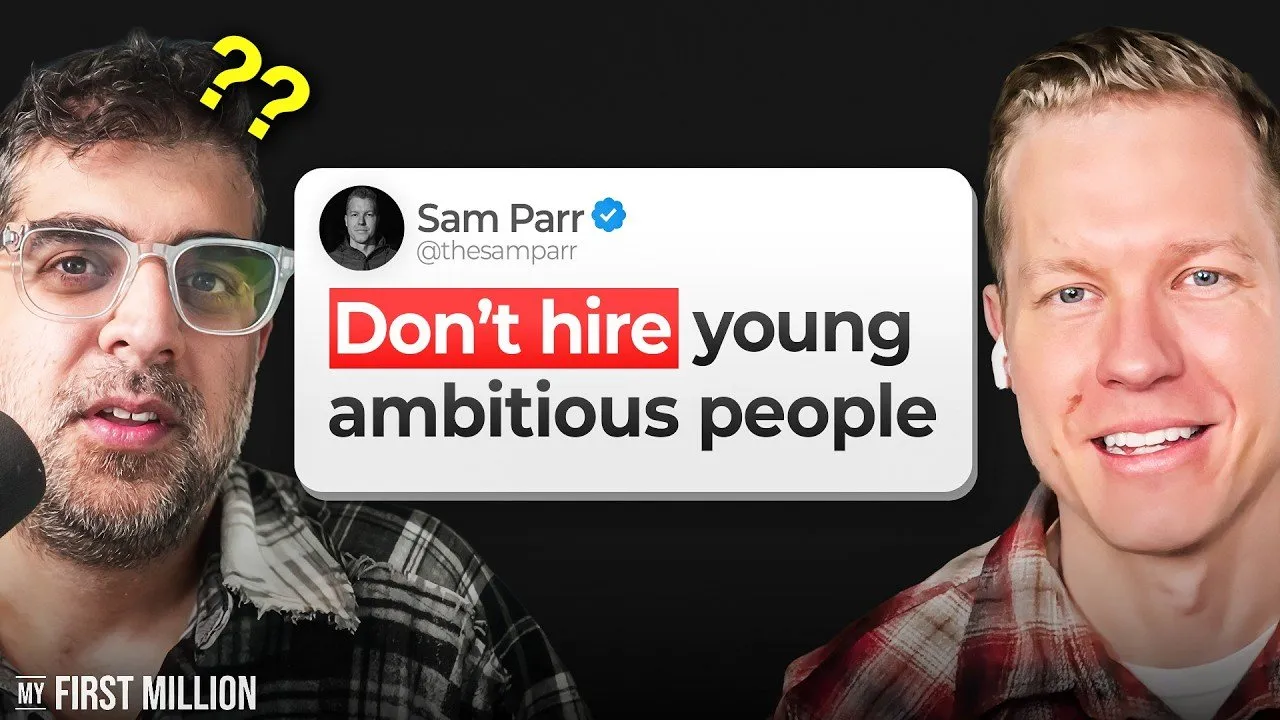
- The "Young and Hungry" Fallacy: While the romantic idea of hiring ambitious, inexperienced talent is appealing, paying a premium for proven experience often yields 5-10x better results with significantly less management overhead.
- Project Selection is the Multiplier: For talented, hardworking individuals, the specific vehicle they choose to build matters more than their effort. "Founder-market fit" is essential to avoid wasted years.
- "Sarah’s List" Strategy: For those seeking wealth without founding a company, joining a mid-stage firm (approx. 1,000 employees) with strong momentum offers the best risk-adjusted return on equity.
- The "One Phone Call" Rule: High-level decision-making requires a mentor who cares personally, possesses superior pattern recognition, and can cut through emotional noise to provide binary advice.
The High Cost of Hiring Potential Over Proof
One of the most persistent biases in early-stage entrepreneurship is the desire to hire "diamonds in the rough." This approach is often rooted in a romanticized version of the American Dream—taking a chance on an ambitious, unproven young person and molding them into a star. While this narrative is compelling, the financial reality often tells a different story.
The "fixer-upper" mentality in hiring is frequently a mask for frugality. Founders often opt for less expensive, inexperienced talent hoping to save capital, but this false economy leads to hidden costs in training, management, and subpar execution.
Most of business is just figuring out what are your own leaks in your bucket. And then of course to other people who don't have that leak, they're like, 'Well that's obvious, right?' But you have to know what are my biases.
The Case for Senior Talent
The alternative approach—hiring senior operators who have already executed the specific playbook you need—can cost two to three times more in salary but often delivers disproportionate returns. When you hire someone who has "been there, done that," you are paying for the elimination of the learning curve.
For founders who still want to leverage youthful energy, a hybrid model can work. This involves hiring a high-agency, inexperienced employee but pairing them with a seasoned consultant or agency for the first 60 days. This allows the junior employee to download the "source code" of success from the experts while retaining the hunger to execute long-term.
The Critical Variable: Project Selection
Hard work and talent are necessary conditions for success, but they are not sufficient. The variable that determines the magnitude of the outcome is project selection. A world-class operator working on a low-leverage opportunity will always be capped by the market dynamics.
Opportunity cost is the silent killer of careers. Spending years building a business with poor unit economics, high churn, or no founder-market fit is time that cannot be recovered. Examples of poor project selection often include low-margin industries like restaurants or hyper-competitive spaces like social media apps, where the winner-take-all dynamics make success statistically improbable.
If you are hardworking and you are sufficiently talented, then the only variable that matters is project selection.
Evaluating Founder-Market Fit
Before committing to a multi-year build, founders must assess their fit for the specific challenge. Do you understand the customer psychology? Do you use the product? If a founder who hates logistics starts an e-commerce heavy shipping business, or someone who dislikes social media tries to build the next Twitter, the friction will eventually erode their will to compete. The best projects align the founder's natural curiosities with a market that has deep, recurring demand.
Wealth Building Without the Founder Risk: "Sarah's List"
Not everyone needs to be a founder to achieve an eight-figure net worth. There is a specific career strategy—dubbed "Sarah's List"—that optimizes for high upside with lowered risk. This strategy involves identifying companies that have passed the "survival" phase but have not yet reached their terminal valuation.
The ideal target for this strategy typically has:
- Approximately 1,000 employees (offering stability and established systems).
- A valuation in the billions, but with a clear path to 5x or 10x growth.
- Strong product-market fit and momentum.
Employees entering these companies receive stock grants that can appreciate significantly over a four-year vesting schedule. Unlike early-stage startups where equity often goes to zero, or massive incumbents where growth is flat, these "mid-stage rockets" offer a sweet spot for wealth generation. Current predictions for this category include companies innovating in brain-computer interfaces (like Neuralink) or vertical SaaS platforms dominating specific niches.
Market Predictions and Investment Theses
Navigating the current market requires looking beyond the hype cycles of AI wrappers and finding companies with defensible moats. Two areas currently stand out for their asymmetric upside.
The "Elon Index" and Neuralink
Betting on proven super-founders remains a viable strategy. Neuralink represents a frontier technology with virtually no competition. By moving from medical applications (restoring function to quadriplegics) to eventual consumer applications, it follows the "Tesla Master Plan" of starting with high-cost, low-volume innovation before moving down-market. The inevitability of brain-computer interfaces suggests that early leaders in this space will capture trilion-dollar value.
Vertical SaaS: The Owner.com Model
In the software world, transparency and "savage" execution are leading indicators of success. Companies that focus relentlessly on customer metrics rather than vanity numbers tend to win. For example, Owner.com provides a case study in vertical SaaS for independent restaurants. When leadership transparently reports churn and treats customer failure as a personal loss, it signals a culture of extreme ownership that investors prize.
Decision Making and the "One Phone Call" Rule
Every entrepreneur eventually faces a crisis where logic loops fail and decision fatigue sets in. In these moments, having a designated "one phone call"—a mentor or peer advisor—is crucial. This person is not just a friend; they serve a specific strategic function.
The ideal advisor for high-stakes decisions must meet three criteria:
- They must care: When you bring them a problem, they treat it with the same urgency as their own.
- They must be wiser: They need better pattern recognition to separate signal from noise.
- They must cut through the noise: The advice should be binary and gut-check oriented, not a list of pros and cons.
I'd rather have 1% effort from a 100 people than 100% effort from me.
Founder Mode: The "Square Wave" of Management
Effective leadership often looks like a "square wave." Leaders must oscillate between two distinct states: the 30,000-foot strategic view and the 1-inch detailed execution. Great founders don't just stay in the clouds; when a problem arises, they dive deep into the pixels, the copy, and the code to fix the root cause, then immediately return to high-level strategy. This ability to telescope in and out is the hallmark of "Founder Mode."
Conclusion
Whether it is re-evaluating hiring practices, pivoting careers, or selecting the next big project, the common thread among successful operators is self-awareness. It is about recognizing the leaks in your own bucket—be it a bias for cheap labor or a tendency to pick difficult markets—and systematically plugging them. By studying the blueprints of those who have won before and surrounding yourself with mentors who demand rigorous honesty, you can shift the odds of success in your favor.