Table of Contents
Most people spend their lives worrying about failure. They fear the embarrassment of a project flopping or a business going under. However, successful entrepreneurs often argue that failure is not the real enemy; the true adversary is mediocrity. Getting stuck in a situation that is "just okay" creates a trap of comfort that slowly drains your potential, time, and energy.
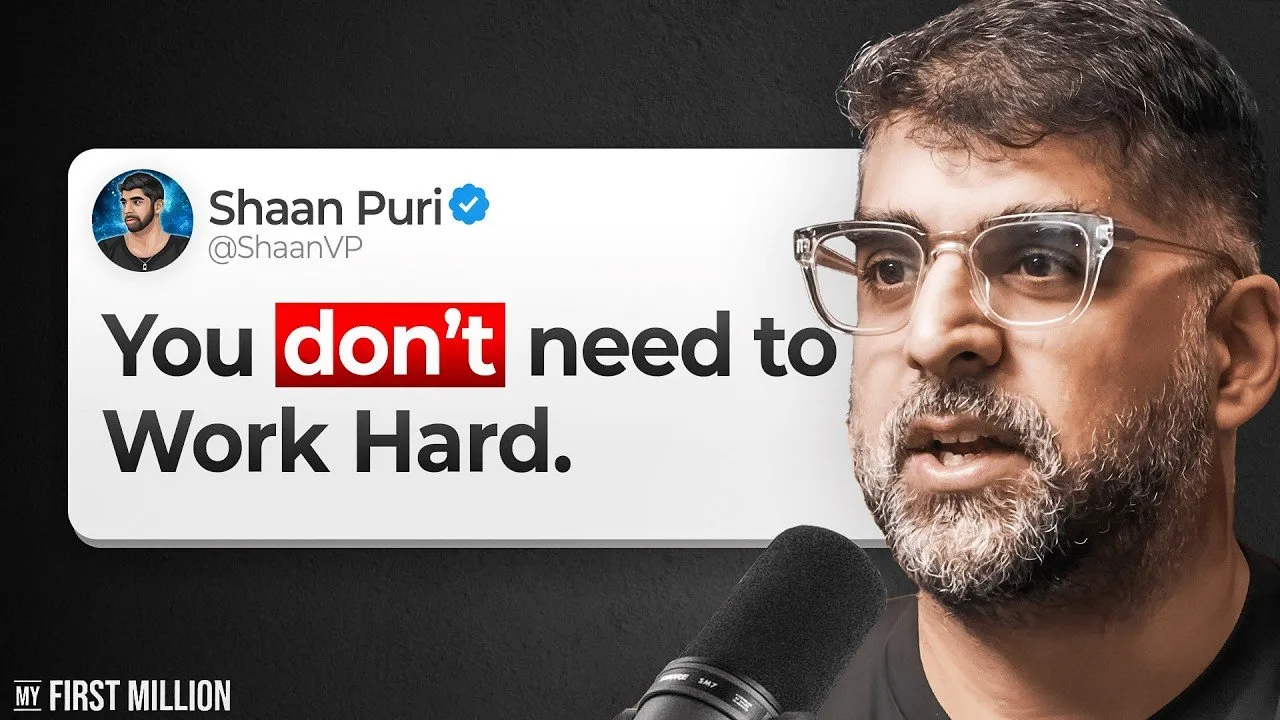
Shaan Puri, a serial entrepreneur who sold his company to Amazon and Twitch, argues that the path to a leveled-up life requires a fundamental shift in how we view risk, work, and decision-making. By analyzing his transition from a corporate employee to a founder, we can uncover a blueprint for optimizing life not just for money, but for freedom, learning, and genuine engagement.
Key Takeaways
- Mediocrity is more dangerous than failure: "Just okay" situations sap your resources and will, whereas failure is a quick, recoverable pain that offers lessons.
- Prioritize project selection over hard work: Hard work is a prerequisite, but success depends more heavily on what you work on and who you work with.
- Leverage the "Strategically Broke" phase: Early in your career, trade financial capital for time capital to maximize learning and adventure.
- Proximity is power: You can accelerate your growth simply by physically placing yourself in networks where high performance is the norm.
- The "Down" Factor: When choosing partners, look beyond intelligence and integrity; find people who are "down" for the adventure and the grind.
The Concept of Being Strategically Broke
There is a pervasive pressure to optimize for income immediately after leaving school. The standard path dictates securing the highest-paying job available to begin accumulating financial wealth. However, this often leads to a state of being "money rich but time poor."
Puri advocates for a counter-intuitive approach: the decision to be "strategically broke." This does not mean being irresponsible; rather, it involves calculating the minimum viable income required to survive while maximizing freedom and flexibility. By keeping expenses aggressively low, you buy back your time.
Optimizing for Learning Efficiency
When you trade a high salary for a lower income stream that offers autonomy, the goal must be to increase the rate of learning. In a standard entry-level corporate role, the breadth of skills acquired is often narrow. In contrast, launching a venture—even a failed one like a sushi restaurant chain—forces you to learn negotiation, supply chain management, marketing, design, and real estate simultaneously.
"If I'm making 10 times less... I got to be learning 12 times more than I would on the job there. And with the business that we were doing, I'm learning about sushi and restaurant operations and how margins work... and I'm learning to pitch investors."
This phase is an investment in "skill capital" which, unlike money, cannot be lost or taxed. Skills acquired during these periods of high agency stick with you and compound over time, making you more effective in future, more lucrative ventures.
Proximity Is Power: The Physics of Networks
Environment dictates performance more than willpower does. The popular adage that "you are the average of the five people you spend the most time with" is biologically and socially accurate. Humans operate through osmosis; we adopt the standards, habits, and pacing of those around us.
If you surround yourself with fitness enthusiasts, you will likely start working out. If you live in a house with obsessive poker players, your game will improve through immersion. This principle applies to business and ambition as well. Moving to a hub where your industry thrives—such as moving to San Francisco for tech startups—is a high-leverage decision.
The Illusion of Competition
A major mental hurdle for many is the fear of competition. It often feels like you are competing against the entire world. However, most people are not serious about their pursuits. They desire the outcome but are unwilling to commit to the process.
Consider the "Rule of 100" used by YouTubers like Mr. Beast. The advice is simple: make 100 videos, improving one specific thing with each iteration. Most aspiring creators never make it past the first few videos because they demand immediate success. If you are willing to do the work consistently, you aren't competing with the millions; you are competing with the tiny fraction of people who possess persistence.
"Most people are not serious. And if you are serious, you're already in that final five out of 50... You got a one in 10 chance. And so like your odds are much better than you think."
Escaping the Trap of Mediocrity
The most treacherous position in a career is not hitting rock bottom; it is floating in the middle. When a project is a disaster, it forces a decision: you quit, pivot, and move on. When a project is "okay"—paying the bills but not growing, or tolerable but not exciting—inertia takes over.
Physics dictates that an object in motion stays in motion unless acted upon by a force. In your life, you are that object, and your current routine is the motion. It takes a significant external force or internal realization to break the inertia of a mediocre path.
The "Re-Hiring" Mental Model
To diagnose if you are stuck in inertia, utilize a simple thought experiment: If you were not doing this project today, would you start it from scratch tomorrow?
If the answer is no, you are only continuing because of sunk cost and momentum. This realization is often the catalyst needed to sell a company, quit a job, or end a relationship. The risk of staying in the wrong thing is that it consumes your most finite resource: time.
"Mediocrity is the real risk for any person with high potential cuz it'll sap you. Sap your will, sap your time, sap your resources, slap your energy, sap your belief in yourself."
Why Hard Work is Overrated
Culture often fetishizes hard work as the primary driver of success. While hard work is necessary, it is rarely the differentiating factor at the highest levels. Puri suggests that hard work is likely the fourth or fifth most important variable in the equation of success.
The Hierarchy of Success Variables
- Project Selection: Working incredibly hard on a declining industry (like a print newspaper) or a low-margin business (like a restaurant) caps your upside regardless of effort.
- Partner Selection: Who you work with determines the quality of execution and your daily enjoyment.
- Timing and Luck: Catching a market wave can propel a business forward faster than grinding against the current.
- Hard Work: This is the engine, but the vehicle and the direction matter more.
The primary utility of hard work early in a career is skill building. When judgment is undeveloped, volume of work compensates for lack of precision. Over time, as judgment improves, you should shift focus toward selecting the right opportunities rather than just grinding at the current one.
Partner Selection: The "Down" Factor
Warren Buffett famously looks for three things in a partner: energy, intelligence, and integrity. While these are foundational, there is a fourth, intangible quality that is equally critical for early-stage ventures: being "Down."
A partner who is "down" possesses a specific type of resilience and adventurous spirit. They are:
- Down to try half-baked ideas without needing a guaranteed roadmap.
- Down to embrace the adventure, choosing the interesting path over the safe one.
- Down to handle the "grind" when things get difficult, without complaining.
You can have a partner who is brilliant and honest, but if they require perfect clarity before acting or crumble under uncertainty, they are ill-suited for entrepreneurship. The best partnerships are formed between people who view business as a shared adventure.
The Flywheel of Interest (Misogi)
Ultimately, the most sustainable fuel for a high-performance life is genuine interest. This connects to the Japanese concept of "Misogi"—taking on a defining yearly challenge that pushes your limits.
When you choose a pursuit based on genuine curiosity—whether it is analyzing casino revenue reports for fun or learning to play the piano—you enter a positive feedback loop:
- Interest: You do it because you enjoy it, not for a result.
- Volume: Because you enjoy it, you do it frequently.
- Skill: Because you do it frequently, you become excellent at it.
- Results: Because you are excellent, the market eventually rewards you.
"The work has to be the win. The win can't be some future hypothetical payoff... Because you enjoy it, you do it all the time. Because you do it all the time, you get really good at it."
Conclusion
Leveling up your life requires stepping out of the fog of inertia. It involves making active choices about your environment, your information diet, and the projects you commit to. By favoring "time wealth" over early financial wealth, and by trusting your internal curiosity over external validation, you build a life that is not only successful by traditional metrics but also deeply interesting to live.
Do not wait for the fog to clear before you start paddling. Motion creates clarity. The biggest cost you face is not taxes or expenses—it is opportunity cost. Ensure you aren't paying it by working hard at the wrong thing.