Table of Contents
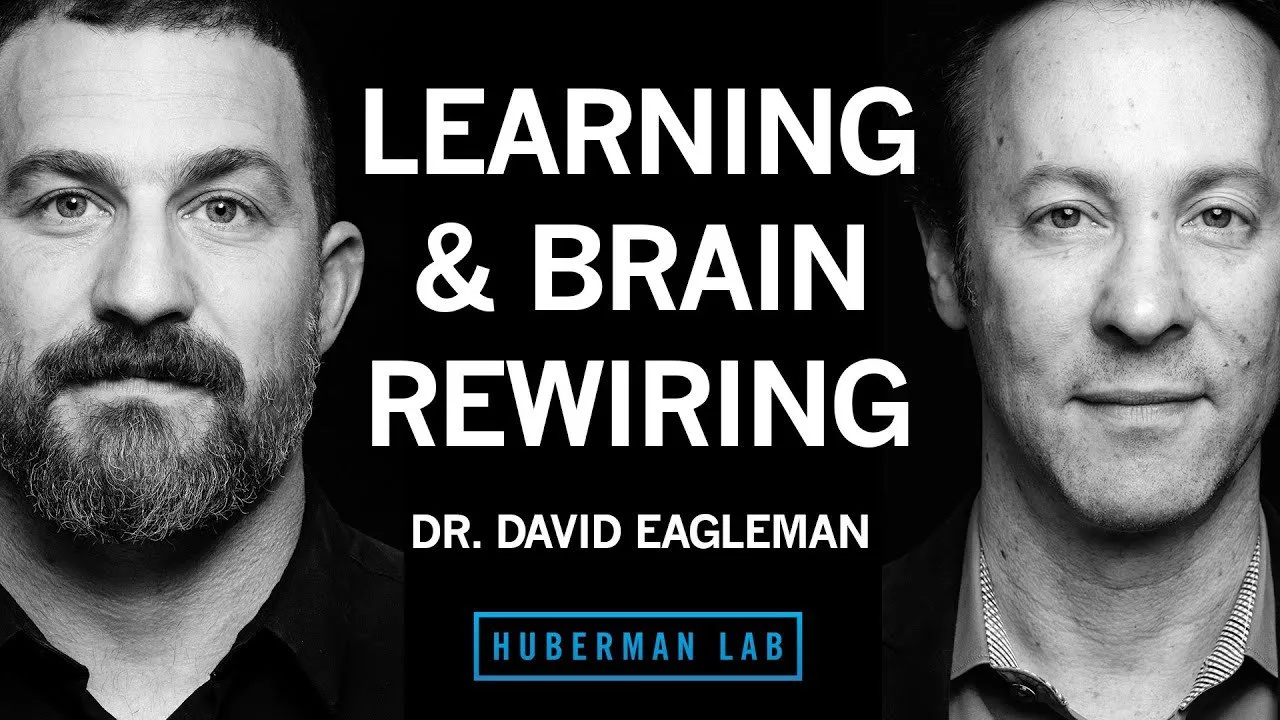
The human brain is often compared to a computer, but this analogy fails to capture its most defining characteristic: its ability to physically constantly reconfigure itself. Unlike hardware, which is fixed once it leaves the factory, the brain is a dynamic, living system that rewires its own circuitry in response to every experience, thought, and challenge. In a recent discussion, neuroscientist Dr. David Eagleman joined Dr. Andrew Huberman to explore the mechanisms of neuroplasticity, revealing how our "half-baked" birth state is actually humanity's greatest evolutionary advantage.
Key Takeaways
- The brain is "livewired," not hardwired: Your 86 billion neurons are constantly unplugging and reconnecting based on environmental demands, rather than following a fixed schematic.
- Plasticity requires novelty: Cognitive growth stops when a task becomes easy; to maintain plasticity, you must constantly engage in activities you are not yet good at.
- The "half-baked" advantage: Humans are born with underdeveloped brains, allowing us to absorb the specific culture, language, and technology of our era.
- The cortex is a universal processor: The outer layer of the brain is a "one-trick pony" that can process any type of sensory data plugged into it, from vision to sound.
The Mechanism of Livewiring
For decades, the prevailing model of the brain was one of a complex but static machine. We now understand that the brain is defined by plasticity—or what Dr. David Eagleman refers to as "livewiring." This is not merely a metaphor; it is a biological reality occurring at the microscopic level every second of your life.
The human brain contains approximately 86 billion neurons. Each of these neurons connects to an average of 10,000 neighbors. However, these connections are not permanent. Eagleman describes neurons almost like living creatures that crawl, search, and reconfigure their relationships.
"It’s not like a fixed thing like you might see in a textbook. Instead, they're plugging and unplugging and searching around and finding new places to plug in and, of course, changing the strength of those connections."
This constant reconfiguration is the brain's strategy for building a model of the world. Because the brain exists encased in the skull, locked in silence and darkness, it relies entirely on electrical signals to interpret reality. When you push the brain with concepts it does not understand, it physically changes its structure to accommodate the new information. This adaptability is the biological foundation of all learning and memory.
The Evolutionary Strategy: Born "Half-Baked"
One of the most profound questions in evolutionary biology is why humans are born so helpless compared to other species. A baby alligator, for instance, is born fully equipped with the instincts to swim, hunt, and survive. It is functionally the same creature it will be as an adult.
Eagleman argues that nature’s "big trick" with humans was dropping us into the world with a "half-baked" brain. While this requires years of parental care, it offers a distinct advantage: we are not hardwired with the instincts of the past, but are designed to be wired by the present.
Absorbing Cultural History
Because our neural circuitry is unfinished at birth, we absorb the world around us. We download the language, culture, belief systems, and technologies of our specific era. This capability allows humans to "springboard" off the discoveries of previous generations.
If you were to transport a human infant from 30,000 years ago to today, they would grow up to be indistinguishable from a modern human, mastering smartphones and modern languages. In contrast, an alligator from the Pleistocene era is identical to an alligator today. This neuroplasticity is why humans have dominated the planet; we do not have to relearn fire or electricity every generation. We simply absorb the "software" of our civilization during childhood.
The Cortex as a One-Trick Pony
A significant portion of human intelligence is attributed to the cortex—the wrinkled, outer three millimeters of the brain. Humans possess four times as much cortex as our nearest evolutionary neighbors. While textbooks often map specific areas for vision, hearing, or touch, the biological reality is far more flexible.
The cortex is essentially a general-purpose computational material. It looks the same everywhere because it is the same everywhere. Its function is defined entirely by what data cables are plugged into it.
Evidence from Sensory Rewiring
The flexibility of the cortex has been demonstrated in landmark studies, such as those by Mriganka Sur at MIT. In experiments with ferrets, researchers rerouted the optic nerve (carrying visual data) into the auditory cortex (usually reserved for sound). The result was that the auditory cortex began to organize itself to process vision. It developed structures to detect lines and motion, proving that the brain tissue itself is not pre-destined for one sense or another.
This suggests that if we could feed different data streams into the brain—such as stock market data or infrared signals—the cortex would likely learn to interpret them just as easily as it interprets light or sound.
The Gap Between Input and Output
The expansion of the cortex in humans provides a massive amount of "computational real estate" between a sensory input and a motor output. In simpler animals, the sensory cortex is often adjacent to the motor cortex: a squirrel sees a nut and immediately moves to eat it.
In humans, the vast expanse of the cortex allows for complex processing before action. We can simulate futures, weigh consequences, and suppress impulses. We can see food but decide to wait because we are on a diet. This ability to run "what if" simulations without physically risking our lives is a primary function of the prefrontal cortex and a direct result of our massive cortical capacity.
Practical Application: How to Maintain Plasticity
Understanding the science of plasticity offers a clear directive for how to maintain cognitive health as we age. Many people believe that repetitive intellectual tasks, such as doing the daily crossword puzzle, are sufficient to keep the brain sharp. However, the nature of plasticity dictates otherwise.
Plasticity is triggered by the struggle to understand. Once you become proficient at a task—whether it is a crossword, a job, or a route to work—the brain creates an efficient, hardened circuit for that activity. It stops changing because it has solved the problem.
"[Doing crossword puzzles] is good until you get good at it and then stop and do something that you're not good at and constantly find the next thing that's a real challenge for you."
To keep the brain "young" and plastic, one must relentlessly seek novelty. This implies that the frustration we feel when learning a new language, an instrument, or a complex skill is actually the feeling of the brain engaging in neuroplasticity. Comfort is the enemy of growth; to rewire your brain, you must constantly step into the unknown.
Conclusion
The human brain is not a static repository of memories, but a living landscape that reflects our interactions with the world. From the moment we are born, our "half-baked" state allows us to inherit the accumulated wisdom of our species, while our massive cortex provides the computational power to simulate futures and control our impulses.
Ultimately, the science of neuroplasticity puts the responsibility of cognitive development in our own hands. By understanding that the brain only changes when challenged, we can make deliberate choices to pursue difficulty over comfort, ensuring that our minds remain adaptable and robust throughout our lives.