Table of Contents
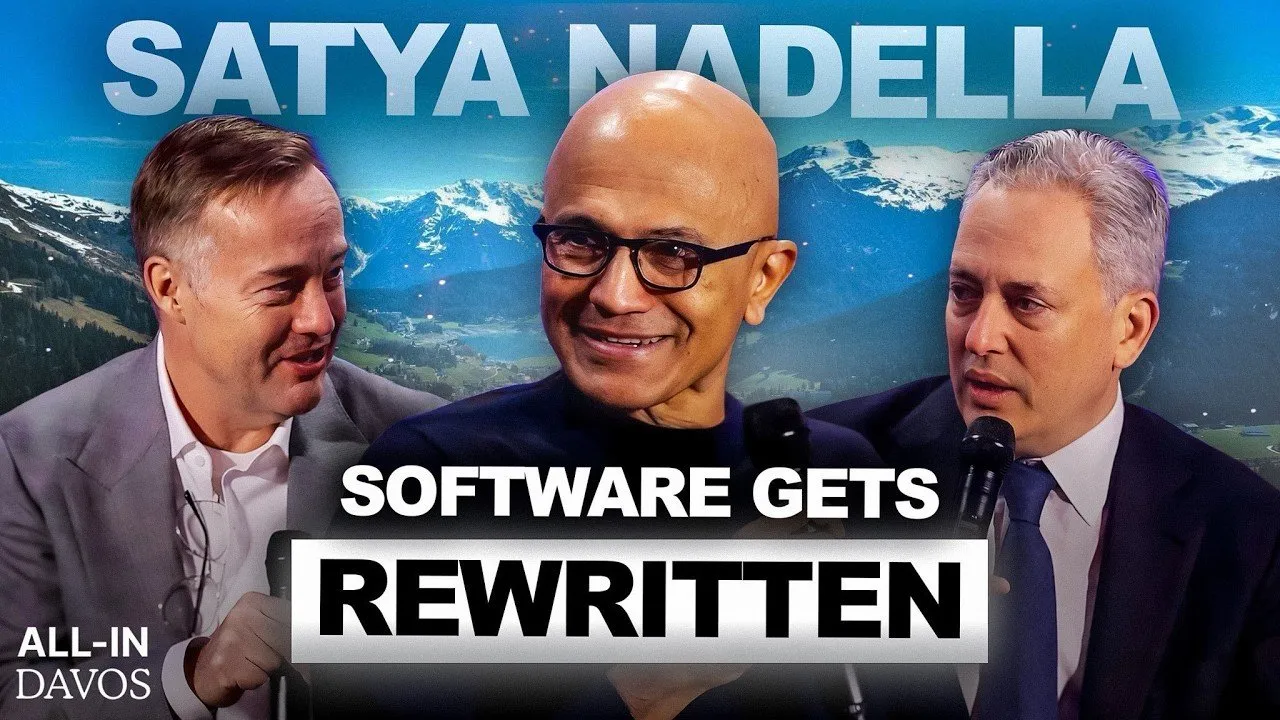
Satya Nadella’s tenure as the third CEO of Microsoft has been defined by a masterclass in adaptation. From cloud computing to the current generative AI explosion, Nadella has steered the tech giant through pivotal shifts that have redefined the industry. In a recent fireside chat with David Sacks, Nadella offered a rare, granular look into how Microsoft is navigating the transition from simple chatbots to autonomous agents, the restructuring of internal teams, and the economic theory behind their massive AI infrastructure build-out.
For business leaders and SaaS founders, Nadella’s insights go beyond product features; they outline a fundamental change in how value is created, distributed, and captured in the AI era. He describes a world where the definitions of "employee" and "software" blur, and where the true measure of a platform’s success is the economic opportunity it creates for others.
Key Takeaways
- The shift from "Bicycle" to "Manager": The metaphor for computing is shifting from Steve Jobs’ "bicycle for the mind" to a "manager of infinite minds," where humans orchestrate digital agents.
- The rise of the "Full-Stack Builder": AI is collapsing traditional silos (PM, Design, Engineering) into single, unified roles, dramatically altering organizational structures.
- Token Factories and App Servers: Microsoft’s strategy relies on building massive infrastructure ("token factories") while providing the logic layer ("app servers") for businesses to orchestrate multiple models.
- The Definition of a Platform: Nadella reiterates Bill Gates’ philosophy that a true platform exists only when the ecosystem’s revenue significantly exceeds the platform owner’s revenue.
- Hybrid AI is the Future: We are moving toward a distributed architecture where AI processing happens both in the cloud and locally on the device (NPU), revitalizing the workstation market.
From Chatbots to "Managers of Infinite Minds"
The narrative around AI often stalls at the "chat" interface, but Nadella views this as merely the first step in a rapid evolution. He traces the trajectory of coding—the purest form of knowledge work—from "next edit suggestion" to chat, to actions, and finally to fully autonomous agents. This evolution is now bleeding into general knowledge work.
To conceptualize this, Nadella moves past the vintage metaphors of personal computing. We are no longer just pedaling a faster bicycle; we are managing a workforce.
"We kind of need now a new concept metaphor for how we use computers in the AI age... It is basically a manager of infinite minds."
Macro Delegation and Micro Stealing
This management style introduces a new workflow Nadella describes as "macro delegation and micro stealing." In this model, the human worker assigns broad, complex objectives to AI agents (macro delegation). While the agent executes the task, the human observes, intervenes, and corrects specific details in real-time (micro stealing). This duality allows for massive productivity gains while maintaining human agency and quality control over the final output.
Identity and the Digital Employee
As these agents become more capable, they effectively become "digital employees." Nadella notes that Microsoft is extending identity management (historically used for humans and devices) to agents. This is crucial for enterprise security. Organizations need to know "who did what to whom," regardless of whether the "who" was a human or a digital agent cloned from a marketing executive.
Restructuring the Organization for the AI Era
Perhaps the most radical insight from Nadella is how AI changes the internal structure of a technology company. The traditional assembly line of software development—distinct roles for product managers, designers, front-end engineers, and back-end engineers—is collapsing.
Using LinkedIn as a case study, Nadella revealed that Microsoft has begun combining these distinct roles into a new archetype: the Full Stack Builder. Because AI can handle the translation between design, spec, and code, a single individual can now own the entire product vertical.
The New Feedback Loop
This structural change is necessitated by a new workflow inherent to building AI products. It is no longer just about writing code; it is about managing a loop of evaluations (evals), science, and infrastructure.
- Evals: The process starts with defining what "good" looks like.
- Science: Data scientists adjust the models to meet those evaluations.
- Infrastructure: Systems engineers build the backend to support the science.
This requires a tighter feedback loop than the siloed communication of the past permitted. By consolidating roles, organizations can increase velocity and adapt to the probabilistic nature of AI development.
The Platform Strategy: Ecosystems Over Moats
In discussing Microsoft’s competitive position against rising rivals and open-source models, Nadella returned to the foundational philosophy of Microsoft’s success: the platform ecosystem. While market share is a metric of success, it is not the ultimate metric.
"You’re not an ecosystem or a platform until the revenue on top of your platform is some factor of your own revenue."
This distinction is vital for understanding the diffusion of AI. Nadella argues that for the US tech stack to be truly successful, it must create massive economic value for other nations and industries. It isn't just about selling Microsoft licenses; it's about a consulting firm in Switzerland or a developer in India building a business on top of Azure and OpenAI that generates multiples of what Microsoft earns.
The "Token Factory" and the "App Server"
Nadella simplifies Microsoft’s AI strategy into two distinct layers:
- The Token Factory (Infrastructure): This is the Azure business. The goal is to build a heterogeneous fleet of infrastructure (using GPUs and custom silicon) to produce intelligence (tokens) as efficiently and cheaply as possible.
- The App Server (Logic): Just as the web era had app servers to manage logic, the AI era requires a layer to orchestrate models. Nadella predicts that applications will not rely on a single "god model." Instead, they will use a "decision orchestrator" to assign specific tasks—investigator, data analyst, domain expert—to different models based on performance and cost.
The Future of Models: Commoditization and Customization
There is a pervasive debate in Silicon Valley regarding whether large language models (LLMs) will become commoditized. Nadella draws a parallel to the database market. Decades ago, one might have assumed the world would converge on a single SQL database. Instead, the market exploded into a rich ecosystem of SQL, NoSQL, graph, and document databases.
Nadella foresees a similar trajectory for AI models. There will be closed-source frontier models, high-performance open-source models, and highly specialized small models. Most importantly, he believes the future of the firm lies in "tacit knowledge."
"A firm should be able to take the tacit knowledge it has and embed it inside a weights in a model that they control."
In this view, every company will eventually have its own proprietary models that represent its unique institutional knowledge, running alongside general-purpose frontier models.
The Return of the Workstation
This proliferation of models leads to a hybrid architecture. Microsoft is betting heavily on local inference—running AI models directly on the device (PC) rather than solely in the cloud. By utilizing NPUs (Neural Processing Units) in modern laptops, businesses can run local models (like Microsoft's Phi-silica) for tasks requiring low latency, privacy, or lower cost, while calling out to the cloud for heavy lifting. This marks a resurgence of the high-power workstation.
Conclusion: The Velocity of Skilling
The conversation concluded with a look at the human element. With AI automating coding and business processes, fears of job displacement are natural. However, Nadella reframes the narrative from displacement to velocity. He argues that the learning curve for new employees will become drastically steeper.
In the past, understanding a legacy code base or a complex organizational workflow took months of mentorship and study. Today, an AI agent can act as an infinite, patient mentor, onboarding a new hire or a recent college graduate instantly. The result is not necessarily fewer humans, but humans who reach proficiency and high-impact output faster than ever before. For Nadella, this diffusion of expertise—empowered by tools that allow us to manage infinite minds—is the true revolution.