Table of Contents
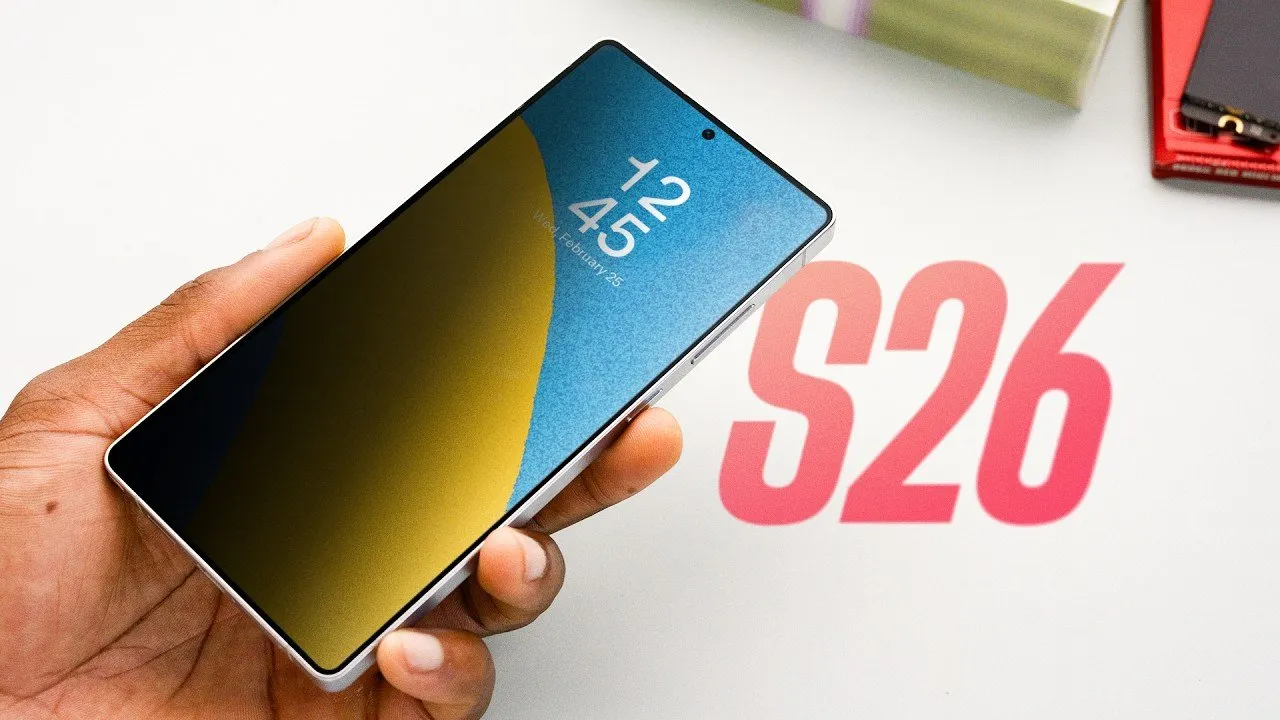
Samsung has officially unveiled its flagship Galaxy S26 series, introducing a lineup defined by refined hardware ergonomics, a strategic upward shift in pricing, and a novel hardware-level privacy display on the Ultra model. Despite logistical challenges surrounding the launch event in California, early hands-on reports and technical spec sheets reveal a device family that balances conservative design evolution with aggressive experimental display technology. The new series positions Samsung to compete more directly in the high-end premium market while clearing space for future mid-range offerings.
Key Points
- The Galaxy S26 lineup sees a baseline price increase of $100 across the standard and Plus models, with the S26 now starting at $900 and the Plus at $1,100.
- The S26 Ultra ($1,300) introduces a proprietary hardware-level privacy screen that allows users to mask the display from off-axis viewing without a physical screen protector.
- All models are powered by the Snapdragon 8 Elite Gen 5 for Galaxy, featuring specific NPU optimizations for a suite of new Galaxy AI tools.
- Hardware refinements for the Ultra include a transition back to aluminum sides from titanium, a thinner chassis, and increased 60W wired charging capabilities.
Pricing Adjustments and Market Positioning
The most immediate shift in the Galaxy S26 series is the abandonment of the $799 entry price. The base S26 now retails for $900, though Samsung has mitigated this increase by doubling the base storage from 128GB to 256GB. The S26 Plus has similarly climbed to $1,100, while the S26 Ultra maintains its $1,300 premium positioning. Industry analysts suggest this "price creep" is a calculated move to differentiate the flagship line from the eventual Fan Edition (FE) release, which is expected to occupy the $800 price point previously held by the base flagship.
Beyond the cost, the physical designs remain largely familiar. The standard models retain the aesthetic language of the previous generation, albeit with a new "plateau" ring around the camera sensors. The S26 Ultra, however, features more significant ergonomic changes; it is thinner, less "boxy," and swaps the titanium frame of the S25 Ultra for aluminum. This redesign necessitated a complete overhaul of the internal vapor chamber to maintain thermal efficiency within the slimmer profile.
Hardware Innovation: The Dynamic Privacy Screen
The standout technical achievement of the S26 Ultra is a hardware-integrated privacy feature. Unlike traditional adhesive privacy filters that degrade screen quality and remain permanently active, Samsung’s solution allows for pixel-level control. When engaged, the display remains clear from a direct viewing angle but fades to gray or black when viewed from the side or top, effectively blocking "shoulder surfing" in public spaces.
"This is a hardware level control over the pixels on the display that can be turned on or off whenever. And when you turn it on, the display should look unchanged from straight on, but as you get off-axis, it actually fades to gray and almost black... That's genuinely really sick," noted tech reviewer Marques Brownlee.
The feature offers granular customization, allowing users to trigger the privacy mode automatically based on geographic location or specific applications, such as banking or photo galleries. It can even be restricted to specific regions of the screen, such as the password input field or the notification shade, representing a significant evolution in display-centric utility.
Internal Specifications and AI Integration
Under the hood, Samsung continues its partnership with Qualcomm, utilizing the Snapdragon 8 Elite Gen 5 for Galaxy. While raw performance gains are expected, the primary focus is on AI optimization. The Galaxy S26 series doubles down on software-driven features, including "Now Nudge," a context-aware keyboard tool, and an LLM-powered version of Bixby that integrates with Gemini and Perplexity.
The camera hardware receives modest updates, primarily on the Ultra model. While the sensor resolutions remain largely unchanged, Samsung has widened the apertures on the primary and telephoto lenses. The main sensor moves from f/1.7 to f/1.4, and the 3x telephoto shifts from f/3.4 to f/2.4. These changes are designed to improve low-light performance and natural depth of field, though the lack of silicon carbon batteries or magnetic charging (similar to Qi2) remains a point of contention for some power users.
"It feels like they're just throwing a bunch of stuff at the wall in the world of AI just to see what will stick... I'm not sure I love how far down the slope we're going, but here we are," Brownlee observed regarding the influx of AI photo manipulation tools like Photo Assist and Creative Studio.
As Samsung moves toward the retail launch of the S26 series, the focus will likely shift to how consumers react to the increased entry price and whether the Ultra's unique display technology is enough to drive upgrades in a maturing smartphone market. Detailed performance benchmarks and long-term battery testing will follow as units begin shipping to global markets.