
Table of Contents
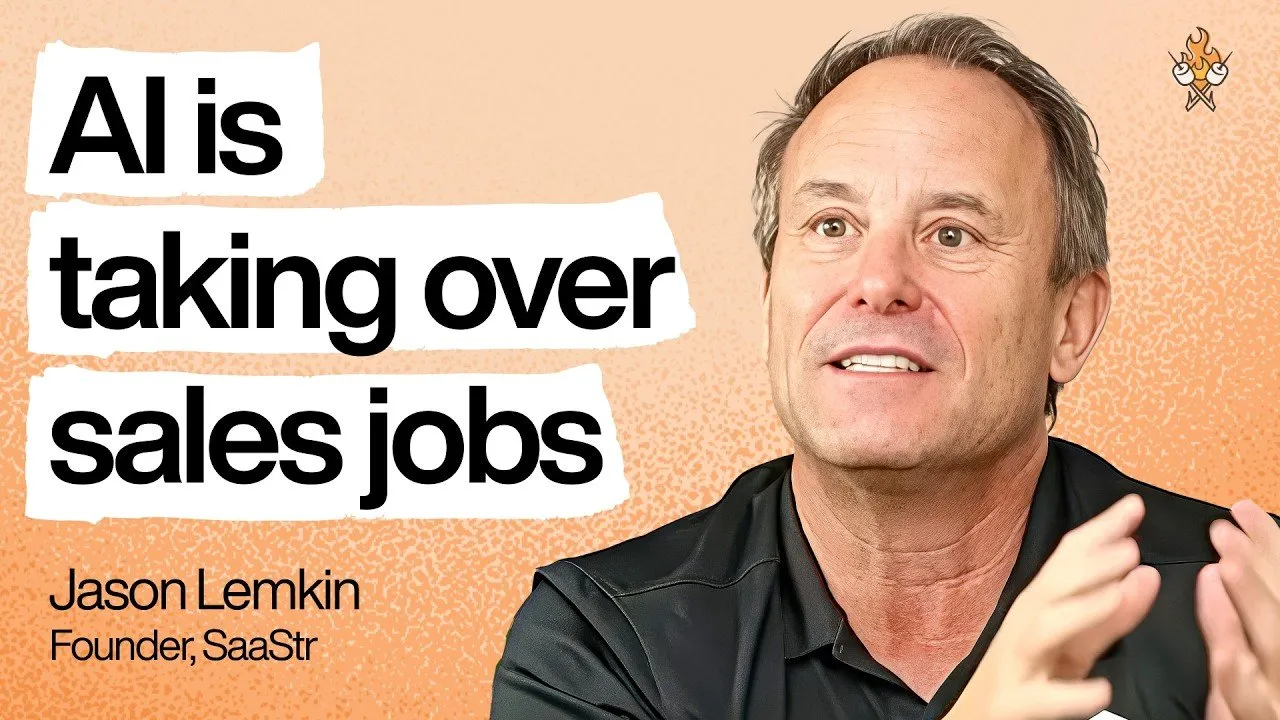
In May of this year, Jason Lemkin, the founder of SaaStr and a veteran voice in the B2B software world, made a radical decision. Faced with a sales team that had dwindled due to attrition—and frustrated by the prospect of hiring yet another cohort of mid-level reps—he decided to stop hiring humans for specific sales roles entirely.
Instead, he replaced a team of nearly 10 full-time SDRs and AEs with "1.2 humans" and 20 AI agents. The results were not just surprising; they were a blueprint for the immediate future of Go-To-Market (GTM) strategies.
The SaaStr business is now performing similarly to when it had a full human team, but with a level of efficiency and scalability that was previously impossible. Lemkin isn't just theorizing about the future of AI in sales; he is living it. From the death of the "contact me" form to the rise of the "Chief AI Officer," here is a deep dive into how SaaStr automated its sales floor and what it means for the future of the profession.
Key Takeaways
- The 1.2 Human Model: SaaStr replaced ~10 GTM desks with 20 AI agents managed by one full-time human and a part-time "Chief AI Officer," maintaining similar revenue output.
- Death of the Classic SDR: The entry-level role of sending cold email cadences and qualifying inbound leads is largely obsolete. AI agents now handle ingestion, qualification, and scheduling 24/7.
- Do Not Build; Buy and Train: Unless you are an engineering-first company, do not build internal AI tools. Buy leading vendors, but commit to the "ingestion and orchestration" process yourself.
- The "Forward Deployed" Necessity: Success depends on vendors who offer Forward Deployed Engineers (FDEs) to ensure the agent works upon deployment. The "turn it on and walk away" method of 2024 does not work.
- Hyper-Employability: Sales professionals who learn to orchestrate agents and embrace transparency will be in high demand, while "people persons" without technical product knowledge face extinction.
The Shift: From 10 Desks to 20 Agents
The catalyst for Lemkin’s transformation was a familiar frustration for many founders: the cycle of hiring, training, and losing sales representatives. After two sales team members quit right at the start of SaaStr Annual—their biggest event of the year—Lemkin turned to his "Chief AI Officer," Amelia, and made a call: "We're done with hiring humans in sales. We're done."
The new structure is starkly efficient. Walk into the SaaStr office today, and you will see desks labeled not with human names, but with the names of the agents working those territories: "Reply" for outbound, "Quali" for inbound, and "Arty" for artisan tasks.
"Agents work all night and they work weekends and they work on Christmas. We're done with hiring humans in sales."
The current setup relies on 1.2 humans: one full-time Account Executive closing deals, and Amelia, who dedicates roughly 20% of her time to orchestrating the fleet of 20 agents. The agents handle the volume—support, inbound qualification, outbound prospecting, and lapsed-customer reactivation—while the human handles the negotiation and closing of high-value sponsorships.
Constructing the AI Sales Stack
Lemkin emphasizes that this transition wasn't about building proprietary software. SaaStr utilized existing market tools, integrating them to cover the entire funnel. The key learning here is to avoid the "Not Invented Here" syndrome. Unless you have the engineering resources of a company like Vercel, you should be buying, not building.
Here is how the SaaStr agent workforce is divided:
1. The Support Layer
It started with Deli, a tool used to create a "Digital Jason" and a support bot. Initially intended for simple queries, the bot surprisingly began closing sponsorships on its own. This proved that a horizontal agent, even one not specifically trained for hard sales, could drive revenue if it provided instant, accurate answers 24/7.
2. The Outbound Engine
For outbound sales, SaaStr deployed Artisan. The strategy was simple but labor-intensive: they took their best human emails—the ones with the highest conversion rates—and used them to train the agent. The agent then iterates and A/B tests variants. The result was 60,000 emails sent with high engagement rates, targeting a database of 400,000 prospects.
3. Inbound Qualification
The "Contact Us" form is a friction point where deals often die. SaaStr implemented Qualified to handle inbound traffic. Instead of a lead waiting 48 hours for a junior SDR to ask "What is your budget?", the AI qualifies the visitor instantly on the website and books a meeting with the human AE immediately.
4. Reactivation
Perhaps the most interesting use case involved Salesforce’s Agentforce. Lemkin deployed this agent specifically to target "dead" leads—prospects that human sales reps had deemed not worth their time or commission. The AI reached out to these ignored leads and achieved a 70% response rate. This highlighted a critical inefficiency in human sales teams: the reluctance to work "mid-pack" leads.
The Implementation Gap: Why AI Sales Failed in 2024
Many companies attempted to deploy AI sales tools in 2024 and failed. Lemkin argues this is because vendors promised a "magic box" solution—plug it in, and revenue comes out. The reality is that these tools require Orchestration and Ingestion.
To succeed, you must adopt the mindset of a "Forward Deployed Engineer." You cannot simply hire an agency and disappear. You must:
- Ingest Data: Feed the agent your wikis, your best email scripts, your prospectus, and your website data.
- Train and Test: Spend the first 30 days correcting the agent. Every morning, review its output. If it hallucinates or uses the wrong tone, correct it.
- Iterate: Treat the agent like a new hire. It needs coaching.
"If you do this for 30 days and every day you spend an hour or two correcting those mistakes, by the 30th day it's going to be pretty good."
This creates a new career opportunity. The professionals who can take a vendor’s tool, handle the ingestion and training, and get it into production are the new power players. If you can bridge the gap between the software and the sales floor, you are "hyper-employable."
The Future of the Sales Profession
The rise of the 20-agent team signals a bifurcation in the sales career path. The middle is falling out.
The Extinction of the "Cadence Monkey"
The classic SDR role—hired out of college to feed leads into email automation tools—is disappearing. There is no economic justification for paying a human to act as a router for emails when an AI can do it faster, with better personalization, and without sleeping. Similarly, BDRs who strictly qualify inbound leads are being replaced by conversational AI that operates instantly.
The Survival of the Expert
However, sales is not dead. Complex, high-value enterprise sales still require a human touch. The "Jen Abel style" of bespoke, whiteboard-led selling for six-and-seven-figure deals remains safe because the ROI of human connection there is high.
But the definition of a "good salesperson" is changing. Being a "people person" is no longer a sufficient skill set. If your primary skill is being friendly on a Zoom call, you are at risk. The surviving salespeople will be technical experts who know the product cold and can answer tough questions immediately, or they will be Orchestrators—reps managing a fleet of 10 agents to do the work of a previous 10-person team.
Actionable Advice for Founders
If you are a founder wondering where to start, Lemkin suggests a "Holiday Incognito Test."
Over the holidays, fire up an incognito browser window and try to buy your own product. Submit a support ticket. Fill out the "Contact Sales" form. See how long it takes to get a response. The results will likely make you cry.
Pick the part of that process that is the most broken—whether it is the 3-day support lag or the ignored inbound lead—and deploy an agent there first. You don't need to overhaul the entire organization overnight. Start with the pain point, train the agent yourself, and prove the model.
Conclusion
The transition to an AI-led sales organization is not just about cost-cutting; it is about capacity. In an era where efficiency is king, AI allows companies to touch every lead, reactivate every dead opportunity, and support every customer 24/7—tasks that humans simply do not want to do at scale.
The window to adopt these tools while they are still a competitive advantage is closing. As Lemkin notes, "The plays all work, but the playbooks are broken." The basics of sales haven't changed, but the machinery running them has been upgraded. Those who embrace the role of the orchestrator will thrive; those who cling to the old manual playbooks risk being left behind by an automated workforce that never sleeps.



)