Table of Contents
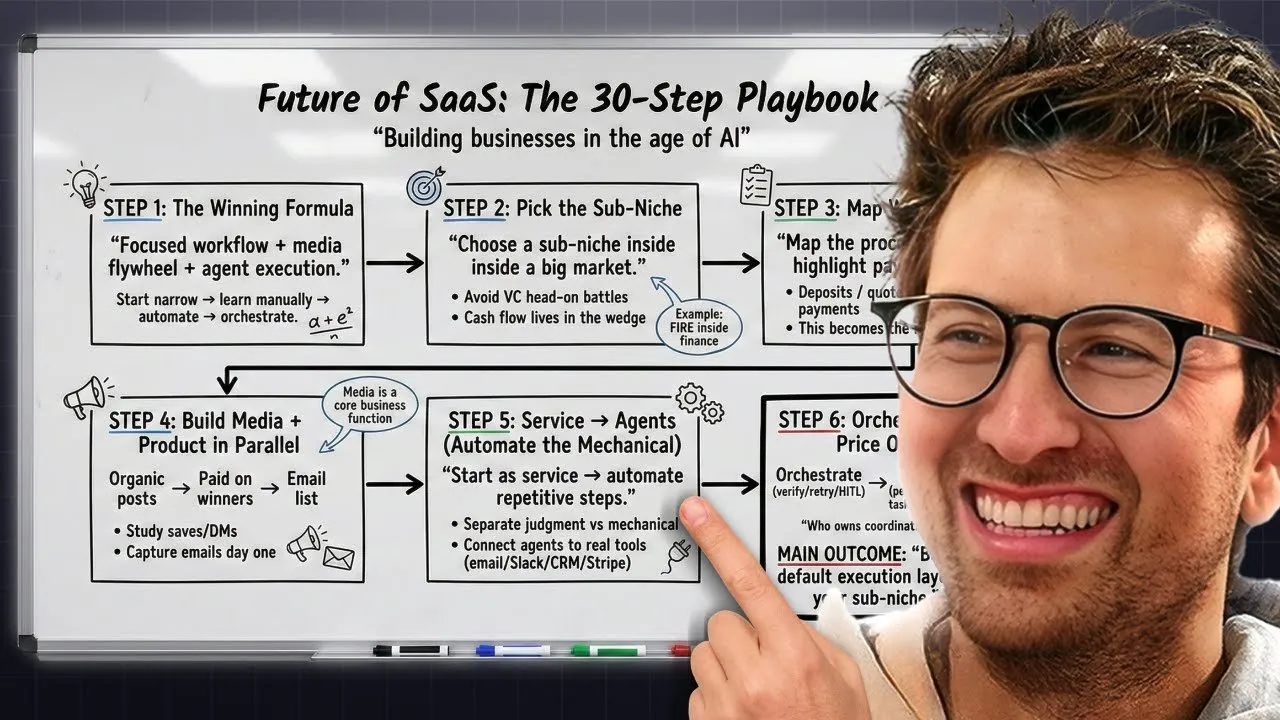
Building a Software as a Service (SaaS) company has never been more accessible. With the explosion of AI tools and the falling costs of development, the barrier to entry has plummeted. While some critics suggest that the "SaaS era" is coming to an end, the reality is far more optimistic: the industry is simply undergoing a massive evolution. Rather than struggling to compete with venture-backed giants in broad markets, savvy entrepreneurs are now building specialized, cash-flowing machines by leveraging agentic workflows and targeted content strategies.
Key Takeaways
- Target Sub-Niches: Avoid broad markets. Focus on specific workflows within smaller niches where you can become the default solution.
- The Power of Media: Build a media company alongside your software. Use organic content to fuel paid acquisition and establish trust.
- Agentic Automation: Shift from human-led services to AI-orchestrated workflows that handle repetitive, mechanical tasks.
- Outcome-Based Pricing: Move away from "per-seat" models toward "per-task" or outcome-based pricing to better align with the value your software delivers.
- Manual Execution First: Manually perform the workflow yourself before automating it to deeply understand the user's pain points and requirements.
Find Your Wedge: Target a Sub-Niche
The biggest mistake new founders make is attempting to build for a massive, saturated market. When you try to build a generic tool, you end up competing directly with well-funded venture-backed companies. Instead, look for a sub-niche. If the broad market is "Finance," your niche might be "Financial Independence for Gen Z."
Mapping the Workflow
Once you have identified your niche, you must map their workflow end-to-end. Whether you are helping a local roofing company or a creative agency, you need to document every step of their daily operations. You can do this manually by interviewing practitioners, drawing it out on a whiteboard, or using AI research tools to generate a comprehensive process map. Identifying exactly where money changes hands—such as contract negotiations or deposit collections—is where you will find your opportunity to wedge your software into their business.
Building a Media Engine
In today's landscape, your product alone is not enough. You must build an audience. By creating "scroll-stopping" content, you turn your brand into a media company. This allows you to bypass expensive, competitive ad auctions by identifying which organic posts resonate with your audience and converting those winners into paid ads.
"The orchestration layer is the new interface layer. As we spend our day coordinating agent workflows in a model agnostic fashion, the ultimate layer to own is where coordination takes place." — Scott Belsky
Content Strategy as a Moat
Use AI as your CMO. Ask models to research viral trends within your specific niche and create a content calendar. By tracking metrics like bookmarks, shares, and replies, you develop an intuition for what your specific audience cares about. This content not only drives traffic but also serves as proof of your expertise, making the eventual sale of your software significantly easier.
The Evolution of SaaS: Agents and Orchestration
The future of software is not just about a UI with buttons; it is about agents completing tasks. You should start by manually performing the workflow yourself. This provides the necessary "domain knowledge" that most developers lack. Once you master the manual process, you can separate the judgment-heavy tasks from the mechanical, repetitive ones.
Designing the Agentic Workflow
Mechanical tasks are prime targets for automation. By connecting AI agents to real tools—like Stripe, Slack, or email—you can build a system that executes work 24/7. This is where orchestration becomes critical. As noted by industry experts, the ability to coordinate agents and validate their outputs is the new "interface" of modern software. By ensuring your agents have the right tools and verification checks, you minimize the risk of AI hallucinations and provide high-value, reliable outcomes for your users.
Redefining Value: From Per-Seat to Per-Task
The traditional "per-seat" pricing model is becoming outdated. In an age where AI can handle vast amounts of work, customers are less interested in how many licenses they own and more interested in the outcomes achieved. When you price your software based on completed tasks, you align your incentives with the customer’s success.
- Quantify the Savings: Calculate how much time you are saving your user and assign a dollar value to those hours.
- Build Switching Costs: Capture user preferences and build long-term memory into your agents so the product becomes more useful the longer they use it.
- Scale Through Proof: Once you have power users, turn their success into high-quality video case studies to drive further growth.
Conclusion
SaaS is not dead; it is evolving into a more efficient, outcome-driven industry. By starting with a specific sub-niche, mastering the workflow manually, and layering in agentic orchestration, you can build a software business that doesn't just solve a problem but becomes an essential part of your customer's daily operations. Stop waiting for the perfect "silver platter" idea. Start by mapping a workflow, building an audience, and automating the mechanical steps that keep businesses from moving forward. The tools are available—the rest is up to you.