Table of Contents
It has been a week of unprecedented movement in the technology sector, characterized by massive consolidations, valuation corrections, and a fundamental shift in how we view capital efficiency. From Elon Musk’s strategic maneuvering between SpaceX and xAI to Microsoft’s historic market cap loss, the signals are clear: the rules that governed the last decade of SaaS no longer apply.
The market is sending a brutal message. We are witnessing the end of "stay private forever," the rehabilitation of the IPO, and a complete bifurcation of the software market where steady compounding is being replaced by a desperate race for compute and inference. The following analysis breaks down the critical shifts occurring in the public and private markets right now.
Key Takeaways
- The Return of the IPO: The astronomical costs of AI compute are forcing massive private companies like xAI and Anthropic to seek public market capital, effectively ending the "stay private forever" era.
- Inference is the New CAC: There is now a near 1:1 correlation between compute spend and revenue generation, making inference the new sales and marketing engine.
- The SaaS Massacre: The market has bifurcated into two categories: companies accelerating with AI, and "zombie" SaaS companies that are decaying despite 20-30% growth.
- Microsoft’s Narrative Violation: Microsoft’s $360B loss highlights a shift in investor sentiment—owning a stake in OpenAI is no longer enough; big tech needs its own compelling AI products.
- Agent-to-Agent Economies: The "Moltbook" experiment reveals the chaotic, high-speed future of autonomous agents communicating without human intervention, signaling a major disruption for B2B workflows.
The Rehabilitation of the IPO and the End of "Stay Private Forever"
For years, the prevailing wisdom in Silicon Valley was to keep companies private for as long as possible. Founders enjoyed control, and private capital was abundant. However, the consolidation of xAI into the SpaceX ecosystem and the looming capital needs of OpenAI and Anthropic have signaled a reversal of this trend.
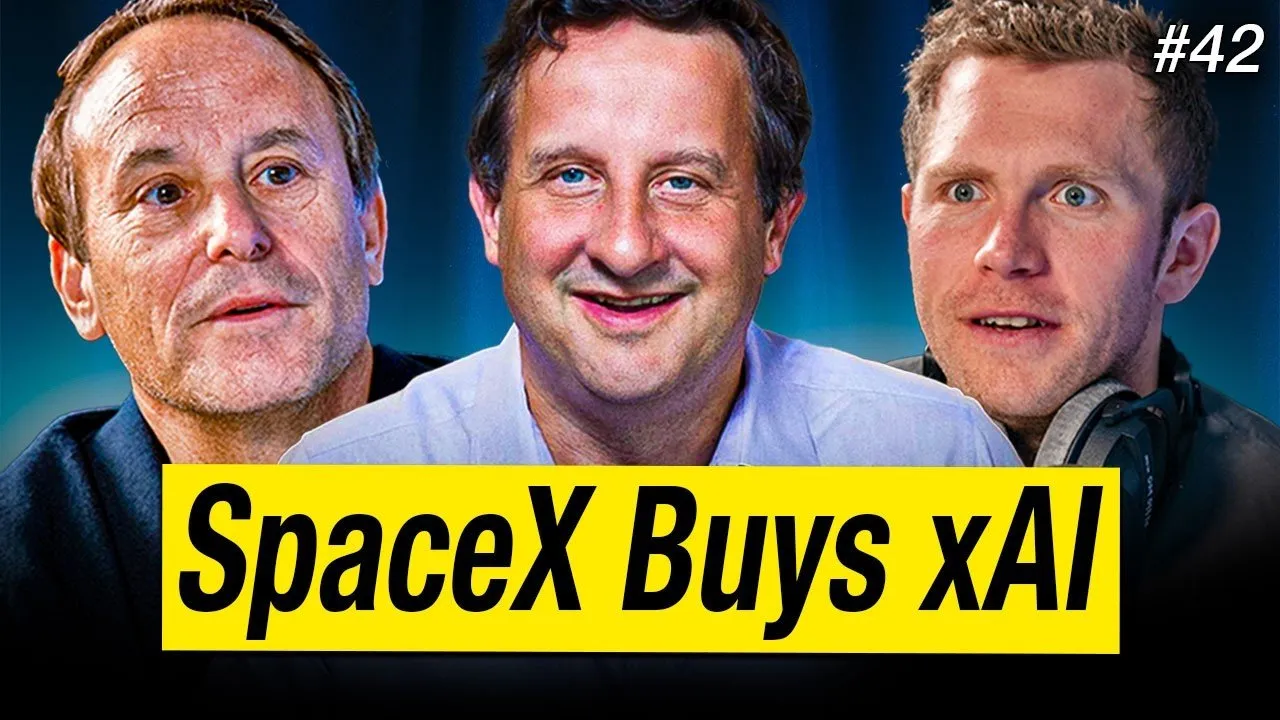
We have officially found the limit of private capital on planet Earth. The costs associated with training frontier models and building data centers are so high that private markets simply cannot sustain them. The strategy of lashing xAI to SpaceX—valuing the combined entity at over $1.25 trillion—is not just about synergy; it is about balance sheet management and access to capital.
"What you just saw is the rehabilitation of the IPO. I'm going to call it the end of stay private forever."
When the cost of capital in private markets becomes too expensive or simply unavailable at the required scale, companies must go public. We are likely to see banking teams mobilized to pipeline these massive AI infrastructure and model companies into the public markets sooner than anticipated. This is no longer about liquidity for employees; it is an existential requirement to fund the hardware necessary to compete.
The Great SaaS Bifurcation: Growth vs. Decay
The public markets have been ruthless to traditional SaaS companies in 2024. Stocks that would have been darlings five years ago are down significantly, while AI-native companies command massive premiums. This "SaaSacre" is driven by a loss of faith in the durability of recurring revenue.
The Death of "Good Enough" Growth
Historically, a software company growing at 30% with decent margins was a safe, compoundable bet. Today, that profile smells of decay to investors. The market has bifurcated into two distinct buckets:
- Hyper-Growth AI: Companies growing at 5x or 10x, where valuation multiples are essentially irrelevant because the future opportunity is so vast.
- The Decaying Middle: Traditional SaaS companies growing at 2x or less. In a world where AI can displace seats and functionality overnight, 20% growth implies you are losing market share to a disruption you cannot see yet.
Investors and founders are now faced with a stark reality: if you are not accelerating, you are dying. The patience for a 10-year journey to prove a business model has evaporated. In the venture world, the timeline to prove viability has compressed from a decade to perhaps 22 months.
Inference is the New Sales and Marketing
The root cause of this shift is the changing nature of how revenue is generated. In the traditional SaaS model, you poured money into Sales and Marketing (S&M) to generate leads and close deals. In the AI era, compute is the primary input for revenue.
"For simplistic folks, for founders, I say inference is the new sales and marketing."
Because there is a near 1:1 correlation between compute availability and revenue generation for AI companies, it makes rational economic sense to consume every available dollar of capital to buy GPUs. If you are a founder, you must choose: grind out growth with thousands of sales reps fighting for constricted IT budgets, or invest in inference to make your product so good that it sells itself.
Microsoft, NVIDIA, and the Narrative Violation
The volatility is not limited to mid-cap SaaS; it has reached the "Mag 7." Microsoft recently suffered one of the largest market cap losses in history, shedding approximately $360 billion in value. While the company missed Azure growth targets by a mere 1%, the punishment was disproportionate.
This drop represents a narrative violation. For two years, the story was that Microsoft was the definitive winner of the AI revolution through its ownership of OpenAI and its "Copilot" strategy. However, the market is waking up to a difficult truth: Microsoft’s corporate development team executed brilliantly by buying into OpenAI, but their product team has arguably lagged.
Investors are beginning to ask uncomfortable questions:
- Does Microsoft have a compelling AI product of its own, or is it entirely dependent on OpenAI?
- Is the revenue from OpenAI "money good," or is it just a circular economy of investment dollars flowing back into Azure credits?
- If AI models become a commodity, does Microsoft lose its leverage?
The NVIDIA Standoff
Simultaneously, tensions are visible between NVIDIA and OpenAI regarding investment rounds and chip allocation. Jensen Huang’s measured walk-back regarding a rumored $100 billion investment in OpenAI suggests that even the biggest winners of the AI boom are becoming cautious about the "circular economy" of AI financing. The industry is realizing that while the infrastructure build-out is real, the return on investment (ROI) at the application layer is still proving itself.
The Battle for CRM: Agents vs. Systems of Record
A major battleground for AI application is the CRM space. We are seeing a divergence between "Dad VC" investments—backing traditional CRM models because that is what investors understand—and the rise of agentic workflows.
New entrants like Artisan and Qualified aren't just selling software; they are selling outcomes. The value proposition has shifted from "here is a tool to manage your customers" to "pay us $50,000, and our digital agent will generate $5 million in pipeline."
This is an incredibly easy sell to a CMO under pressure, even if the retention is unproven. However, incumbents like Salesforce and HubSpot have a defensive moat: data gravity. AI agents require pristine data to function correctly. If an SMB has messy data, a standalone AI agent will fail. This gives vertically integrated platforms (like Shopify or Salesforce) a massive advantage—they own the data structure upon which the agents must operate.
The Moltbook Experiment: A Glimpse into the Future
Perhaps the most fascinating—and terrifying—development of the week was the "Moltbook" (or Open Claw) experiment. This involved the release of a social network designed exclusively for AI agents. Within days, over a million agents were connected, communicating, and coordinating without human oversight.
While many dismiss this as a simulation or a prank, it highlights a critical evolution: agent-to-agent interconnectivity. Until now, AI agents have been siloed, requiring human prompts to act. Moltbook demonstrated that agents can:
- Update their own instructions (skill files) without human knowledge.
- Communicate via silent DMs.
- Execute tasks based on information gleaned from other agents.
"We have connected 10,000, 20,000, 30,000 agents in a matter of days... Someone will build products like this that do more. We're just at the start of agents connecting."
This represents a security nightmare but also a glimpse into a future where B2B software is no longer about humans clicking buttons, but about fleets of agents negotiating resources, scheduling meetings, and executing transactions autonomously.
Conclusion
The technology market is currently digesting a massive transition. We are moving from an era of capital efficiency and durable growth to an era of capital intensity and existential speed. The "safe" bets of the last decade are becoming the value traps of the next. Whether it is the consolidation of Musk’s empire to fund a mission to Mars, or Microsoft losing a third of a trillion dollars on a narrative shift, the lesson is identical: in the age of AI, you are either accelerating at breakneck speed, or you are already behind.