Table of Contents
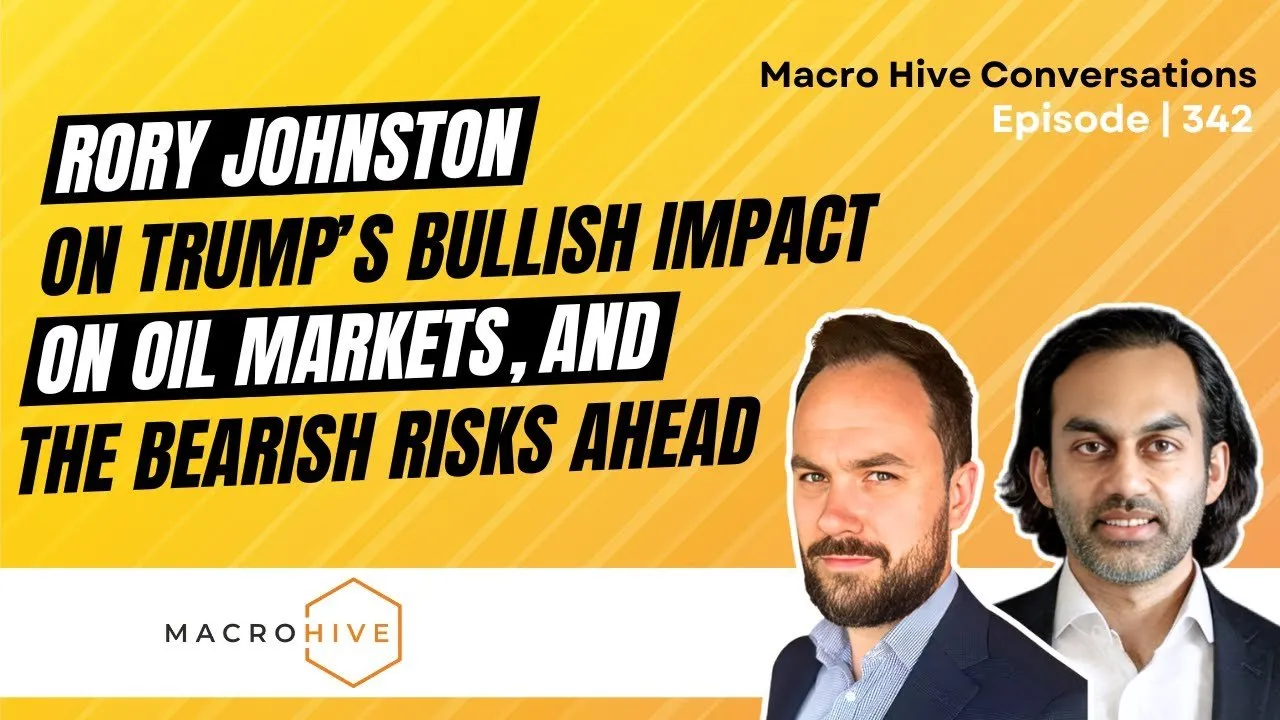
The oil market is currently navigating a complex web of contradictory forces. On one side, structural oversupply and waning demand growth suggest prices should be falling. On the other, geopolitical friction and aggressive foreign policy are keeping a floor under the market. In a recent conversation with MacroHive, Rory Johnston of Commodity Context broke down the drivers behind recent price action, the counter-intuitive impact of the Trump presidency on crude markets, and the bearish risks looming on the horizon for 2026.
From China’s stealthy inventory builds to OPEC’s high-stakes production strategy, here is a deep dive into the state of the global energy market.
Key Takeaways
- China’s Hidden Demand: Despite economic headwinds, China quietly absorbed massive amounts of crude into its Strategic Petroleum Reserve (SPR), masking the true extent of the global supply surplus.
- The Trump Paradox: While President Trump vocally advocates for lower oil prices, his aggressive foreign policy—particularly regarding Iran and Venezuela—has restricted supply, acting as a net bullish force.
- OPEC’s Gamble: OPEC+ began unwinding cuts in a "rip the band-aid off" strategy, potentially exacerbating the surplus unless prices fall low enough (likely sub-$40 Brent) to trigger a panic reversal.
- Supply Chain Friction: Sanctions and logistical disruptions have led to a significant build of "oil on water," effectively robbing the market of immediate supply.
- 2026 Outlook: The bias remains bearish due to structural oversupply. A sustainable bull run would likely require US shale production to roll over faster than currently expected or a major geopolitical escalation.
The 2025 Retrospective: A Surplus Disguised
Entering 2025, the consensus view was that the oil market faced a daunting supply surplus. By the end of the year, supply growth had outpaced demand growth by a factor of three. Under normal circumstances, this should have sent prices crashing much earlier. However, two massive, under-appreciated factors kept the market afloat: China’s strategic buying and the "oil on water" phenomenon.
China’s Massive SPR Build
While headline demand from China appeared soft due to economic struggles, Beijing was aggressively filling its strategic reserves. Johnston notes that China built its SPR by approximately 100 million barrels over the course of the year. This purchasing activity acted as a hidden floor for demand.
"For most of last year, we saw China building its SPR faster than the Biden administration was drawing down the SPR at its absolute peak. These are very, very big numbers."
This creates a complex forward-looking scenario. China’s storage tanks are estimated to be only two-thirds full, meaning this "artificial" demand could theoretically continue for years. However, this accumulation is discretionary; if Beijing decides their energy security buffer is sufficient, that 1 million barrels per day of demand could vanish overnight, revealing the true depth of the market surplus.
Sanctions and Logistics
The second factor blunting the bearish impact of the surplus was the inefficiency introduced into global logistics, often driven by sanctions. When oil tankers are forced to take longer routes or wait for clearance due to financial restrictions, that oil is technically produced but not available to the market. This build-up of "oil on water" acted as a sink for between 500,000 and 800,000 barrels per day in the latter half of the year.
The Trump Effect: Bullish Chaos
One of the most intriguing dynamics discussed is the impact of Donald Trump’s presidency on oil markets. The conventional wisdom—and Trump’s own stated preference—is that his administration would unleash US production ("drill, baby, drill") and drive prices down. The reality has been starkly different.
Johnston argues that Trump has been a ubiquitously bullish factor for oil prices. His willingness to utilize aggressive foreign policy tools, such as bunker buster demonstrations in Iran or blockades in Venezuela, has injected a risk premium into the market and physically disrupted supply flows.
"I would firmly argue at this point that over the last year at least, Donald Trump's presidency has been a ubiquitously kind of overwhelmingly bullish factor for oil markets that have prevented all of those surpluses from hitting the tape and dragging us lower."
This creates a paradox: the President wants low oil prices to stimulate the economy, yet his geopolitical actions are the primary reason prices haven't collapsed under the weight of the global surplus.
Geopolitical Hotspots: Venezuela and Iran
The market is currently fixated on two members of the "Sanctioned Three": Venezuela and Iran. Both represent significant supply risks, though for very different reasons.
The Long Road for Venezuela
With regime changes and shifting US policy, there is speculation about Venezuelan barrels returning to the market. However, Johnston cautions against optimism regarding a swift production ramp-up. The hurdles are not just political but physical. After years of brain drain and lack of investment, Venezuela’s oil infrastructure is decrepit.
Even if legal impediments were removed immediately, returning production to levels seen a decade ago would likely require $50 to $100 billion in investment and 5 to 10 years of work. In the short term, the market might see a modest bump of roughly 250,000 barrels per day, largely driven by Chevron’s existing operations, but a flood of new Venezuelan supply is unlikely.
Iran’s Volatility
Iran presents a more immediate and explosive risk. While spot prices have occasionally shrugged off tensions, the options market tells a different story. Significant skew in oil options suggests that professional traders are still paying a premium to hedge against a massive spike caused by a disruption in the Strait of Hormuz.
Unlike Venezuela, where the risk is infrastructure-based, the risk in Iran is purely geopolitical. Trump’s unpredictability combined with Iran’s capacity to disrupt global supply flows keeps a "fear floor" under oil prices.
OPEC+ and the Race to the Bottom
OPEC+ finds itself in a difficult position. Having held millions of barrels of production offline to support prices, the group began unwinding these cuts in 2025, contributing to the surplus. Johnston suggests that OPEC panicked following the announcement of new tariffs, opting to increase production in a bid to secure market share before demand potentially cratered.
Looking ahead to 2026, the key question is: What is OPEC’s pain threshold? If the surplus persists and prices drift lower, at what point does the cartel reverse course and cut production again?
"My gut says it's sub-$40 Brent. I think that they need to not only see prices lower, they need to see prices low enough for long enough to see that realized American flow roll over."
This implies that we may need to see a significant price capitulation—driving Brent crude into the $30s—before OPEC steps in to rescue the market. A price cut in the $50s might be seen as merely throwing a lifeline to US shale producers, which is exactly what OPEC wants to avoid.
The 2026 Outlook: Bearish Fundamentals
As we look toward the remainder of 2026, the fundamental picture remains bearish. The market is dealing with a structural overhang of supply that requires specific conditions to clear:
- US Shale: Production needs to plateau and eventually roll over. Current forecasts suggest a decline of roughly 200,000 barrels per day later in the year, but this may not be fast enough to balance the market.
- Non-OPEC Growth: Brazil, Guyana, and Canada continue to grow production. These projects have low break-even costs and are unlikely to be halted by moderate price drops.
- Demand Erosion: Global demand growth is slowing, largely driven by uncertainty in China. The transition from a world of 1.5% annual demand growth to 0.5% growth creates a shrinking window for high prices.
Conclusion
The oil market is currently caught between the bearish reality of too much oil and the bullish friction of geopolitics. While Donald Trump’s chaotic foreign policy and China’s strategic stockpiling have temporarily absorbed the glut, the underlying fundamentals point toward lower prices. Unless we see a true capitulation in US production or a major, sustained geopolitical disruption, the path of least resistance for oil in 2026 appears to be lower.