Table of Contents
A rapidly emerging robotics startup has secured substantial backing from industry giants including Nvidia, Samsung, and LG, raising $1.4 billion to develop a universal "brain" capable of powering diverse robotic hardware. By shifting the focus from mechanical engineering to general-purpose artificial intelligence, the company aims to overcome the software limitations that have historically prevented robots from scaling beyond controlled industrial environments.
Key Points
- Significant Capital Injection: The startup has raised $1.4 billion, drawing investment from major strategics in consumer electronics and software.
- "Omni-Body" Architecture: The core technology is a single AI "brain" designed to control any type of robot across various tasks, rather than custom software for specific machines.
- Hybrid Training Model: The AI learns by combining observations of human video data with rigorous practice in digital simulations.
- Rapid Revenue Growth: The company projects scaling from zero to tens of millions in revenue within months during 2025, driven initially by enterprise applications.
Solving the "Missing Brain" Problem
Despite 70 years of advancements in robotic hardware, the widespread integration of robots into daily life remains elusive. According to the company's leadership, the industry has been held back not by a lack of capable bodies, but by the absence of adaptable intelligence.
While popular culture and Hollywood have conditioned the public to view robotics through the lens of hardware, the startup argues that the physical machinery is already sufficient for many tasks. The critical deficit lies in the software's ability to adapt to unstructured environments.
"The main thing behind not having robots around us today is the brain is missing. And if you have the brain for robots, you can really enable them around in a variety of areas to add to applications."
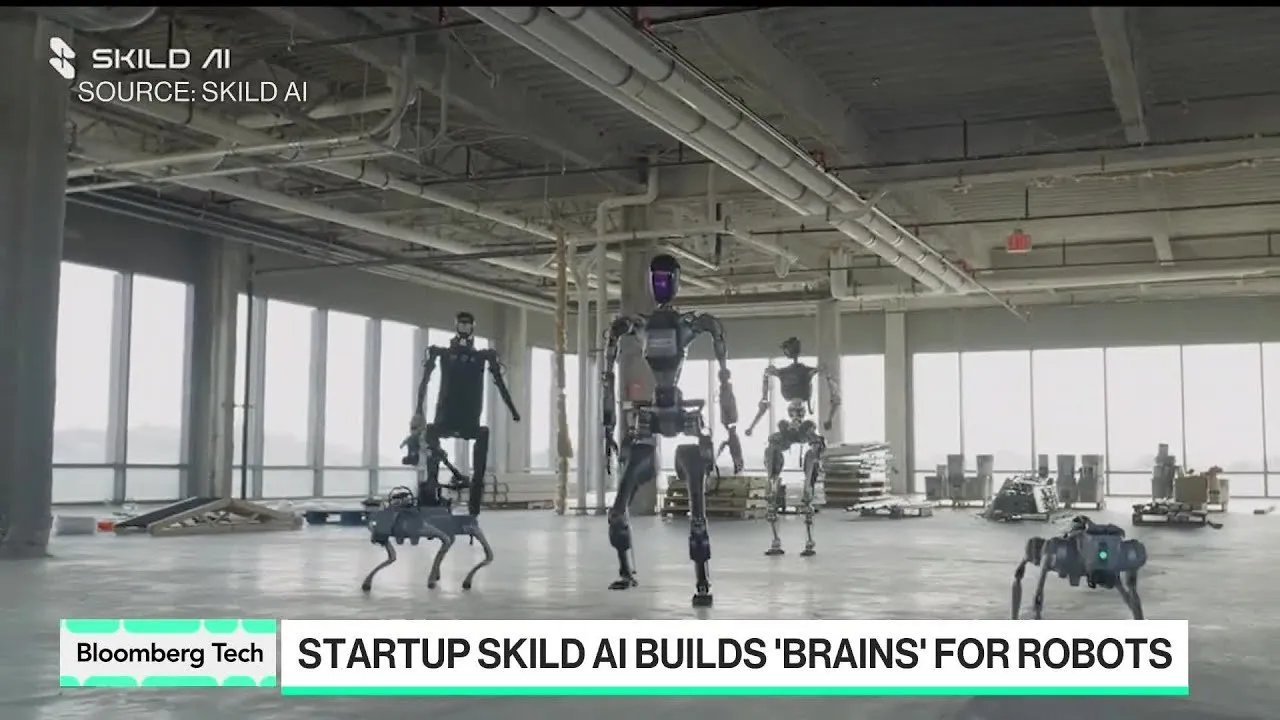
The company is developing what it describes as an "omni-body brain"—a foundational model capable of operating any robot for any task. This approach mirrors the trajectory of Large Language Models (LLMs) in the software sector, where a single generalized model can handle diverse linguistic tasks.
Training Without an Internet of Robotics
A major hurdle in developing general-purpose robotic intelligence is the scarcity of training data. Unlike LLMs, which scrape the vast expanse of the internet for text and images, there is no "internet of robotics" containing ready-made motion data for every conceivable physical action.
To circumvent this, the startup utilizes a two-pronged training strategy:
- Observation: The AI processes vast amounts of video data showing humans performing tasks in real-world scenarios, such as kitchens or factories.
- Simulation: Because observation alone does not build muscle memory, the system practices these tasks in physics-based digital twins, utilizing platforms similar to Nvidia's Omniverse.
The founder drew a parallel to professional sports to explain why video data is insufficient on its own:
"Watching alone is not enough. Because if it was enough, I could play like Federer [by] keeping watching his games all day, and that's where practice comes into play."
Market Strategy and Competition
The robotics AI sector is becoming increasingly crowded, with competitors like Physical Intelligence and 1X also vying for dominance. However, this startup distinguishes itself through its hardware-agnostic philosophy. The goal is to decouple the "brain" from the "body," allowing the same software to pilot a humanoid robot, a quadruped dog, or a robotic arm.
While the long-term vision includes consumer home applications, the immediate commercial focus is on enterprise deployment. The company is reportedly seeing rapid adoption, with revenue expected to jump from zero to tens of millions of dollars in 2025. Current deployments cover point-to-point delivery, security, data center operations, and manufacturing.
By leveraging the "watch and practice" methodology, the company aims to bypass the high costs of real-world trial and error, positioning itself to scale robotics adoption faster than competitors relying solely on one training modality.