Table of Contents
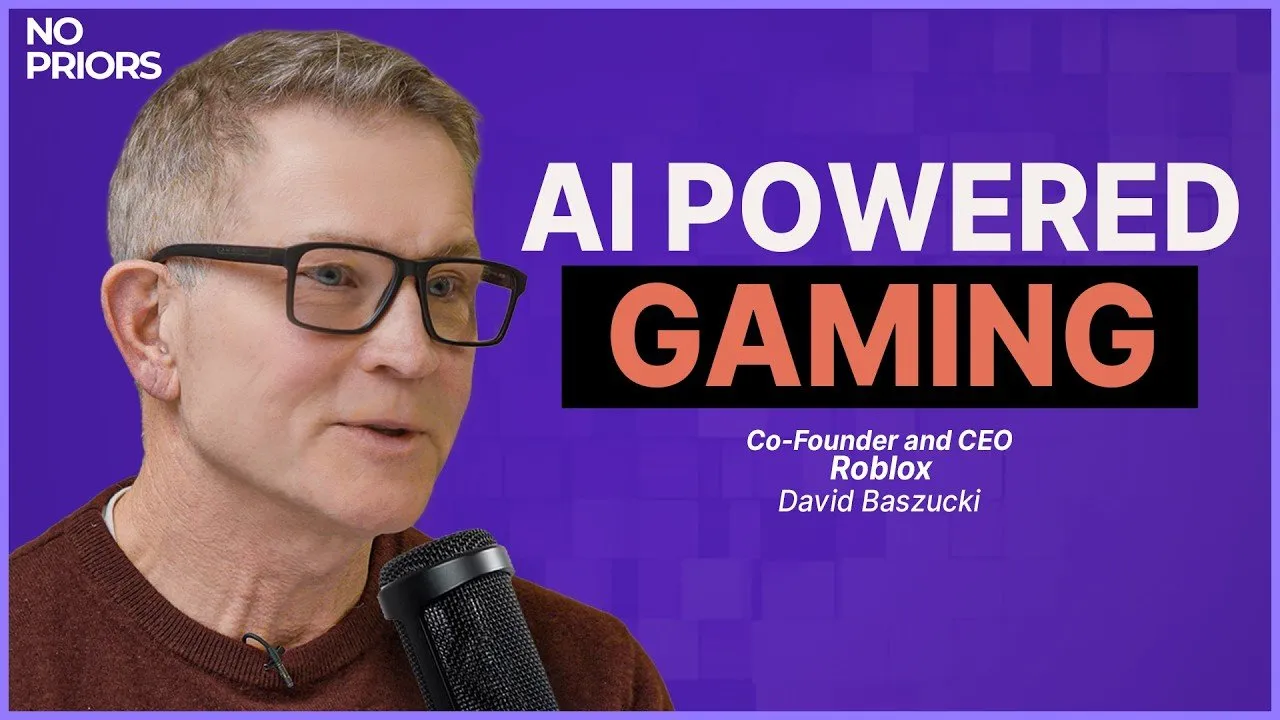
For nearly two decades, Roblox has operated with a singular, ambitious vision: building the "Holodeck." While the platform is often categorized simply as a gaming site for younger demographics, its trajectory suggests something far more expansive. In a recent conversation with the No Priors podcast, Roblox founder and CEO Dave Baszucki outlined a future defined not just by gaming, but by "human co-experience"—a category where physics-compliant, photorealistic 4D simulations allow thousands of people to interact in real-time.
As the gaming industry grapples with the influx of generative AI, world models, and agentic workflows, Roblox is leveraging its massive repository of user data—13 billion hours per month—to pioneer new forms of interaction. From virtual doppelgangers to meritocratic hiring algorithms, the company is bridging the gap between sci-fi concepts and scalable infrastructure.
Key Takeaways
- The Shift from 3D to 4D: Roblox is evolving beyond visual 3D shapes to "4D" simulation, which includes functional physics, realistic acoustics, and the synchronization of 10,000 concurrent users in a single space.
- Vector-Based NPC Training: Unlike models trained on rasterized video, Roblox trains native NPCs on 13 billion hours of 3D vector data, allowing for agents that understand spatial navigation and gameplay mechanics from any angle.
- The Agentic Doppelganger: Future iterations of the platform may allow users to deploy privacy-compliant, AI-driven versions of themselves to interact with others or perform tasks within the virtual world.
- Cloud-Native Asset Generation: Generative AI will enable "just-in-time" asset creation, upsampling primitive designs into photorealistic environments dynamically based on the user's device.
- Meritocratic Hiring: Roblox has replaced traditional resume screening with proprietary 3D simulation tests to identify problem-solving talent, decoupling hiring from university prestige.
Building the Ultimate Co-Experience
The original business plan for Roblox, drafted nearly 20 years ago, drew inspiration from Snow Crash and Ready Player One. The goal was never merely to host games, but to facilitate "human co-experience." While modern generative AI often focuses on "real-time dreaming"—where a user consumes a hyper-personalized, solitary experience—Roblox focuses on shared reality.
Baszucki distinguishes between these two future paths. In one, a user might inhabit a Vanilla Sky-style dreamscape, entirely generated by AI and populated by NPCs. In the other, the "Holodeck" model, the priority is high-fidelity social connection backed by rigorous physics simulation. The technical challenge here is not just generating pixels, but synchronizing the state of thousands of users simultaneously.
"The technology for this... is what's the most efficient way to synchronize the state of 10,000 people. And how do we fall back to 100 or 10 or one? We feel it's super robust to build a communication platform."
Defining 4D Simulation
The term "4D" in this context extends beyond the three spatial dimensions to include function and time-based physics, specifically acoustics. In a Zoom call, audio is mixed flatly; in a true 4D simulation, audio attenuates based on distance and environment. If you walk closer to someone in a virtual crowd, you hear them more clearly. This spatial fidelity is essential for the platform's goal of hosting gatherings of 10,000 users where social dynamics mirror the real world.
Data, NPCs, and the Virtual Doppelganger
The current wave of AI development relies heavily on video and text data. However, Roblox possesses a unique dataset: 13 billion hours of monthly user activity stored not as video (raster), but as vector data. This records the history of everything happening in the 3D space, allowing interactions to be replayed from any camera angle and analyzed for underlying logic rather than just visual patterns.
This data is the foundation for a new class of NPCs (Non-Player Characters). Rather than relying solely on Large Language Models (LLMs) for dialogue, Roblox is training models on human behavior, navigation, and gameplay. This leads to the concept of the "virtual doppelganger."
Agentic AI in Gaming
Baszucki envisions a future where users can train a privacy-compliant agent on their own historical behavior. This agent could act as a proxy in the digital world.
"Challenge level two is by watching if I so opt in in a privacy compliant way, my behavior is the way I act. literally my gestures, the way I look at things, the way I talk. Would we allow you to have your own virtual doppelganger if you wanted?"
This extends to creators as well. A developer building a historical simulation could instantiate an NPC with the personality of Benjamin Franklin, backed by an LLM for knowledge and Roblox's navigation models for physical movement. This hybrid approach—combining semantic intelligence with spatial awareness—represents a significant leap over text-based AI companions.
Generative AI and the Creator Economy
A common debate in the gaming industry is whether generative AI will drive down costs or simply raise the bar for quality. Baszucki argues for the latter. As creating assets becomes cheaper, consumer expectations for fidelity will rise in tandem. To meet this, the industry must move toward fully cloud-native, vertically integrated pipelines.
In this architecture, assets like textures and meshes may no longer be static files downloaded to a device. Instead, they could be prompts generated and upsampled on demand. A user on a high-end PC might see a 4K photorealistic texture generated by the cloud, while a mobile user sees a purely functional version. This allows creators to build a "primitive 3D skeleton" of a game and let AI tools "skin" the world with appropriate aesthetics automatically.
"One can then imagine that you have to be cloud connected because for all of these assets... full range of LOD [Level of Detail], just like with video streaming up sampling on low end devices... and ultimately on-demand AI generation."
This lowers the barrier to entry for coding as well. Roblox Studio is integrating assistant tools that allow creators to generate code and environments through natural language, running side-by-side with traditional development workflows. This democratization aligns with the platform's history of enabling young developers to build commercially viable products.
Innovation in Hiring and Culture
Maintaining innovation over a 20-year horizon requires a specific organizational culture. Baszucki emphasizes a dual focus: "Taking the long view" while simultaneously "getting stuff done." To sustain this, Roblox has radically rethought its hiring process to filter for pure problem-solving ability rather than pedigree.
Through the acquisition of assessments company Imbellus, Roblox utilizes a proprietary 3D simulation test for candidates. This assessment evaluates how individuals solve complex systems problems—like programming a factory or managing robot logistics—in a gamified environment.
This data-driven approach has revealed that talent is distributed far more widely than traditional recruiting signals suggest. High performance on these cognitive simulations often comes from candidates at community colleges or lesser-known engineering schools, challenging the industry's reliance on top-tier university credentials.
"We have found community college, the small Midwestern engineering school... because we're assessing our own way, we kind of, we basically ignore the signal of where you went to university."
Conclusion
Roblox’s evolution illustrates a convergence between gaming, social networking, and advanced AI. By moving toward a "3x" goal of 10% of global gaming content and a long-term vision of a billion daily users, the platform is betting that the future of the internet is immersive and synchronous.
Whether through AI-driven acoustics, agentic NPCs that mimic human behavior, or a meritocratic workforce building the infrastructure, the company is systematically removing the barriers between digital simulation and physical reality. As Baszucki notes, while the technology changes daily, the fundamental human desire for shared experience—the "universal truth"—remains the constant that drives the Holodeck vision forward.