Table of Contents
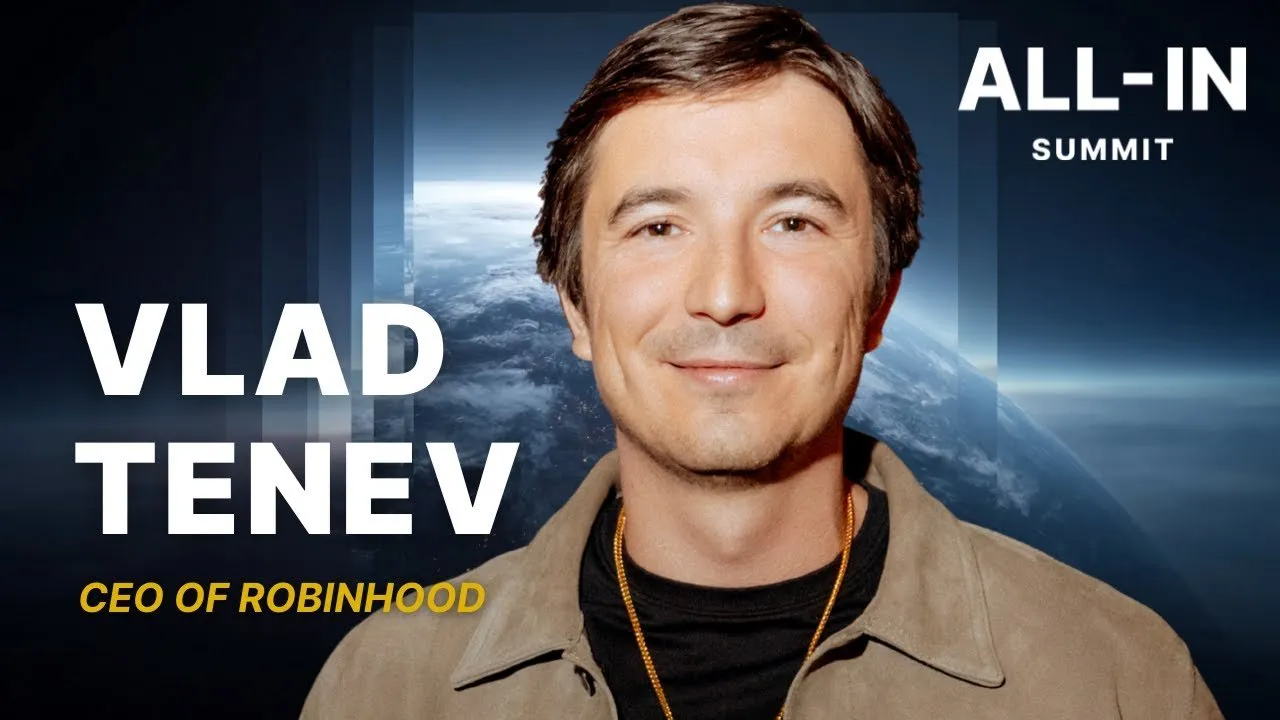
Ten years ago, the idea of a commission-free trading platform targeting millennials seemed improbable to many venture capitalists. Today, Robinhood is not only a household name but a newly minted member of the S&P 500. Following a year where the stock surged over 400% and Gold subscriptions hit a record 3.5 million, CEO Vlad Tenev is looking far beyond simple stock trading. From tokenizing private assets on the blockchain to building mathematical superintelligence, Robinhood is positioning itself at the convergence of traditional finance, crypto, and artificial intelligence.
Key Takeaways
- Tokenization of Real-World Assets: Robinhood is piloting the tokenization of stocks, including private companies like OpenAI and SpaceX, to enable 24/7 trading and instant settlement.
- The Financial Super App: Contrary to fears of cannibalization, new products like retirement accounts and credit cards have led to increased deposits, driving a strategy to become a comprehensive financial home for users.
- Regulatory Evolution: After years of playing "defense," the company anticipates a shift toward clearer regulatory frameworks that could allow for investor self-certification and broader access to complex assets.
- AI Ambitions: Beyond Robinhood, Tenev is chairing Harmonic, a company focused on "mathematical superintelligence" designed to eliminate hallucinations in LLM-generated code.
The Future of Trading: Tokenizing Public and Private Assets
One of the most ambitious frontiers for Robinhood is the migration of traditional financial assets onto the blockchain. Following a pilot event in France, Tenev revealed the company’s vision to rebuild the trading stack on crypto technology. This isn't just about trading Bitcoin; it is about applying the mechanics of stablecoins—minting tokens backed one-to-one by reserves—to equities.
The immediate benefits of this shift are clear: 24/7 market access and instant settlement. However, Tenev argues the true disruption lies in democratizing access to illiquid, high-value assets.
Unlocking Private Shares
Currently, investing in high-growth private companies like SpaceX or OpenAI is largely restricted to institutional investors and the ultra-wealthy. Robinhood aims to change this by tokenizing these private shares. In Europe, they have already experimented with this model, though it comes with complexities regarding issuer cooperation.
"I think a lot of people are okay with it in principle, but if you're a company and you're focused on your mission... and you hear about some new thing, it's kind of a distraction."
While private companies may initially view this as a distraction or a loss of control over their capitalization table, the pressure to open access is mounting. Tenev emphasizes that as AI companies potentially disrupt the labor force, allowing retail investors to own equity in these firms could be a crucial economic hedge for the general public.
Navigating the Regulatory Landscape
Innovation in financial services is inextricably linked to regulation. Tenev described a distinct shift in the political climate. During previous years, the company often found itself playing defense against enforcement actions and Wells notices. However, the tone in Washington is changing toward cooperation and the establishment of clear rules.
A central point of contention remains accreditation standards. Current US regulations restrict access to private markets based largely on net worth, a metric that critics argue is an outdated proxy for sophistication. Tenev advocates for a move toward self-certification, where investors acknowledge the risks—including the potential for total loss—rather than being barred from entry entirely.
This regulatory clarity is essential for the US to remain competitive. While Europe allows for certain tokenization experiments, the US market requires legislative updates to facilitate synthetic contracts or tokenized private equity legally.
Building the Comprehensive Financial Platform
The fintech landscape is witnessing a massive convergence. Payments companies are building banks, and exchanges are issuing credit cards. Robinhood’s strategy relies on a counter-intuitive insight: adding more products does not cannibalize existing ones; it compounds user activity.
Data from their platform shows that customers who open retirement accounts or use the Robinhood Gold credit card end up depositing more capital into their individual brokerage accounts. This behavior supports the company's "share of wallet" strategy.
The $130 Trillion Wealth Transfer
The long-term play focuses on the looming intergenerational wealth transfer. As an estimated $130 trillion moves from Baby Boomers to younger generations, Robinhood is positioning itself as the primary institution for the recipients of that wealth.
"We've got over a quarter trillion assets on the platform already, which seems like a big number, but it's actually just a drop in the bucket compared to what's going to happen."
By capturing users early with accessible trading and keeping them with comprehensive banking services, the platform aims to outmaneuver incumbents like JPMorgan or Visa, which Tenev notes can be slowed down by legacy technology and slower engineering cycles.
Mathematical Superintelligence: The Harmonic Project
Outside of his role at Robinhood, Tenev is deeply involved as chairman of Harmonic, an AI company focused on mathematical reasoning. Unlike general-purpose Large Language Models (LLMs) that function probabilistically, Harmonic aims for formal verification—proving that a statement is mathematically true.
This distinction is critical for the future of software development. As engineers increasingly rely on AI to generate code, the "hallucination" problem—where an AI confidently invents incorrect information—becomes a dangerous bottleneck. Harmonic recently achieved a gold medal-level performance at the International Math Olympiad, a feat that demonstrates the model's ability to reason logically rather than just predict the next word.
The goal is to create a verification layer that ensures AI-generated code is functionally correct, solving a massive scalability issue for enterprise software development.
Conclusion
From a pitch in a Palo Alto dive bar to an S&P 500 powerhouse, Robinhood has successfully captured a generation of investors. However, the company’s roadmap suggests that commission-free trading was merely the first act. By pushing for regulatory modernization, integrating blockchain technology for instant settlement, and building a "super app" ecosystem, Vlad Tenev is betting that the future of finance looks less like Wall Street and more like Silicon Valley.
![Bitcoin Is on Sale [How to Buy It in 2026]](/content/images/size/w1304/format/webp/2026/03/how-to-buy-bitcoin-2026.jpg)